

Photoswitchable eye drops restore light sensitivity in blind animals
New CapabilitiesBarcelona-led team's light-activated compounds bypass dead photoreceptors without surgery, implants, or gene therapy
Today: Eye-drop delivery path highlightedNew here? Follow stories to track developments over time. Create a free account to get updates when stories you care about change.
Overview
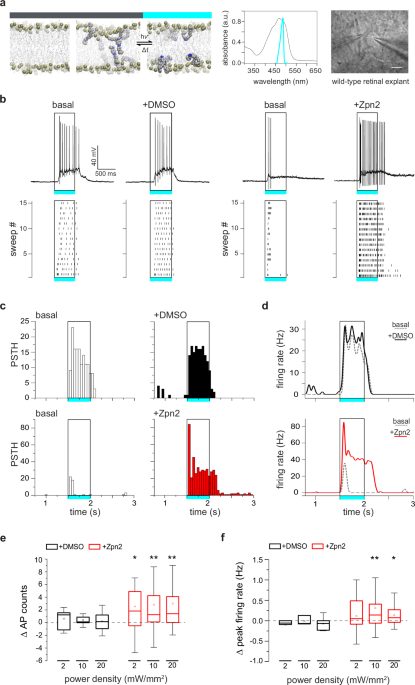
Updated 1 hour agoBlind mice given a new eye drop regained an instinct they had lost: avoiding bright areas. The drug, called prosthe6, restored light perception in animal models of age-related macular degeneration and retinitis pigmentosa within hours of a single dose. The treated mice avoided bright zones at light levels comparable to indoor lighting or a cloudy day.
Prosthe6 is a photoswitchable small molecule. It attaches to metabotropic glutamate 6 receptors on ON bipolar cells, the neurons that relay photoreceptor signals deeper into the retina. When photoreceptors die, these cells stay intact. The drug lets them sense light directly, turning on in the dark and off in ambient white light.
Why it matters
If prosthe6 reaches humans, millions with advanced macular degeneration or retinitis pigmentosa could regain functional vision without surgery, gene therapy, implants, or specialized equipment.
Questions about this story
Free account needed to ask — your question is kept and asked for you right after sign-up. Answers are public.
No questions yet — be the first to ask.
Key Indicators
Voices
Curated perspectives — historical figures and your fellow readers.
Play
Exploring all sides of a story is often best achieved with Play.
Higher or Lower
A number from this story, against one from elsewhere in the news — guess which is bigger, then keep the chain going. 5 rounds, 3 strikes; a miss costs a strike and resets your streak.
Keyboard: ↓/L lower · ↑/H higher
0 points — sign up to put that on the leaderboard.
Connections
Sixteen names from the news. Find the four hidden groups of four. Four mistakes max.
Sign up to keep a daily streak — a new puzzle lands every day.
Exit debate?
Your progress in this debate will be lost.
- 1 Two AI personas square off on this story.
- 2 You predict who'll win each round — correct picks earn XP.
- 3 One crossfire question is yours to fire. Pick it carefully.
Couldn't generate a topic
Select Your Champions
Choose one persona for each side of the debate
DEBATE TOPIC
Choose personas with different perspectives for a more dynamic debate.
Select debater for this side:
No debate personas available right now.
Select debater for this side:
No debate personas available right now.
Who's Got This Round?
Make your prediction before the referee scores
The referee scores both sides on
Round Results
Set the Crossfire
Pick the question both personas must answer in the final round
Debate Oracle! You called every round!
Sharp Instincts! You know your debaters!
The Coin Flip Strategist! Perfectly balanced!
The Contrarian! Bold predictions!
Inverse Genius! Try betting the opposite next time!
XP Breakdown
Prediction History
People Involved
Organizations Involved
Public research institute in Barcelona that led development of the prosthe6 compounds.
Spin-off company formed by the prosthe6 researchers to fund safety studies and clinical trials.
Developer of KIO-301, the first photopharmacological vision drug to reach human trials.
Timeline
January 2016 September 2026
-
Eye-drop delivery path highlighted
Today CoverageOptimist Daily features prosthe6 as a simpler alternative to gene therapy and implants, emphasizing the two compounds that work as ordinary eye drops.
-
Prosthe6 results published in JACS
PublicationConsortium reports restored light avoidance in blind mice and saccadic eye movements in blinded zebrafish. Two compounds work as eye drops.
-
Research program begins
OriginsIBEC and partner Spanish institutions begin developing photoswitchable molecules for vision restoration.
Historical Context
3 moments from history that rhyme with this story — and how they unfolded.
Optogenetics for vision restoration (2010s)
Researchers spent a decade developing optogenetic approaches that deliver light-sensitive proteins to surviving retinal cells via gene therapy. Early human trials began in the late 2010s.
Animal studies showed restored light sensitivity, but human trials required gene delivery and often high-intensity light.
The approach proved the concept that inner retinal neurons can substitute for photoreceptors, but the genetic delivery mechanism added complexity and risk.
Prosthe6 achieves the same goal as optogenetics without genetic manipulation—the drug is simply applied as drops and is reversible.
Argus II retinal prosthesis (2013)
The FDA approved Argus II, the first retinal prosthesis, for adults with advanced retinitis pigmentosa. The device required surgical implantation of a 60-electrode array on the retina plus a camera on eyeglasses.
Patients could detect light and identify large shapes, but resolution remained very limited.
The device demonstrated that restoring some vision is possible without intact photoreceptors, but its invasiveness and cost restricted adoption.
Prosthe6 aims to achieve what Argus II did with a drug instead of surgery, at a fraction of the complexity.
Luxturna gene therapy approval (2017)
The FDA approved Luxturna, the first gene therapy for an inherited retinal disease. It delivers a working RPE65 gene to retinal cells, restoring vision in patients with that specific mutation.
Patients with RPE65 mutations gained meaningful vision, often for years.
The treatment only works for the small fraction of retinitis pigmentosa patients with RPE65 mutations, and requires surgery and permanent genetic modification.
Prosthe6's key advantage is mechanism independence—it works regardless of which mutation killed the photoreceptors, reaching patients gene therapy cannot.
