


Pull to refresh
Logo
Anthropic lets Claude approve routine pull requests

Anthropic lets Claude approve routine pull requests

New Capabilities

Claude Ship bundles a fixer agent and an approver agent for GitHub, governed by a policy file each team writes

Overview

Updated 2 hours ago

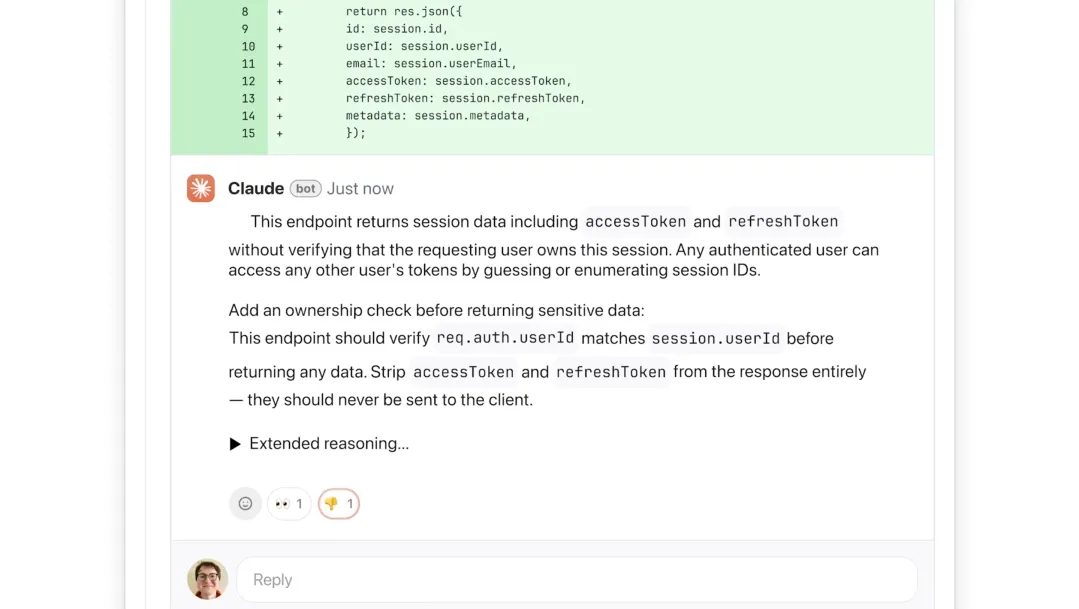
On November 23, 2026, Anthropic opened a beta called Claude Ship for its Team and Enterprise customers. It puts two agents on GitHub pull requests: one fixes failing tests and merge conflicts, the other can approve a change without a person signing off.

Review tools have flagged problems in code for years. Approving is new. Claude Ship approves a change when a policy file in the repository says it may, which turns the last human step in a merge into a configuration choice.

Why it matters

If teams require its approval in branch protection, code can merge with no person reading it.

Questions about this story

Free account needed to ask — your question is kept and asked for you right after sign-up. Answers are public.

No questions yet — be the first to ask.

Key Indicators

3
Agents in the Claude Ship bundle
Code Review, PR Steward and Claude Approvals, with only the first out of beta.
>40%
Fall in share of merged pull requests later reverted
Anthropic's own figure for its Claude Code team, June to September 2026.
2x
Growth in merged pull requests on the Claude Code team
Anthropic says merged PRs more than doubled June to September 2026.
3
Review depth settings per repository
Admins pick Quick, Standard or Deep, alongside a monthly spend limit.

Voices

Curated perspectives — historical figures and your fellow readers.

Sign up to generate historical perspectives on this story.

People Involved

Organizations Involved

Timeline

March 2026 November 2026

3 events Latest: Yesterday
  1. Claude Ship beta adds a fixer and an approver

    Latest Launch

    PR Steward fixes CI failures and merge conflicts but cannot merge. Claude Approvals can approve routine changes when a policy file on the default branch allows it. Developers can trigger the same flow with the /ship command.

  2. Code Review reaches general availability

    Product

    The review agent leaves preview and becomes the base layer of what is later sold as Claude Ship.

  3. Anthropic announces Code Review

    Product

    An agent that reads a pull request against the codebase through several lenses, checks its own findings and posts them.

Scenarios

1

Claude Approvals leaves beta and becomes a required branch check

Likely Resolves by Q2 2027

Discussed by: Anthropic's launch materials, which recommend running the policy in observe-only mode before wiring it into branch protection

Teams start by watching what Claude would have approved. Once the record looks clean, they make its sign-off a required check, and routine changes begin merging with no human reviewer. The trigger is trust in the observe-mode log; the friction is any incident that makes a reviewer doubt the log.

2

A Claude-approved change breaks production and a customer disables approvals

Possible Resolves by Nov 23, 2027

Discussed by: InfoWorld's launch coverage, where researchers warn that an AI model should not be the only quality gate and that generator and reviewer can share blind spots

The failure mode critics describe is specific: the reviewing model shares training and habits with the model that wrote the code, so a defect passes both. If a named company traces an outage or a security problem to a pull request Claude approved, the approval agent gets switched off and human sign-off returns.

3

Claude Ship adds a second code host beyond GitHub

Possible Resolves by Q2 2027

Discussed by: Anthropic's own documentation, which lists GitHub as the only supported platform at launch

Most large engineering organizations run at least one repository outside GitHub. Extending the agents to GitLab, Bitbucket or Azure DevOps is the step that turns Claude Ship from a launch-week demo into something a mixed estate can standardize on.

Historical Context

3 moments from history that rhyme with this story — and how they unfolded.

August 2012

Knight Capital deployment failure (2012)

A software release at the trading firm Knight Capital left one of its eight servers running old code. When markets opened, that server sent a flood of unintended orders. The firm lost hundreds of millions of dollars in under an hour and needed an emergency rescue.

Then

Knight was sold within months, and the incident became the standard case study in release-process failure.

Now

Firms added deployment checklists, staged rollouts and kill switches, and treated the release step as a place where a named person signs off.

Why this matters now

Claude Ship automates a different human step, approval, not deployment. Knight shows what rides on the last gate before code reaches production.

1985-1987

Therac-25 radiation overdoses (1985-1987)

A radiation therapy machine was redesigned so that software replaced hardware interlocks that had physically prevented dangerous doses. Software faults produced massive overdoses. At least three patients died.

Then

The machine was recalled and the manufacturer faced lawsuits and regulatory action.

Now

Medical device software faced stricter standards and independent verification, on the principle that a single software check is not a safety system.

Why this matters now

The failure was not bad code alone. It was removing a separate check and trusting one layer to catch its own errors, the same concern critics raise about a model reviewing a model.

October 2018

Amazon scraps its automated résumé screener (2018)

Reuters reported that Amazon had built a machine-learning tool to rank job applicants and then shut the project down. The system had learned from a decade of mostly male hiring and penalized résumés that mentioned women's activities or colleges.

Then

Amazon disbanded the team and did not deploy the tool widely.

Now

The case became the standard example of an automated gatekeeper reproducing the biases of the data it learned from.

Why this matters now

An approval agent makes a judgment call that used to belong to a person. The Amazon case shows how those judgments can inherit flaws nobody intended to program in.

Sources

(8)