

Pull to refresh
Logo
AstraZeneca invests $2 billion in Summit Therapeutics for ADC combination strategy

AstraZeneca invests $2 billion in Summit Therapeutics for ADC combination strategy

Money Moves

British pharma giant bets on a PD-1/VEGF bispecific to anchor its antibody-drug conjugate pipeline

Today: AstraZeneca invests $2 billion in Summit Therapeutics

Overview

Updated 1 hour ago

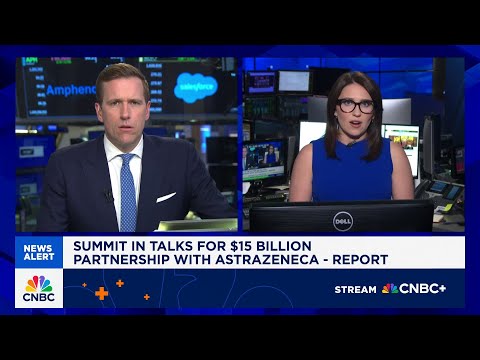
AstraZeneca is paying $2 billion for roughly 12% of Summit Therapeutics, betting that a next-generation lung-cancer drug can anchor its antibody-drug conjugate portfolio. The investment funds a clinical collaboration pairing Summit's ivonescimab with AstraZeneca's experimental ADC, Sone-Ve, in gastrointestinal cancers.

Ivonescimab blocks two targets at once — PD-1, which cancer uses to evade the immune system, and VEGF, which tumors rely on to grow blood vessels. If the combinations work, they could improve on current immunotherapies across lung, breast, and gastrointestinal cancers. If they don't, AstraZeneca holds a stake in a single-asset biotech with no approved products outside China.

Why it matters

If these combinations work, they could set a new standard for first-line lung and gastrointestinal cancer treatment.

Questions about this story

Free account needed to ask — your question is kept and asked for you right after sign-up. Answers are public.

No questions yet — be the first to ask.

Key Indicators

$2B
Equity investment in Summit
AstraZeneca buys convertible preferred shares, gaining ~12% of Summit's outstanding common stock.
12%
Stake in Summit (10.6% fully diluted)
Held after the investment closes, expected within a week of the announcement.
$18.36
Per-share price, 18.6% premium
Premium to Summit's $15.48 closing price on the day before the deal was announced.
+15%
Summit shares rise after the announcement
Extended-trading gain on the news of the AstraZeneca investment.

Voices

Curated perspectives — historical figures and your fellow readers.

Ever wondered what historical figures would say about today's headlines?

Sign up to generate historical perspectives on this story.

People Involved

Organizations Involved

Timeline

March 2023 September 2026

4 events Latest: Today
Tap a bar to jump to that date
  1. AstraZeneca invests $2 billion in Summit Therapeutics

    Today Deal

    AstraZeneca buys a ~12% stake and launches a clinical collaboration to test Sone-Ve with ivonescimab in gastrointestinal cancers.

  2. Sone-Ve shows survival benefit in gastric cancer trial

    Clinical

    AstraZeneca reports positive results from CLARITY-Gastric01, a Phase III trial in advanced gastric cancer; data set for ESMO Congress 2026.

  3. Ivonescimab approved in China

    Regulatory

    The PD-1/VEGF bispecific receives its first marketing authorization, for non-small cell lung cancer.

  4. AstraZeneca licenses Sone-Ve from KYM Biosciences

    Deal

    AstraZeneca gains a global exclusive license to Sone-Ve, a CLDN18.2-targeting antibody-drug conjugate.

Scenarios

1

FDA approves ivonescimab for EGFR-mutated NSCLC

Possible Resolves by Q2 2027

Discussed by: The companies and FDA review timeline; the drug's existing China approval gives it a development head start

The FDA is reviewing the Biologics License Application for ivonescimab in EGFR-mutated non-small cell lung cancer. Approval would give Summit its first marketed product outside China and validate the PD-1/VEGF mechanism ahead of the combination studies. The review is the nearest catalyst for the AstraZeneca stake.

2

Combination trials show promise; AstraZeneca deepens the alliance

Possible Resolves by End of 2028

Discussed by: Both companies, which stated intent to start gastrointestinal trials imminently and signed a non-binding MOU for a broader collaboration

The clinical collaboration in gastrointestinal cancers and the MOU to test ivonescimab with additional AstraZeneca medicines could expand into a wider alliance. If early data from Sone-Ve plus ivonescimab show a clear signal, AstraZeneca may increase its stake or formalize the MOU into a definitive agreement.

3

Combination trials falter; partnership stalls

Unlikely Resolves by End of 2028

Discussed by: Risks typical of early combination studies in oncology

The combination trials could fail to meet endpoints or show unexpected toxicity, slowing momentum. AstraZeneca's 12% stake would lose value, and the non-binding MOU might never become a definitive agreement. A single-asset biotech with no approved products outside China would face a harder funding market.

Historical Context

2 moments from history that rhyme with this story — and how they unfolded.

March 2019

AstraZeneca-Daiichi Sankyo Enhertu collaboration (2019)

AstraZeneca paid Daiichi Sankyo $6.9 billion, then the industry's largest antibody-drug conjugate deal, to co-develop and co-commercialize trastuzumab deruxtecan (Enhertu), a HER2-targeting ADC. AstraZeneca gained commercial rights outside Japan.

Then

Enhertu won approvals in breast, lung, and gastric cancers and became a blockbuster, cementing AstraZeneca's ADC strategy.

Now

The deal validated ADCs as a core oncology pillar and showed AstraZeneca's willingness to make large bets on licensed assets.

Why this matters now

The Summit investment repeats the Enhertu playbook — a big upfront payment to secure a drug that becomes the backbone of a franchise — now extending it to pair ADCs with a bispecific immunotherapy.

September 2020

Gilead acquires Immunomedics (2020)

Gilead paid $21 billion to acquire Immunomedics for Trodelvy (sacituzumab govitecan), an ADC approved for triple-negative breast cancer. The price reflected a bet that Trodelvy would become a major oncology franchise.

Then

Trodelvy won FDA approval and expanded into several cancer types, underpinning Gilead's oncology push.

Now

The deal demonstrated both upside and risk in single-asset ADC bets: the drug delivered, but growth later faced competition.

Why this matters now

Shows the scale of single-asset bets in oncology and the risk-reward of paying a premium for a pipeline-defining drug — the same gamble AstraZeneca is taking on ivonescimab.

Sources

(10)