Anchor

A national builder bets on 'missing middle' homes priced below Sandy's median.
2 days ago: Building Salt Lake reports Sandy Station groundbreakingNew here? Follow stories to track developments over time. Create a free account to get updates when stories you care about change.
Overview
Updated 7 hours agoA national homebuilder just started work on 63 four-bedroom townhomes in Sandy, Utah, priced around $550,000. That is roughly $150,000 below the area's median home price, in a county where 88% of residential land is zoned for detached single-family houses.
The project, called Sandy Station, is a market-rate test of 'missing middle' housing: denser than a single-family lot, smaller than an apartment building. If it sells, other builders may follow. If it stalls, it shows the limits of building density one project at a time.
Why it matters
Sandy's median home price hit $699,619, and 88% of Salt Lake County's residential land is single-family-only. This project tests a cheaper, denser alternative.
Questions about this story
Free account needed to ask — your question is kept and asked for you right after sign-up. Answers are public.
No questions yet — be the first to ask.
Key Indicators
63
Townhomes under construction
Units in the Sandy Station project at 8925 S. Harrison St.
$550,000
Starting price
List price for a four-bedroom, three-bathroom townhome.
$699,619
Sandy median home sale price
Mid-2026 median, up 6.8% from the same period a year earlier.
88%
Single-family-only zoning
Share of Salt Lake County residential land zoned exclusively for detached single-family homes.
150,000
Utah housing target
New housing units the state wants built by December 2028.
Related Media
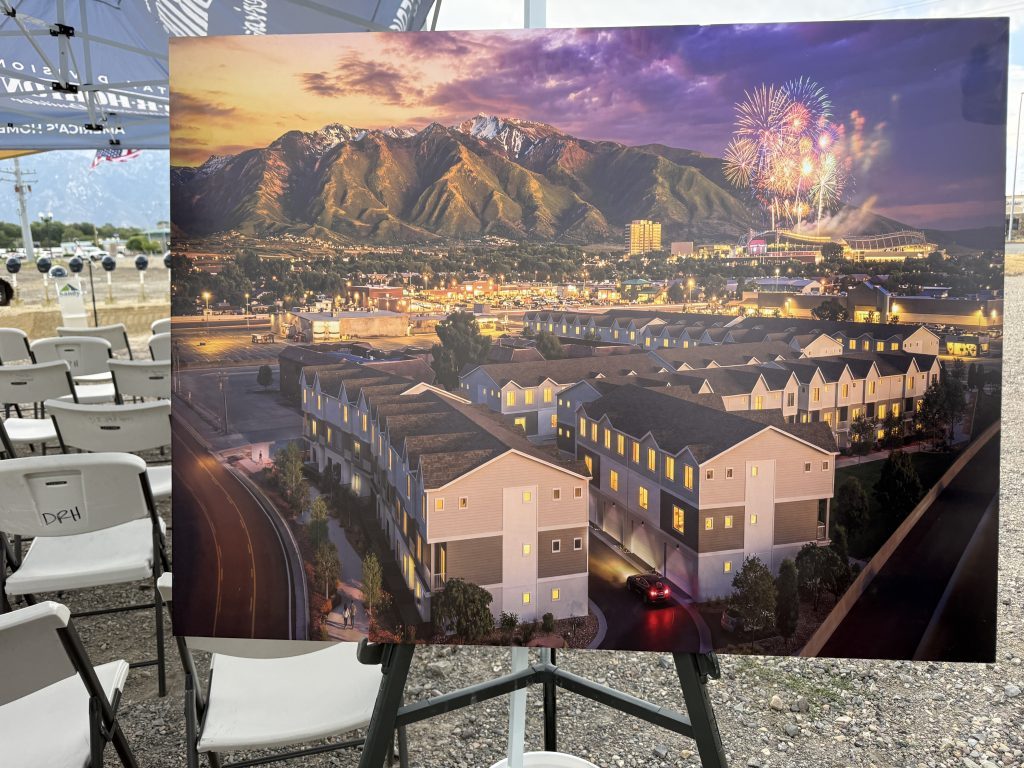
D.R. Horton breaks ground on family-sized, for-sale townhome project in Sandy - Building Salt Lake
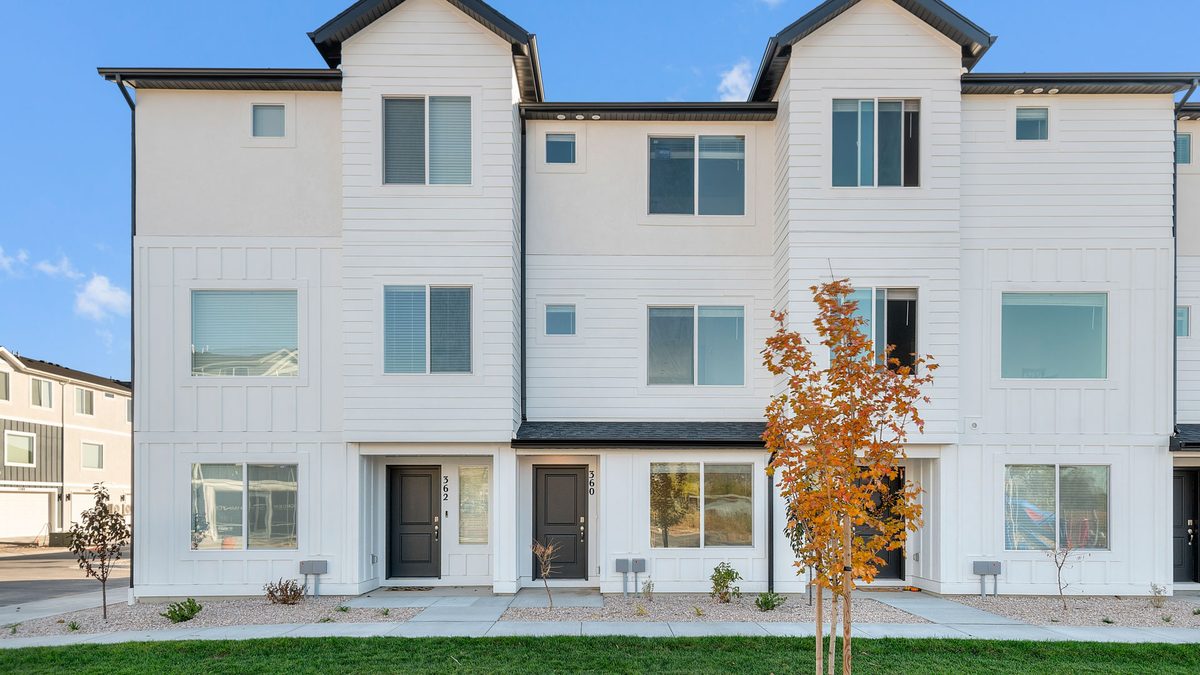
Houses For Sale in Sandy, UT | Sandy Station | D.R. Horton

489 views
2:55
Inside DR Horton's NEW Sandy Ridge Townhomes | 3-Story, 3- ...
Evolution Ave | Kenyon Hunter | Home of Motivation

173 views
14:27
How Missing Middle Housing Can Help Close Affordability Gap
NAHBTV

169 views
34:08
Designing Smarter: Solving the Missing Middle Housing Crisis
Housing Industry Association
Images from Openverse under Creative Commons licenses. Videos from YouTube.
Voices
Curated perspectives — historical figures and your fellow readers.
Play
Exploring all sides of a story is often best achieved with Play.
Most of these play right now — no account needed. Sign up to save scores, keep a streak, and unlock Debate and Predict.
Log in
Sign Up
Higher or Lower
A number from this story, against one from elsewhere in the news — guess which is bigger, then keep the chain going. 5 rounds, 3 strikes; a miss costs a strike and resets your streak.
Example
Anchor
EU tariff revenue
$52B
Big for this kind of number
Mystery
Pentagon AI contract
?
Round 1
Streak: 0
Mystery
?
Keyboard: ↓/L lower · ↑/H higher
0 pts
Best streak: 0 · Rounds: 0
0 points — sign up to put that on the leaderboard.
Now try on this story
Connections
Sixteen names from the news. Find the four hidden groups of four. Four mistakes max.
Loading today's puzzle…
0/4 groups
Mistakes
Sign up to keep a daily streak — a new puzzle lands every day.
Now try on this story
Exit debate?
Your progress in this debate will be lost.
How it works
- 1 Two AI personas square off on this story.
- 2 You predict who'll win each round — correct picks earn XP.
- 3 One crossfire question is yours to fire. Pick it carefully.
Couldn't generate a topic
Select Your Champions
Choose one persona for each side of the debate
DEBATE TOPIC
Choose personas with different perspectives for a more dynamic debate.
SIDE A (PRO)
Select debater for this side:
No debate personas available right now.
SIDE B (CON)
Select debater for this side:
No debate personas available right now.
VS
Get ready to make your prediction...
Round of
Claim
Evidence
Stakes
Crossfire Answer
Closing Statement
Claim
Evidence
Stakes
Crossfire Answer
Closing Statement
Your Crossfire Question
Generating arguments...
Who's Got This Round?
Make your prediction before the referee scores
The referee scores both sides on
Correct predictions earn +20 XP
· Press 1 or 2 to pick
Evidence
40%
Logic
30%
Detail
20%
Style
10%
Round Results
Your Pick
Not this time
(%)
Overall Score
/10
Your Pick
Not this time
(%)
Overall Score
/10
Set the Crossfire
Pick the question both personas must answer in the final round
Crafting crossfire questions...
Choosing a question earns +10 XP crossfire bonus
🏆
Total XP Earned
Cred Change
Predictions
Debate Oracle! You called every round!
Sharp Instincts! You know your debaters!
The Coin Flip Strategist! Perfectly balanced!
The Contrarian! Bold predictions!
Inverse Genius! Try betting the opposite next time!
XP Breakdown
Base completion
+20 XP
Rounds played ( rounds x 5 XP)
+ XP
Correct predictions ( correct x 20 XP)
+ XP
Crossfire bonus
+10 XP
Accuracy
%
Prediction History
Round
You picked:
✓
✗
Now try on this story
Keep debating to level up your credibility and unlock achievements
People Involved
Organizations Involved
D.R. Horton
Homebuilder
Developer of Sandy Station
The largest U.S. homebuilder by volume since 2002; closed 84,863 homes in fiscal 2025.
Sandy City
Municipal government
Approved and supported the project
Approved Sandy Station's site plan and subdivision review by unanimous vote in November 2025.
The Road Home
Nonprofit shelter operator
Operates the Medically Vulnerable People facility adjacent to Sandy Station
Runs the Medically Vulnerable People transitional housing facility next door to the new townhomes.
Timeline
August 2023 September 2026
4 events
Latest: 2 days ago
Tap a bar to jump to that date
-
Building Salt Lake reports Sandy Station groundbreaking
Latest ReportBuilding Salt Lake reports the groundbreaking, detailing four-bedroom homes starting around $550,000.
-
Groundbreaking at Sandy Station
GroundbreakingD.R. Horton and Sandy officials break ground on the 63-townhome project.
-
Sandy approves Sandy Station site plan
ApprovalSandy Planning Commission unanimously approves Sandy Station's site plan and subdivision review.
-
Shelter buys former EconoLodge on Harrison Street
AcquisitionShelter the Homeless buys the former EconoLodge on Harrison Street for a medically vulnerable shelter.
Historical Context
3 moments from history that rhyme with this story — and how they unfolded.
1947-1951
Levittown (1947-1951)
William Levitt built 17,000 nearly identical houses on Long Island farmland with assembly-line methods. A four-room Cape Cod sold for about $8,000, and veterans could buy with no down payment.
Then
The first homes sold within hours; Levittown became the symbol of postwar suburbia.
Now
Mass-produced single-family homes became the American default, and zoning codes across the country were written to keep them that way.
Why this matters now
D.R. Horton is the same playbook at national scale. Sandy Station turns that machinery toward attached townhomes, but it still has to win approval in a zoning system built for detached houses.
December 2018
Minneapolis 2040 Plan (2018)
Minneapolis became the first major U.S. city to allow up to three housing units on any residential lot, ending single-family-only zoning. The change was part of the city's comprehensive plan.
Then
New duplexes and triplexes appeared slowly, and litigation delayed some implementation.
Now
The reform inspired similar statewide changes in Oregon and California, making Minneapolis a reference point for zoning reform.
Why this matters now
Minneapolis changed the rule. Sandy Station works within it, testing whether for-sale missing-middle housing can pencil out without a zoning change.
June 2019
Oregon House Bill 2001 (2019)
Oregon became the first state to ban single-family-only zoning, allowing duplexes in most city residential zones and fourplexes in the largest cities.
Then
Cities had to rewrite codes; construction of new middle housing was gradual.
Now
The law remains in place and became a template for other states considering state-level zoning overrides.
Why this matters now
Utah is debating whether to follow this path. Sandy Station is what builders can deliver before that debate is resolved.