

Pull to refresh
Logo
FAA updates CFM56-7B fan blade inspection rule

FAA updates CFM56-7B fan blade inspection rule

Rule Changes

The November 2026 directive replaces a 2018 order, keeping 1,600-flight-cycle checks and adopting CFM's revised ultrasonic procedure

Overview

Updated 37 minutes ago

Every CFM56-7B engine on a US-registered airplane — 4,553 of them — must have its fan blade dovetails checked for cracks, then checked again every 1,600 flight cycles. The Federal Aviation Administration published that requirement as a final rule on November 24, 2026, replacing a 2018 directive with a revised inspection standard.

Two methods remain legal: ultrasonic inspection under CFM's updated service bulletin, which widens the area examined, or eddy current testing under the engine shop manual. A blade that shows a crack indication comes off before the next flight, and any blade installed afterward must have fewer than 17,000 cycles since new or a passing inspection within the previous 1,600 cycles.

Why it matters

The rule sets how often 4,553 US-registered engines get their fan blades checked, and what counts as a blade safe to reinstall.

Questions about this story

Free account needed to ask — your question is kept and asked for you right after sign-up. Answers are public.

No questions yet — be the first to ask.

Key Indicators

4,553
US-registered engines affected
The FAA's estimate of CFM56-7B engines installed on airplanes of US registry.
1,600
Flight cycles between inspections
The repeat interval for dovetail inspections, unchanged from the 2018 directive.
17,000
Cycle limit for installation without inspection
A fan blade with fewer cycles since new counts as eligible for installation without a fresh check.
$340
Estimated inspection cost per engine
Two work-hours at $85 plus $170 in parts, per the FAA's estimate.
$208,385
Estimated cost to replace a blade pair
One work-hour of labor plus $208,300 in parts, incurred only if an inspection finds a crack.
$1,548,020
Compliance cost across US operators
4,553 engines multiplied by the $340 per-engine inspection estimate.
1
Passenger deaths in the 2018 failure
The April 2018 engine failure that started this directive chain killed one person aboard.

Voices

Curated perspectives — historical figures and your fellow readers.

Sign up to generate historical perspectives on this story.

Organizations Involved

Timeline

April 2018 November 2026

6 events Latest: Today
Tap a bar to jump to that date
  1. Final rule supersedes AD 2018-26-01

    Today Rule

    The directive takes effect December 29, 2026 and keeps the 1,600-flight-cycle repeat interval.

  2. CFM publishes Service Bulletin 72-1033 Revision 06

    Manufacturer action

    The revision updates figures and instructions and grants credit for work done under Revision 05.

  3. FAA proposes replacing the 2018 directive

    Rule

    The notice of proposed rulemaking cited improved ultrasonic procedures and an expanded inspection area.

  4. AD 2018-26-01 sets the repetitive inspection schedule

    Rule

    The directive required initial and repeat inspections at intervals not exceeding 1,600 flight cycles.

  5. FAA orders emergency fan blade inspections

    Rule

    The agency required operators to inspect CFM56-7B fan blade dovetails on a compressed schedule.

  6. Fan blade failure kills a passenger on Flight 1380

    Accident

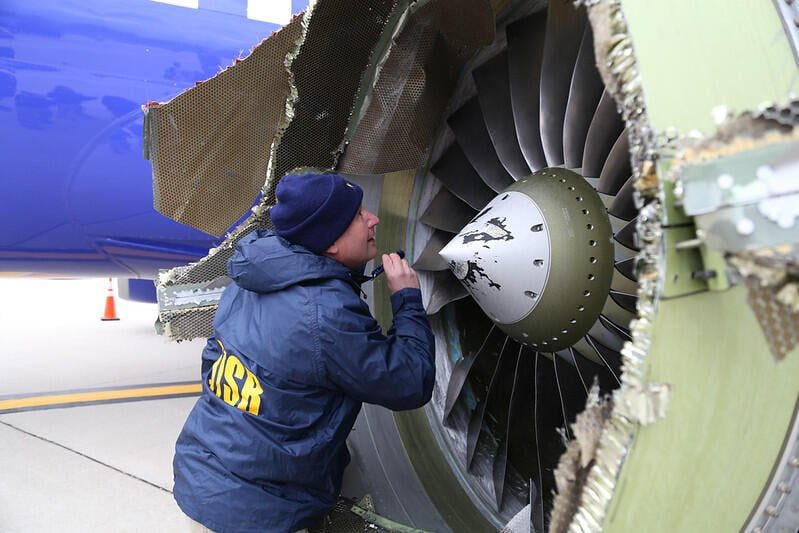
    A CFM56-7B fan blade broke on a Southwest 737; debris punctured the fuselage and broke a cabin window.

Scenarios

1

Inspections continue without another fleet-wide directive

Likely Resolves by End of 2028

Discussed by: The FAA's own compliance cost estimate, which assumes 4,553 engines inspected at 1,600-cycle intervals with no further rulemaking.

Operators fold the ultrasonic or eddy current check into existing engine shop visits. Because the rule requires no reporting to the FAA and no return of parts to the manufacturer, the agency sees only the inspections that turn up cracks. If no new failure mode emerges, the directive stands until CFM issues another service bulletin revision.

2

FAA drops eddy current testing and requires ultrasound alone

Unlikely Resolves by Q2 2028

Discussed by: Commenters on the July 2026 proposed rule, who argued the newer ultrasonic method should not remain optional after the Flight 1380 findings.

The FAA rejected that request in the final rule, writing that ultrasonic inspection was not shown to detect more cracks and was changed only to match the area eddy current testing already covered. A future reversal would require new data, most likely from inspections conducted under the revised bulletin.

3

A new in-flight fan blade failure triggers another emergency directive

Uncertain Resolves by End of 2027

Discussed by: The NTSB's Flight 1380 findings, which traced the 2018 break to fatigue cracking in a blade.

A repeat failure would restart the cycle the 2018 event began: an emergency order, a shortened inspection interval, and possibly a narrower set of blades eligible for installation. The FAA's current threshold of 17,000 cycles since new is the number most likely to move first.

Historical Context

2 moments from history that rhyme with this story — and how they unfolded.

February 2021

United Airlines Flight 328 (2021)

A Boeing 777-200 bound for Honolulu suffered an uncontained fan blade failure in its Pratt & Whitney PW4077 engine shortly after leaving Denver. The engine cowl fell into a residential neighborhood; nobody aboard was hurt. Investigators traced the break to fatigue cracking in a fan blade.

Then

The FAA issued an emergency directive requiring immediate inspections of 777s with PW4000 engines and grounded the variant with hollow fan blades.

Now

The episode repeated a familiar sequence: one blade failure, a fleet-wide inspection order, and a return to service contingent on passing checks.

Why this matters now

Same failure mode, same regulatory response — blade fatigue leads to an inspection directive covering an entire engine fleet.

November 2010

Qantas Flight 32 (2010)

An Airbus A380 flying from Singapore suffered an uncontained failure of a Rolls-Royce Trent 900 engine. Debris damaged the wing and control systems; the crew landed safely and none of the 469 people aboard were injured. Investigators traced the failure to a manufacturing defect in an oil feed tube.

Then

European regulators issued airworthiness directives requiring Trent 900 inspections, and Rolls-Royce replaced affected components across the fleet.

Now

The case became a reference point for how a single manufacturing defect in a high-volume engine produces a global inspection regime rather than a redesign.

Why this matters now

Shows how one engine failure converts into a recurring inspection obligation for every operator of that engine model.

Sources

(5)