

Pull to refresh
Logo
Google releases Gemini 4 Neon, undercutting Claude Opus 5.5 on price

Google releases Gemini 4 Neon, undercutting Claude Opus 5.5 on price

New Capabilities

A $3-per-million-input-token model Google places between Hydrogen and Carbon, aimed at long-running coding agents

Overview

Updated 9 minutes ago

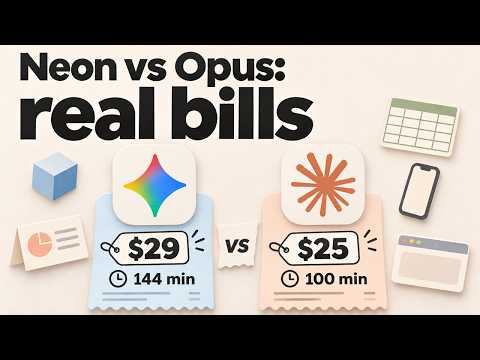
Gemini 4 Neon lists at $3 per million input tokens and $15 per million output. Claude Opus 5.5, the model Google benchmarks it against, lists at $4 and $20. Same 25% gap on both halves of the bill.

Google's own scorecard puts Neon third on the Artificial Analysis Intelligence Index at 61, behind two larger models and two points ahead of Opus 5.5. The company sells it as the middle rung of a three-model ladder: Hydrogen for volume, Neon for hard jobs that recur, Carbon for long projects. The benchmark carrying that pitch is coding, where Neon tops the Artificial Analysis Coding Agent Index at 58.6.

Why it matters

Agentic coding tools now have a mid-priced model Google says matches the frontier, which changes what a long-running agent costs to run.

Questions about this story

Free account needed to ask — your question is kept and asked for you right after sign-up. Answers are public.

No questions yet — be the first to ask.

Key Indicators

61
Artificial Analysis Intelligence Index score
Neon's score at its highest thinking setting, ranked third overall on the leaderboard.
25%
Price gap versus Claude Opus 5.5
Neon charges $3 input and $15 output against Opus 5.5's $4 and $20, a 25% discount on both.
$3
Input price per million tokens
Cached input is billed at $0.15 per million tokens, a 95% discount.
$15
Output price per million tokens
Output is the expensive half of agent workloads, which read files and write patches repeatedly.
65.2%
Terminal-Bench 4.1 score
Google's reported score on a command-line agent benchmark; Opus 5.5 scores higher.
39.0%
SWE-sweep score inside Google Antigravity
The same model scores 12.8% on the mini-SWE harness, so the surrounding software supplies most of the gain.

Voices

Curated perspectives — historical figures and your fellow readers.

Sign up to generate historical perspectives on this story.

People Involved

Organizations Involved

Timeline

October 2026 November 2026

4 events Latest: Today
Tap a bar to jump to that date
  1. Google releases Gemini 4 Neon

    Today Launch

    Announced Nov 18 and generally available in the Gemini API, Neon costs $3 per million input tokens and $15 per million output, with a 1 million-token context window and four thinking levels.

  2. Google opens Carbon to paying customers

    Availability

    Anthropic's Claude Fable 5.2 had already passed Carbon on the index by the time Google removed the restriction.

  3. Carbon takes first place on the intelligence index

    Benchmark

    Gemini 4 Carbon leads a revised Artificial Analysis Intelligence Index while access remains restricted.

  4. Argon ships to approved partners only

    Launch

    Google publishes results showing Gemini 4 Argon ahead of GPT-6 Astra and Claude Opus 5.5 on 12 of 18 tests, but limits access to vetted cybersecurity partners.

Scenarios

1

Anthropic cuts Claude Opus 5.5 to match Neon's price

Possible Resolves by Feb 28, 2027

Discussed by: VentureBeat's launch comparison and Google's published price sheet

Opus 5.5 sits at $4 input and $20 output, 25% above Neon on both. The trigger for a cut is customer churn on long-running agent jobs, where token volume turns a small per-token gap into a visible monthly line item. Anthropic can respond by repricing the existing model rather than shipping a new one.

2

Neon drops out of the top three on the intelligence index

Possible Resolves by Feb 28, 2027

Discussed by: Artificial Analysis leaderboard; Digital Trends' comparison of Neon, Opus 5.5 and GPT-6.2 Sol

Neon's 61 sits behind two larger, slower models and one point clear of the next tier. Rivals ship on their own schedules, and a single release can push Neon to fourth without anything changing at Google. The index also depends on each provider's self-declared reasoning effort, so a rival's max setting can shift the ordering.

3

Outside harnesses close Neon's coding gap

Possible Resolves by Q1 2027

Discussed by: The Inference and Google's Antigravity launch post

Neon scores 12.8% on the mini-SWE harness and 39.0% inside Google Antigravity. The 26-point spread comes from the software wrapped around the model, not the weights. If outside developers tune their scaffolds the way Google tuned Antigravity, the mini-SWE number should climb without a new model release.

Historical Context

2 moments from history that rhyme with this story — and how they unfolded.

October 2026

Gemini 4 Argon ships to vetted partners only (2026)

Google published results showing Argon ahead of GPT-6 Astra and Claude Opus 5.5 on 12 of 18 tests it chose to release. Access went to approved cybersecurity partners, so most developers could read the numbers but could not run the model.

Then

Carbon followed on Oct 28 under a similar restriction and took first place on a revised intelligence index.

Now

By the time Google opened Carbon to paying customers on Nov 10, Anthropic's Claude Fable 5.2 had already passed it.

Why this matters now

Neon reverses the pattern. It is generally available in the API on announcement day, at a listed price, to anyone with an account.

October-November 2026

Carbon's two-week reign (2026)

Gemini 4 Carbon reached first place on the Artificial Analysis Intelligence Index on Oct 28 while access was still restricted. Google removed the restriction on Nov 10.

Then

A competitor model had overtaken Carbon before most customers could use it.

Now

Leadership on any single index has been changing hands within weeks, which is why Google now sells three price tiers instead of one champion.

Why this matters now

Neon's pitch rests on price and reliability across many jobs, not on holding first place in a ranking that keeps moving.

Sources

(12)