
Pull to refresh
Logo
Grand Rapids adding pedestrian beacons to two Michigan Street crossings

Grand Rapids adding pedestrian beacons to two Michigan Street crossings

Built World Grand Rapids, MI local

Crossings at Houseman and Grand are part of a 12-location city-wide upgrade; the Michigan Street corridor authority adds up to $75,000 for curb extensions

October 2026: Corridor authority commits up to $75,000 to Michigan Street crossings

Overview

Updated 2 hours ago

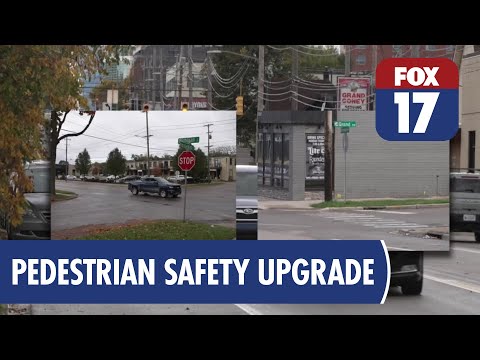
Two pedestrian-activated crossing signals are going in on Michigan Street at Houseman and Grand Avenue. Work is due to start within weeks, and the city expects both running by Thanksgiving. The Michigan Street Corridor Improvement Authority is putting up to $75,000 toward the project, adding curb extensions that shorten the crossings and make walkers easier to see.

Michigan Street is one of the city's busiest corridors, lined with hospitals, businesses, and Rapid bus stops. The crossings are part of the 2026-2027 batch of 12 locations, funded with federal Highway Safety Improvement Program grants that cover 90% of construction costs. Together with a 14-location batch from 2025-2026, the program adds safer crossings at 26 Grand Rapids intersections.

Why it matters

These signals target busy crossings near schools, parks, businesses and transit stops. A 2010 federal study found pedestrian hybrid beacons, the full-signal version of these crossings, cut pedestrian crashes by 69%.

Monday: what changed in Grand Rapids, MI

One short email a week with the openings, closings, permits and council votes we covered. Free. Unsubscribe in one click.

Questions about this story

Free account needed to ask — your question is kept and asked for you right after sign-up. Answers are public.

No questions yet — be the first to ask.

Key Indicators

2
New pedestrian beacons on Michigan Street at Houseman and Grand
Pedestrian-activated rapid flashing beacon crossings in the 2026-2027 construction batch.
12
Crossing locations in the 2026-2027 batch
Includes the two Michigan Street crossings and ten others near schools, parks, and transit stops.
26
Total crossing upgrades planned for 2025-2027
Fourteen locations from 2025-2026 plus twelve from 2026-2027.
90%
Federal share of construction costs
Highway Safety Improvement Program grants cover 90%; city Vital Streets and Mobile GR cover the rest.

Voices

Curated perspectives — historical figures and your fellow readers.

Ever wondered what historical figures would say about today's headlines?

Sign up to generate historical perspectives on this story.

People Involved

Organizations Involved

Timeline

October 2018 October 2026

5 events Latest: October 2026
Tap a bar to jump to that date
  1. Corridor authority commits up to $75,000 to Michigan Street crossings

    Latest Construction

    The Michigan Street Corridor Improvement Authority plans up to $75,000 for curb extensions at the Houseman and Grand crossings; the city expects the beacons running by Thanksgiving.

  2. Construction begins on 12 additional crossings

    Construction

    Work starts on the 2026-2027 batch, including Michigan Street at Grand and Houseman.

  3. City presents 14-location crossing plan publicly

    Public Engagement

    Meeting presentation details the 14 pedestrian crossing locations for 2025-2026.

  4. City notifies residents of 14 planned crossings

    Public Engagement

    Mailers sent to residents within 350 feet of the planned crossing locations.

  5. City installs first Michigan Street pedestrian beacon

    Milestone

    Grand Rapids activates its first pedestrian hybrid beacon on Michigan Street near Baynton Avenue.

Scenarios

1

Michigan Street crossings complete on schedule by end of 2026

Likely Resolves by Jan 31, 2027

Discussed by: City of Grand Rapids project materials; FOX17

Construction on the two Michigan Street beacons finishes by Thanksgiving as the city expects and both signals go live. The city's stated timeline has all 12 locations in the 2026-2027 batch complete by Spring 2027, so this is the base case.

2

Delays push some crossings past Spring 2027

Possible Resolves by May 31, 2027

Discussed by: FOX17; Michigan Complete Streets Coalition

Weather, supply chain, or contractor availability issues delay completion of some 2026-2027 locations beyond the Spring 2027 target. The Michigan Street crossings may still finish on time, but the full program slips. The coalition notes education and enforcement are needed alongside signals to realize safety gains.

3

City announces third phase of crossing upgrades

Uncertain Resolves by End of 2027

Discussed by: City staff; pedestrian safety advocates

After the 26 planned locations are installed, the city announces additional crossing upgrades, citing demonstrated safety benefits. Federal HSIP grants remain the likely funding source, consistent with the program's structure.

Historical Context

3 moments from history that rhyme with this story — and how they unfolded.

October 2018

Grand Rapids' first pedestrian hybrid beacon (2018)

The city activated its first pedestrian hybrid beacon on Michigan Street near Baynton Avenue, a $150,000 signal in the Medical Mile corridor. It was installed as foot traffic grew from The Rapid's new Route 19, which offered free rides alongside Spectrum Health hospitals.

Then

It gave the city its first operating pedestrian-activated signal on a busy corridor.

Now

It set the pattern for the 26-crossing program now underway, which uses the same federally approved technology.

Why this matters now

The 2018 pilot showed the technology works on Michigan Street; the current program scales it across the city.

2009

FHWA approves pedestrian hybrid beacons (2009)

The Federal Highway Administration added pedestrian hybrid beacons to the Manual on Uniform Traffic Control Devices, the national standard governing traffic signals. The approval made the devices eligible for federal funding.

Then

Cities gained a federally recognized tool for mid-block crossings.

Now

A 2010 FHWA study of 21 installations found PHBs cut pedestrian crashes by 69% and total crashes by 29%.

Why this matters now

The 2009 approval is why Grand Rapids can use Highway Safety Improvement Program grants to pay for its crossings.

2010

FHWA safety study documents PHB effectiveness (2010)

A federal before-and-after study of 21 pedestrian hybrid beacons found a 69% reduction in pedestrian crashes, a 29% reduction in total crashes, and a 15% reduction in severe crashes.

Then

The data gave states and cities evidence to justify PHB installations.

Now

PHBs became a standard safety tool near schools, parks, and transit stops.

Why this matters now

This evidence base underlies Grand Rapids' decision to spend federal funds on 26 crossings.

Sources

(5)