
Pull to refresh
Logo
L.A. City Council approves Arts District towers without planned office space

L.A. City Council approves Arts District towers without planned office space

Built World Los Angeles, CA local

Onni Group's 474-unit project replaces a 2021 plan that included a 36-story tower and 187,000 square feet of offices

Overview

Updated 58 minutes ago

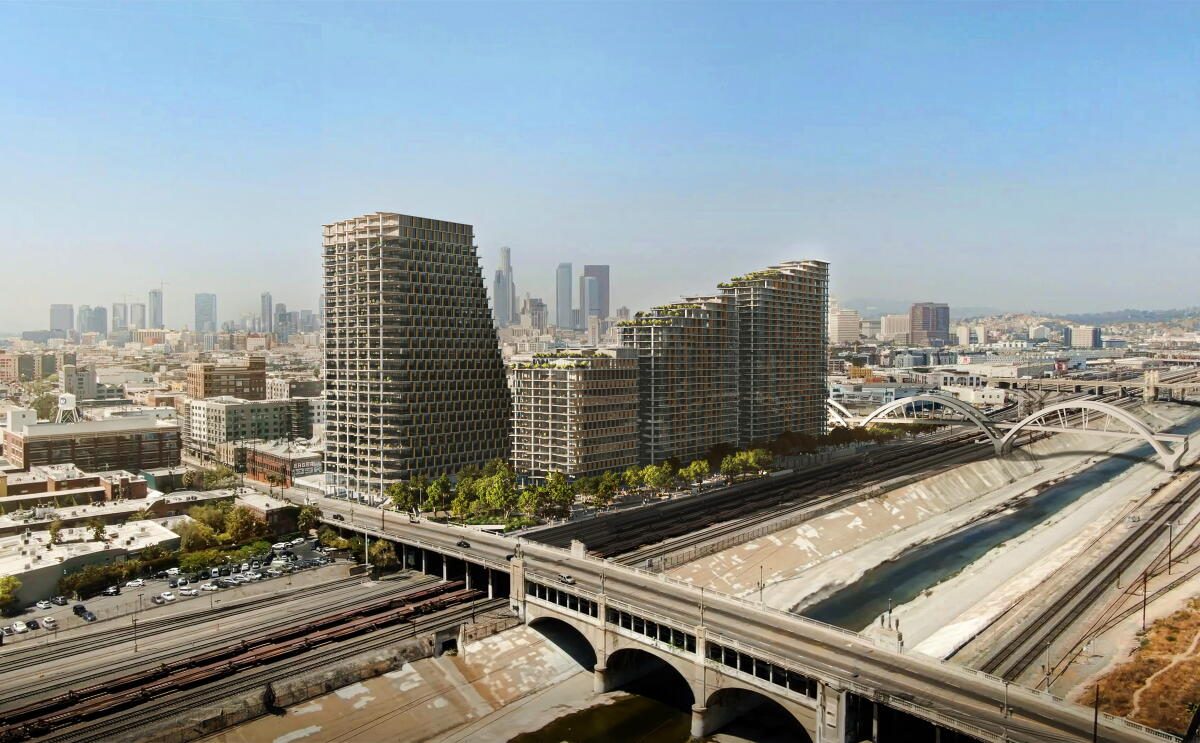
The Los Angeles City Council approved Onni Group's plan for two Arts District towers on October 29. The 30- and 20-story buildings will hold 474 apartments and just over 2,000 square feet of ground-floor commercial space.

The vote closes a five-year overhaul of the project. Onni's 2021 plan paired a 36-story tower with an eight-story office building; the final version has no office space at all, with 77 units set aside as below-market-rate housing under Measure JJJ.

Why it matters

The vote is another sign Downtown L.A. is trading empty offices for homes: 187,000 square feet of planned office space became 474 apartments.

Monday: what changed in Los Angeles, CA

One short email a week with the openings, closings, permits and council votes we covered. Free. Unsubscribe in one click.

Questions about this story

Free account needed to ask — your question is kept and asked for you right after sign-up. Answers are public.

No questions yet — be the first to ask.

Key Indicators

474
Residential units approved
One-, two-, and three-bedroom apartments across the two towers.
77
Below-market-rate units
Very low- and extremely low-income units required under Measure JJJ.
187,374 sq ft
Office space in original 2021 plan
All office space was removed from the project in the revised plans.
2,000 sq ft
Ground-floor commercial space
Down from 21,858 sq ft in the originally approved plan.

Voices

Curated perspectives — historical figures and your fellow readers.

Sign up to generate historical perspectives on this story.

Organizations Involved

Timeline

November 2016 October 2026

4 events Latest: Yesterday
Tap a bar to jump to that date
  1. City Council approves final residential plan

    Latest Approval

    Council signed off on 30- and 20-story towers with 474 apartments and 77 affordable units.

  2. Onni revises plan, drops offices

    Revision

    Onni submitted revised plans removing all office space and expanding to 474 residential units.

  3. Planning Commission approves original plan

    Approval

    Approved a 36-story tower and eight-story office building with 347 units and 187,374 sq ft of offices.

  4. L.A. voters pass Measure JJJ

    Ballot measure

    Voters approved the measure, requiring affordable units and labor standards in exchange for zone changes.

Scenarios

1

Construction begins on the Arts District towers

Likely Resolves by End of 2028

Discussed by: Urbanize LA; Maher Commercial Realty

With entitlements finalized, Onni needs financing and building permits before site work. The project's residential-only form responds to current rental demand, and the approval removes a major regulatory hurdle. Construction would likely start within one to two years.

2

Onni delays or shelves the project

Possible Resolves by End of 2028

Discussed by: Urbanize LA (citing Onni's office pullbacks elsewhere)

If construction financing stays expensive or rental demand softens, Onni could stall the project as it did with its office plans. The approved entitlements would sit unused, as they have for other entitled projects across downtown.

3

Plan is revised again before construction

Unlikely Resolves by End of 2028

Discussed by: Urbanize LA; Maher Commercial Realty

Onni could seek another amendment if market conditions shift, matching its 2024 office removal. This would push back construction further and require new approvals from city planning or the council.

Historical Context

One moment from history that rhymes with this story — and how it unfolded.

1999

Los Angeles Adaptive Reuse Ordinance (1999)

The L.A. City Council passed an ordinance allowing owners of older downtown commercial buildings to convert them to housing without meeting full code requirements for new construction. The policy let developers turn vacant offices, warehouses, and factories into lofts, and it is widely credited with the rebirth of downtown Los Angeles. The Arts District, a cluster of former industrial buildings, became one of its signature success stories.

Then

Thousands of loft units were created across downtown in the following years, drawing residents to neighborhoods that had emptied out after business hours.

Now

The ordinance established downtown as a residential market and set the stage for ground-up towers like the one approved at 2143 E. Violet Street.

Why this matters now

The 1999 ordinance turned the Arts District from an industrial zone into a dense residential neighborhood. The newly approved towers are the next chapter of that same transformation, replacing office and industrial uses with housing.

Sources

(3)