

Pull to refresh
Logo
SoLa Impact's 188-unit modular affordable complex takes shape in South LA

SoLa Impact's 188-unit modular affordable complex takes shape in South LA

Built World Los Angeles, CA local

Vermont Square project is fully income-restricted, built with prefabricated units from the developer's Watts factory.

Overview

Updated 2 hours ago

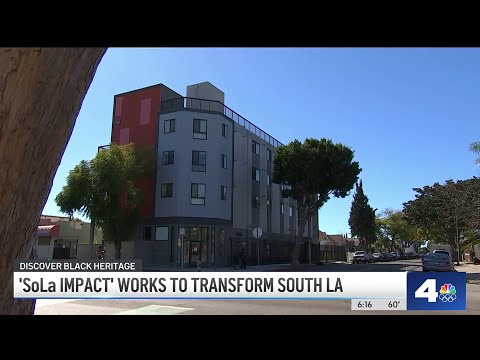
Prefabricated modular units are now stacked into a five-story frame at 4301 S. Vermont Ave in Los Angeles' Vermont Square neighborhood. Developer SoLa Impact is building 188 one-bedroom apartments there, every one reserved for low- and moderate-income households.

The project leans on the city's expedited-permitting rules for 100% affordable housing and a density bonus that allows a taller building than the zone would normally permit. The bigger bet is on SoLa's subsidiary Model Z, whose Watts factory builds the standardized units — a vertical-integration model the developer says cuts construction waste by 35% and shortens the build by a third.

Why it matters

If SoLa's factory-built model works, Los Angeles gains a faster, cheaper template for the affordable housing it's short by tens of thousands of units.

Monday: what changed in Los Angeles, CA

One short email a week with the openings, closings, permits and council votes we covered. Free. Unsubscribe in one click.

Questions about this story

Free account needed to ask — your question is kept and asked for you right after sign-up. Answers are public.

No questions yet — be the first to ask.

Key Indicators

188
Units in the complex
All 188 one-bedroom apartments are income-restricted.
$34.8M
Construction loan from ACORE Capital
Arranged by Walker & Dunlop in 2025.
80%
Units reserved for low-income households
Restricted to households earning 80% of area median income or less; the rest go to moderate-income renters.
35%
Projected cut in construction waste and carbon
The modular approach is also expected to finish in about two-thirds the typical timeline.

Voices

Curated perspectives — historical figures and your fellow readers.

Sign up to generate historical perspectives on this story.

People Involved

Organizations Involved

Timeline

2025 October 2026

3 events Latest: Today
  1. Modular units installed

    Today Construction

    Prefabricated units from Model Z's Watts factory are in place on the five-story frame.

  2. Groundbreaking

    Construction

    Ground breaks on the five-story, 188-unit complex in Vermont Square.

  3. Construction loan secured

    Financing

    ACORE Capital provides $34.8M construction loan, arranged by Walker & Dunlop.

Scenarios

1

4301 Vermont opens with 188 income-restricted units

Likely Resolves by Q2 2027

Discussed by: Urbanize LA and SoLa Impact project materials

Construction continues through 2027. The project completes, receives its certificate of occupancy, and begins leasing to households with Section 8 vouchers, prioritizing tenants who pay no more than 30% of income on rent.

2

Model Z factory supplies more SoLa projects

Possible Resolves by Q2 2028

Discussed by: SoLa Impact's public statements on scaling

If the modular model performs on schedule and budget, SoLa announces additional projects using Model Z units — or the factory signs work for an outside developer — proving the plant can run at high volume and spread its fixed costs.

3

Construction setback delays 4301 Vermont past mid-2027

Possible Resolves by Q2 2027

Discussed by: Project financing risk flagged in trade press

Modular construction hits supply, labor, or financing snags, pushing the completion date past mid-2027 and testing the factory model's promise of a one-third shorter schedule.

Historical Context

2 moments from history that rhyme with this story — and how they unfolded.

2015-2021

Katerra (2015-2021)

SoftBank-backed Katerra raised more than $1.5 billion to vertically integrate construction, running its own factories that prefabricated walls, bathrooms, and structural modules. It promised to undercut traditional builders on price and speed.

Then

Katerra won big contracts but lost money on mismanaged projects and filed for Chapter 11 in June 2021, selling its factory to a rival.

Now

Its collapse became the cautionary tale for modular construction.

Why this matters now

Model Z's economics depend on steady factory volume; if SoLa's pipeline stalls, the same fixed-cost problem could hit at a smaller scale.

1947-1951

Levitt & Sons / Levittown (1947-1951)

After World War II, Levitt & Sons applied assembly-line methods to homebuilding — crews performing single tasks, pre-cut lumber, standardized parts — and built roughly 17,000 near-identical houses in four years on Long Island, with prices starting near $8,000.

Then

The houses sold out almost immediately, and Levittown became a national symbol of mass-produced homeownership.

Now

It demonstrated that factory-style standardization could cut housing costs sharply when volume was high.

Why this matters now

SoLa is chasing the same logic: standardized modular units from a dedicated factory, betting that volume drives down cost and timeline.

Sources

(4)