
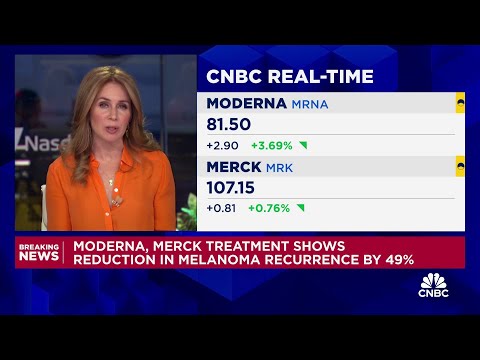
Cancer vaccines have promised to train the immune system against tumors for decades. None has delivered a durable, replicable benefit—until now. On January 20, 2026, Moderna and Merck reported that their personalized mRNA vaccine, combined with the immunotherapy Keytruda, cut the risk of melanoma recurrence or death by 49% at five years in a Phase 2b trial of 157 patients. The sustained result—identical to the three-year mark—suggests the vaccine permanently reprograms immune surveillance rather than offering temporary protection.
The announcement triggered a 15% surge in Moderna's stock and positions the company at the center of oncology's next revolution. With the pivotal Phase 3 melanoma trial (INTerpath-001) fully enrolled and a parallel lung cancer trial (INTerpath-002) now recruiting, regulatory submissions are expected by late 2026. If Phase 3 replicates the durability seen in Phase 2b, the first commercial personalized cancer vaccine could reach patients by 2027—validating mRNA technology beyond infectious disease and reshaping how medicine attacks tumors.
Click a figure to generate their perspective on this story
Debate Arena
Two rounds, two personas, one winner. You set the crossfire.
Choose Your Battle
Watch two AI personas debate this story using real evidence
Make predictions and set the crossfire to earn XP and cred
Select Your Champions
Choose one persona for each side of the debate
DEBATE TOPIC
SIDE A (PRO)
Select debater for this side:
✓
SIDE B (CON)
Select debater for this side:
✓
Choose personas with different perspectives for a more dynamic debate
VS
Get ready to make your prediction...
Round of
Claim
Evidence
Stakes
Crossfire Answer
Closing Statement
Claim
Evidence
Stakes
Crossfire Answer
Closing Statement
Your Crossfire Question
Generating arguments...
Who's Got This Round?
Make your prediction before the referee scores
Correct predictions earn +20 XP
Evidence
40%
Logic
30%
Detail
20%
Style
10%
Round Results
Your Pick!
+20 XP
Your Pick
Not this time
Evidence (40%)
Logic (30%)
Detail (20%)
Style (10%)
Overall Score
/10
Your Pick!
+20 XP
Your Pick
Not this time
Evidence (40%)
Logic (30%)
Detail (20%)
Style (10%)
Overall Score
/10
Set the Crossfire
Pick the question both personas must answer in the final round
Crafting crossfire questions...
Choosing a question earns +10 XP crossfire bonus
🏆
Total XP Earned
Cred Change
Predictions
Debate Oracle! You called every round!
Sharp Instincts! You know your debaters!
The Coin Flip Strategist! Perfectly balanced!
The Contrarian! Bold predictions!
Inverse Genius! Try betting the opposite next time!
XP Breakdown
Base completion+20 XP
Rounds played ( rounds x 5 XP)
+ XP
Correct predictions ( correct x 20 XP)
+ XP
Crossfire bonus+10 XP
Accuracy
%
Prediction History
Round
You picked:
✓✗
Keep debating to level up your credibility and unlock achievements
People Involved
Stéphane Bancel
CEO, Moderna (Positioning Moderna's cancer vaccine pipeline as core to post-pandemic strategy)
Dean Y. Li
President, Merck Research Laboratories (Overseeing Merck's post-Keytruda pipeline strategy)
Organizations Involved
MO
Moderna
Biotechnology Company
Status: Co-developer of mRNA-4157/V940 cancer vaccine
The company that proved mRNA vaccines could work at pandemic scale, now attempting to prove they work against cancer.
ME
Merck & Co.
Pharmaceutical Company
Status: Co-developer and commercialization partner
The maker of Keytruda—the world's best-selling drug—seeking its successor before patent expiration.
U.
U.S. Food and Drug Administration
Federal Regulatory Agency
Status: Granted Breakthrough Therapy Designation
The agency whose regulatory decisions will determine when—and whether—the vaccine reaches patients.
Timeline
Moderna Stock Surges 15% on Five-Year Data
Financial
Moderna shares jump 15% following announcement of sustained 49% risk reduction, with analysts projecting potential approval by 2027.
Five-Year Data: 49% Risk Reduction Holds
Data Release
Five-year follow-up confirms sustained 49% reduction in recurrence or death, with 75.3% recurrence-free survival versus 55.6% for Keytruda alone.
Phase 3 Melanoma Trial Fully Enrolled
Clinical Trial
INTerpath-001 completes enrollment of 1,089 patients, setting up interim data readout and potential regulatory submission.
Bancel Frames Cancer Vaccine as Post-Pandemic Pivot
Strategic
At J.P. Morgan Healthcare Conference, Moderna CEO describes 2026 pipeline as 'full of catalysts' with cancer vaccine central to company's oncology transformation.
Second Lung Cancer Phase 3 Trial Initiates
Clinical Trial
INTerpath-003 begins enrolling patients receiving mRNA-4157 as adjuvant therapy following neoadjuvant Keytruda and chemotherapy in resected NSCLC.
Three-Year Data Confirms Durability
Data Release
Three-year follow-up shows 49% risk reduction maintained, suggesting durable immune reprogramming rather than temporary benefit.
Lung Cancer Phase 3 INTerpath-002 Begins
Clinical Trial
Phase 3 trial initiates for adjuvant treatment of resected Stage II-IIIB non-small cell lung cancer, targeting disease-free survival endpoint.
Phase 3 INTerpath-001 Initiates
Clinical Trial
Global Phase 3 trial begins, targeting 1,089 patients across 165+ sites in 25+ countries.
FDA Grants Breakthrough Therapy Designation
Regulatory
FDA designates mRNA-4157 plus pembrolizumab as Breakthrough Therapy for adjuvant treatment of high-risk melanoma.
Initial Results: 44% Risk Reduction
Data Release
Two-year follow-up data shows 44% reduction in recurrence or death risk, triggering FDA Breakthrough Therapy Designation application.
Merck Exercises $250M Option
Financial
Merck pays $250 million to exercise its option for joint development and commercialization, splitting future costs and profits 50-50.
KEYNOTE-942 Trial Begins
Clinical Trial
Phase 2b trial initiates enrollment, randomizing patients 2:1 to mRNA-4157 plus Keytruda versus Keytruda alone.
Partnership Expands to Shared Antigens
Partnership
Moderna and Merck expand collaboration to include shared antigen mRNA cancer vaccines, including KRAS-targeting mRNA-5671.
mRNA-4157 Development Begins
Development
Moderna initiates development of mRNA-4157, a personalized neoantigen therapy encoding up to 34 tumor-specific mutations.
Moderna-Merck Partnership Begins
Partnership
Moderna and Merck form initial collaboration on personalized mRNA cancer vaccines, with Merck investing $125 million in Moderna equity.
Scenarios
1
Phase 3 Succeeds, FDA Approves by 2027
Discussed by: William Blair analysts, Moderna investor communications
INTerpath-001 replicates the Phase 2b results in a larger, more diverse population. Moderna and Merck file for FDA approval in late 2026, receiving approval in 2027 under accelerated review. The vaccine becomes standard of care for high-risk resected melanoma, generating several billion dollars annually and validating personalized mRNA oncology as a platform.
The Phase 3 trial shows a statistically significant but smaller benefit than Phase 2b—perhaps 25-35% risk reduction. FDA grants conditional approval with post-marketing requirements. Adoption is slower due to the manufacturing complexity (4-6 weeks per patient dose) and high projected cost ($100,000+), limiting initial use to specialized academic centers.
3
Phase 3 Fails, Development Continues in Other Cancers
INTerpath-001 fails to show statistical significance in the primary endpoint, echoing the troubled history of cancer vaccines. Moderna and Merck pivot to ongoing trials in lung cancer, kidney cancer, and bladder cancer, hoping different tumor types respond better. Stock prices decline sharply, but the platform survives in development.
Even with FDA approval, the requirement to sequence each patient's tumor and custom-manufacture each vaccine dose creates severe capacity constraints. The therapy launches but reaches only thousands of patients annually rather than the hundreds of thousands who could benefit, echoing the commercial struggles of Provenge.
Discussed by: J.P. Morgan analysts, Moderna investor relations
Phase 3 trials succeed in both melanoma and lung cancer, with FDA approving both indications in 2027-2028. The platform demonstrates efficacy across tumor types, validating the personalized neoantigen approach. Moderna and Merck expand into kidney, bladder, and other solid tumors, creating a multi-billion-dollar franchise that rivals Keytruda's peak sales.
Historical Context
Provenge (Sipuleucel-T) Approval and Dendreon Collapse (2010-2014)
April 2010 - November 2014
What Happened
The FDA approved Provenge, the first therapeutic cancer vaccine, for metastatic prostate cancer in 2010. Developed by Dendreon, it extended median survival by 4.1 months and was priced at $93,000 per treatment course. Despite the breakthrough, Dendreon filed for bankruptcy in 2014.
Outcome
Short Term
Reimbursement confusion, complex three-week manufacturing process, and competition from simpler oral drugs limited adoption to a fraction of eligible patients.
Long Term
Provenge survives under new ownership, but the failure chilled cancer vaccine investment for years. It proved personalized cell therapy could win FDA approval—but commercial success requires more than clinical efficacy.
Why It's Relevant Today
The Moderna-Merck vaccine faces similar manufacturing complexity—each dose custom-made for each patient. The partnership structure (two large companies sharing costs) and simpler mRNA manufacturing may avoid Dendreon's fate, but the precedent looms.
Checkpoint Inhibitor Revolution (2011-Present)
2011 - Present
What Happened
Ipilimumab's 2011 FDA approval for melanoma launched the checkpoint inhibitor era. Keytruda followed in 2014, eventually becoming the world's best-selling drug at $29.5 billion annually. Five-year melanoma survival rates jumped from 15-20% to 34-52% for advanced disease.
Outcome
Short Term
Checkpoint inhibitors transformed melanoma from a death sentence to a manageable disease for many patients, though response rates plateau around 40-50%.
Long Term
Keytruda's 2028 patent expiration creates both urgency and opportunity for Merck—the mRNA vaccine could extend Keytruda's relevance and create a new combination standard of care.
Why It's Relevant Today
The mRNA vaccine builds on rather than replaces checkpoint inhibitors—it provides immune targeting while Keytruda removes immune brakes. Success would represent the next evolution, not a replacement, of immuno-oncology.
COVID-19 mRNA Vaccine Validation (2020-2021)
December 2020 - December 2021
What Happened
Moderna's mRNA-1273 and BioNTech/Pfizer's BNT162b2 became the first mRNA vaccines approved for human use, delivering in under a year what typically takes a decade. Billions of doses administered proved the technology safe and manufacturable at scale.
Outcome
Short Term
Moderna's market cap briefly exceeded $150 billion. The company gained manufacturing expertise, regulatory credibility, and billions in revenue.
Long Term
COVID success validated mRNA as a platform but left an existential question: could the technology work beyond infectious disease? Cancer is the proving ground.
Why It's Relevant Today
The pandemic built the infrastructure, expertise, and investor confidence now being deployed against cancer. But cancer vaccines require personalization that COVID vaccines did not—a harder manufacturing and regulatory challenge.