


Logo
Daily Brief
Following
Why
Crane Collapse Kills 28 on Thai-Chinese Railway Project

Crane Collapse Kills 28 on Thai-Chinese Railway Project

A construction disaster tests Beijing's flagship Southeast Asia infrastructure initiative

Today (Latest): Crane Collapses onto Passenger Train

Overview

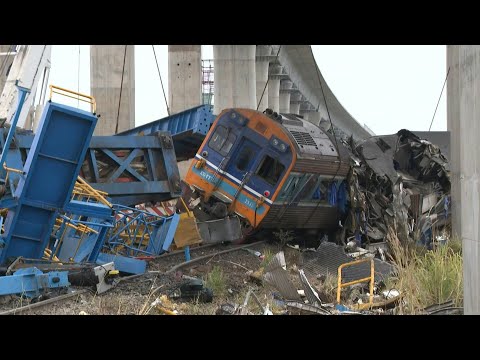
A construction crane building an elevated section of Thailand's long-delayed high-speed rail link to China collapsed onto a moving passenger train on January 14, 2026, killing at least 28 people and injuring more than 60 others. The crane, operated as part of a joint Thai-Chinese project 99.5% complete in its first phase, dropped a 20-30 ton concrete segment onto Special Express Train No. 21 as it carried 195 passengers through Sikhio district, derailing and igniting the carriages.

The disaster immediately suspended construction on what was already running nine years behind schedule—a $16.8 billion flagship of Beijing's Belt and Road Initiative meant to eventually connect Kunming to Singapore. Italian-Thai Development, the primary contractor, now faces legal action and scrutiny over its safety record, including its role in the collapse of a Bangkok skyscraper that killed 92 during the 2025 Mandalay earthquake.

Key Indicators

28+
Fatalities
At least 28 killed, 64 injured, 4 still missing as of initial reports
$16.8B
Total project investment
The two-stage Bangkok-Nong Khai rail project budget
99.5%
Phase 1 completion
Bangkok-Nakhon Ratchasima segment was nearly finished before the accident
9 years
Project delay
Original 2021 target missed; now projected for 2030 completion

People Involved

Phiphat Ratchakitprakarn
Thailand Deputy Prime Minister and Transport Minister (Ordered full investigation into the disaster)
Anan Phonimdaeng
Anan Phonimdaeng
Acting Governor, State Railway of Thailand (Leading investigation and coordinating victim compensation)
Premchai Karnasuta
Premchai Karnasuta
President and Chairman, Italian-Thai Development (Already facing charges for 2025 Bangkok building collapse)

Organizations Involved

IT
Italian-Thai Development (ITD)
Construction Company
Status: Primary contractor facing legal action and safety scrutiny

Thailand's largest construction firm, responsible for Suvarnabhumi Airport, the BTS Skytrain, and major MRT projects.

ST
State Railway of Thailand (SRT)
Government Agency
Status: Suspended construction; covering victim medical costs

Thailand's state rail operator, managing both conventional rail and high-speed rail development projects.

China Railway Construction Corporation
State-Owned Enterprise
Status: Responsible for design and construction supervision

Chinese state contractor providing design, supervision, and technical support for Thailand's high-speed rail.

Timeline

  1. Crane Collapses onto Passenger Train

    Accident

    Construction crane drops concrete segment onto Special Express Train No. 21, killing at least 28 and injuring 64. Fire breaks out in derailed carriages.

  2. Construction Suspended

    Response

    State Railway of Thailand halts construction pending investigation. Legal action against ITD announced.

  3. Bangkok Tower Collapse

    Accident

    ITD-built State Audit Office building collapses during Myanmar earthquake, killing 92. Premchai Karnasuta later charged.

  4. Rama 2 Elevated Project Accident

    Accident

    Another launching crane incident on a Bangkok expressway project causes fatalities and injuries.

  5. Tunnel Collapse Kills 3

    Accident

    Railway tunnel on the high-speed route collapses in Nakhon Ratchasima during heavy rainfall, killing three workers.

  6. ITD Debt Crisis Revealed

    Financial

    Italian-Thai Development announces 100+ billion baht debt following failure of Myanmar Dawei Port project.

  7. Launching Crane Collapse (Laad Krabang)

    Accident

    Launching crane collapses during elevated bridge construction on a separate Bangkok project, causing fatalities.

  8. China-Laos Railway Opens

    Infrastructure

    The connecting Kunming-Vientiane line opens, adding pressure for Thailand to complete its segment.

  9. Construction Begins

    Construction

    Ground broken on Bangkok-Nakhon Ratchasima segment, with 2021 target for completion.

  10. Thailand Opts for Self-Financing

    Policy

    Prayuth government decides Thailand will fund construction independently due to disagreements over Chinese loan terms.

  11. Thailand-China Rail Agreement Signed

    Diplomatic

    Thailand and China sign memorandum of understanding for high-speed rail link as part of Belt and Road Initiative.

Scenarios

1

ITD Faces Criminal Charges; Contract Revoked

Discussed by: Thai engineering associations, Nation Thailand

Given ITD's connection to two major fatal incidents in under a year—the 2025 Bangkok building collapse and the January 2026 train disaster—authorities could pursue criminal negligence charges against company leadership and terminate the construction contract. This would require Thailand to find a replacement contractor for the nearly-complete first phase, potentially inviting greater direct Chinese involvement or triggering a rebidding process that adds years of delay.

2

Safety Review Delays Project to 2032+

Discussed by: South China Morning Post, industry analysts

A comprehensive safety audit across all construction segments could suspend work for 6-18 months, pushing the already-delayed project well past its 2030 target. Given China's reputation stake in Belt and Road projects—and the contrast with the China-Laos Railway's clean safety record—Beijing may push for stricter supervision protocols, adding cost and time.

3

Project Completed With Enhanced Oversight

Discussed by: Thai government officials, The Diplomat

The first phase was 99.5% complete when the disaster occurred. Thailand could complete the segment with enhanced Chinese supervision and new safety protocols, treating the incident as a tragic but isolated failure in an otherwise successful project. This maintains momentum toward the 2030 full completion target.

4

Political Fallout Strains Thai-Chinese Relations

Discussed by: Hong Kong Free Press, regional analysts

The disaster could become a rallying point for critics of Chinese infrastructure projects in Thailand, potentially affecting negotiations for the second phase (Nakhon Ratchasima to Nong Khai). If blame falls heavily on Chinese design supervision, Bangkok may seek to renegotiate terms or involve other international partners.

Historical Context

Grand Mosque Crane Collapse, Mecca (2015)

September 2015

What Happened

A construction crane operated by Saudi Binladin Group collapsed onto the Grand Mosque in Mecca during a thunderstorm, killing 107 people and injuring nearly 300 international pilgrims. The crane had not been properly secured for weather conditions.

Outcome

Short Term

Saudi Binladin Group was temporarily banned from new government contracts. Hajj continued with additional safety measures.

Long Term

Saudi Arabia implemented stricter crane safety regulations for construction near holy sites. The incident remained the deadliest crane accident in modern history.

Why It's Relevant Today

Both incidents involve major infrastructure projects where crane operations killed bystanders rather than workers. The Mecca collapse shows how contractor penalties and enhanced regulations typically follow such disasters.

FIU Pedestrian Bridge Collapse, Miami (2018)

March 2018

What Happened

A newly installed 862-ton pedestrian bridge collapsed onto an eight-lane road at Florida International University, killing six people including five motorists stopped at a traffic light. Engineers had observed cracks in the bridge but allowed traffic to continue beneath it.

Outcome

Short Term

OSHA investigation faulted the engineering firm FIGG for calculation errors. Victims' families received $102.7 million in settlements.

Long Term

The NTSB report led to industry-wide discussions about peer review requirements and construction-zone traffic management.

Why It's Relevant Today

Like the Thailand disaster, the FIU collapse killed members of the public passing beneath active construction. Both cases raise questions about whether traffic should be permitted near elevated construction work.

China-Laos Railway Construction (2016-2021)

December 2016 – December 2021

What Happened

China built a 1,035km railway through Laos in five years despite mountainous terrain, 170 bridges, 72 tunnels, and unexploded ordnance from the Vietnam War. The $6 billion project opened on schedule in December 2021.

Outcome

Short Term

The railway opened with immediate economic impact, handling 43 million passengers in its first three years.

Long Term

The project became a Belt and Road success story, with over 100,000 train trips completed without safety incidents. It set the benchmark for the Thai connection.

Why It's Relevant Today

The China-Laos Railway demonstrates what the Thai project was meant to achieve. Its clean safety record contrasts sharply with the Thai segment's repeated construction accidents, raising questions about the difference between direct Chinese construction and joint ventures with local contractors.

10 Sources: