Pull to refresh
Logo
Tor Browser exploit shows a one-click path to users' real IP addresses

Tor Browser exploit shows a one-click path to users' real IP addresses

New Capabilities

Calif researcher Carlos Roque published the chain on November 26; Tor had shipped the fix two months earlier.

Overview

Updated 37 minutes ago

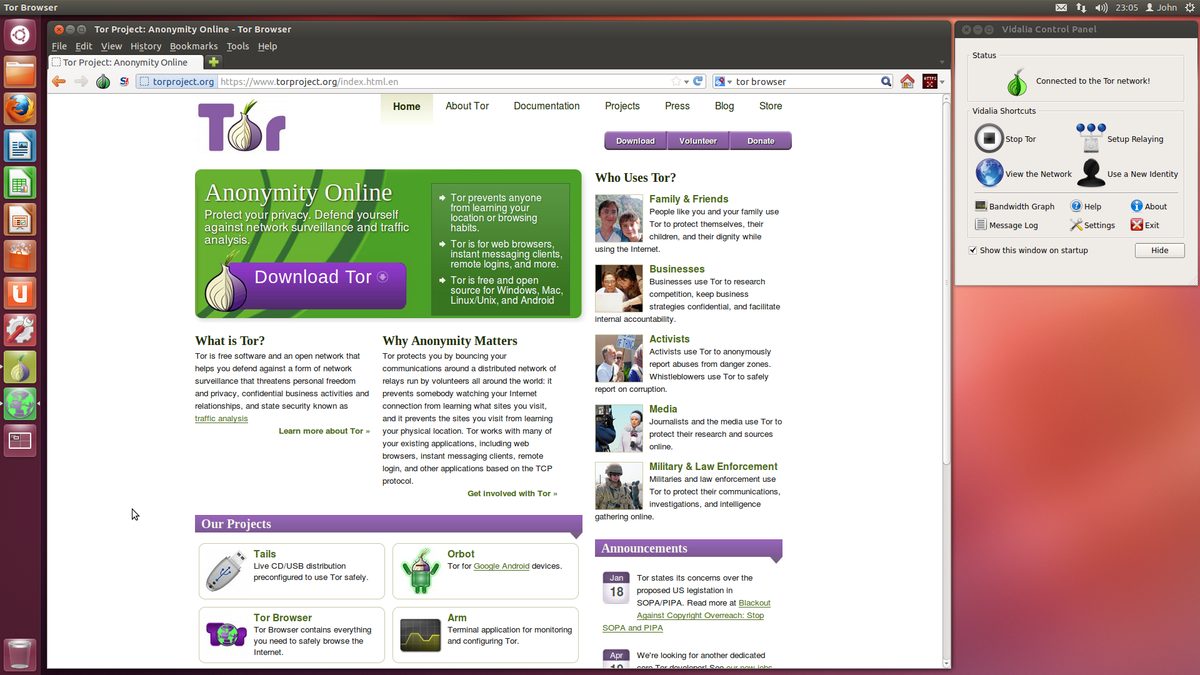
A malicious website could make Tor Browser connect straight to an attacker's server and hand over the visitor's public IP address. Calif researcher Carlos Roque published a working chain on November 26, 2026, that did it on Tor Browser 15.0.22 with default settings. Tor had shipped a fix in version 15.0.23 on September 15, more than two months earlier.

Tor's protection depends on every connection leaving through its relay network. The exploit crossed from a memory bug in the browser's Streams code into the parent process, which opened a raw TCP socket outside Tor's proxy. The attacker's server read the real address during the first handshake.

Why it matters

A leaked IP undoes Tor's core protection, and the proof locates the failure in the browser boundary rather than the network.

Questions about this story

Free account needed to ask — your question is kept and asked for you right after sign-up. Answers are public.

Is there going to be a fix?

Yes — the fix is already out: Tor Browser 15.0.23 (September 15, 2026) patches the flaw, and the current stable is 16.0.3.

Anyone still running 15.0.22 or older stays exposed until they update; there is no workaround.

3 details5 sources2 disagreements
  • Tor Browser 15.0.23 shipped September 15, 2026, moving to Firefox ESR 140.16 and fixing CVE-2026-92027, a use-after-free in the DOM Streams component rated high impact with a CVSS score of 8.8.
  • The fix carries into Tor Browser 16.0 (released October 29) and 16.0.3 (November 24, the current stable).
  • No confirmed in-the-wild exploitation: CISA's November 25 Known Exploited Vulnerabilities catalog does not list CVE-2026-92027.
Room for disagreement
  • Mozilla's advisory credits Mozilla itself as the reporter of CVE-2026-92027, while Calif's write-up describes the full chain without naming who found it first — a gap that hasn't been resolved.
  • The Tor Project's 15.0.23 notes confirm the Firefox fix but don't state whether the parent process that accepts the forged history entry was hardened independently, which one analysis flagged as unverified.
0 AI answers with web search. May be wrong.

Key Indicators

8.8
CVSS severity score
Mozilla rates CVE-2026-92027 high impact and notes user interaction is required.
72
Days from patch to public disclosure
Tor shipped 15.0.23 on September 15, 2026; Calif published its chain on November 26.
1
Clicks needed to trigger the chain
The victim must click once to open a same-origin popup that starts the memory corruption.
0
Confirmed in-the-wild attacks
No public evidence of exploitation as of the November 26 disclosure.

Voices

Curated perspectives — historical figures and your fellow readers.

Sign up to generate historical perspectives on this story.

People Involved

Organizations Involved

Timeline

September 2026 November 2026

5 events Latest: 2 days ago
Tap a bar to jump to that date
  1. Calif publishes the TORtilla with Onion chain

    Latest Disclosure

    Carlos Roque details a one-click path from a memory bug to a direct socket that bypasses Tor.

  2. No known exploitation in CISA's catalog

    Assessment

    The November 25 Known Exploited Vulnerabilities list does not include CVE-2026-92027.

  3. Tor Browser 16.0 carries the fix forward

    Release

    Rebases onto Firefox ESR 153.6 with the Streams fix already included.

  4. Tor Browser 15.0.23 fixes the Streams bug

    Patch

    Moves to Firefox ESR 140.16; Mozilla's MFSA 2026-92 rates CVE-2026-92027 high impact.

  5. Tor Browser 15.0.22 released

    Release

    The build Calif later used as its proof target ships with default settings.

Scenarios

1

No in-the-wild exploitation is confirmed through mid-2027

Likely Resolves by Jun 1, 2027

Discussed by: Calif and Mozilla advisories; CISA's Known Exploited Vulnerabilities catalog

The research demonstrates a working chain on one build. Neither Calif nor Mozilla reported active attacks, and CVE-2026-92027 was absent from CISA's catalog on November 25. If no vendor or government report surfaces, the disclosure stays a research finding.

2

A working Windows or macOS port of the chain appears

Possible Resolves by End of 2027

Discussed by: Calif's own limitations note; independent security researchers

Calif's proof used memory addresses calculated for the 64-bit Linux sandbox of 15.0.22. Porting requires rebuilding the heap layout and ROP chain for each platform. If someone publishes a working port, the flaw's practical reach grows beyond the tested build.

3

Mozilla updates its advisory to credit an external reporter

Uncertain Resolves by Jun 1, 2027

Discussed by: Calif's write-up; Mozilla's MFSA 2026-92 advisory

Mozilla's advisory lists Mozilla as the reporter, while Calif's write-up does not say who found the bug first. Mozilla sometimes updates advisories to credit outside researchers. If it does, the credit question closes; if not, it stays open.

Historical Context

3 moments from history that rhyme with this story — and how they unfolded.

August 2013

Tor Browser Bundle JavaScript exploit (2013)

An exploit targeting Tor Browser Bundle 2.3.25-13, built on Firefox 17 ESR, was delivered to users connected to the Freedom Hosting takedown. The malware phoned home to a server with the user's real IP and MAC address, defeating Tor's routing.

Then

The FBI used the technique in its Freedom Hosting investigation, and Mozilla fixed the underlying Firefox bug.

Now

It became the reference case for client-side de-anonymization: a browser compromise can undo network anonymity.

Why this matters now

Roque's chain is the same class of failure with a different mechanism: a browser bug turns into a direct connection outside Tor.

November 2017

TorMoil IP leak (2017)

A researcher going by 'johndoe' disclosed a macOS bug that bypassed Tor's proxy and leaked the real IP address. It affected Tor Browser on Apple's operating system.

Then

The Tor Project fixed it in Tor Browser 7.0.9 within days.

Now

It showed that a single browser-level flaw can pierce the proxy boundary.

Why this matters now

Like TorMoil, the 2026 chain works by making the browser itself open a connection that skips the proxy.

June 2019

Firefox zero-day CVE-2019-11707 (2019)

A type-confusion bug in Array.pop was exploited in the wild. The exploit affected Firefox and Tor Browser users alike.

Then

Mozilla rushed out Firefox 67.0.3 and 60.7.0; Tor Browser updated too.

Now

It reinforced Tor Browser's dependence on upstream Firefox security.

Why this matters now

The 2026 chain also begins in the browser engine, in a memory-safety bug addressed by the upstream fix.

Sources

(8)