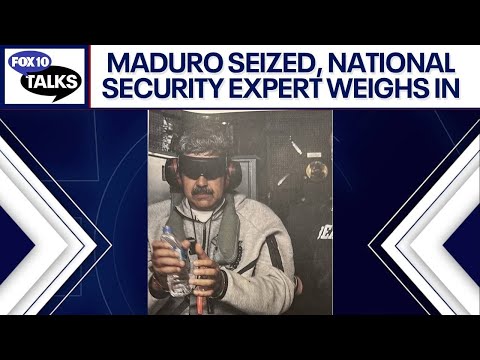
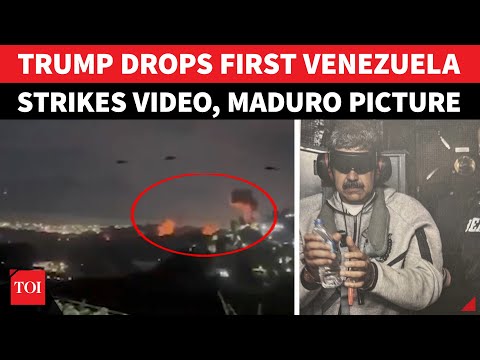
At 2 a.m. on January 3, 2026, Delta Force operators stormed Nicolas Maduro's compound in Caracas while U.S. warplanes bombed air defenses across northern Venezuela. Hours later, Maduro and his wife sat in a Manhattan courtroom facing narco-terrorism charges. Over 100 Venezuelans—soldiers, Cuban advisors, civilians—died in what the U.S. calls a law enforcement operation and the UN calls a dangerous precedent that shreds international law.
What happens next could reshape Latin American geopolitics for decades. The U.S. plans to control Venezuela's oil industry and oversee a multi-year transition to elections. Venezuela's interim government releases political prisoners while vowing to 'rescue' Maduro. Opposition leaders recognized by Washington as legitimate winners of a stolen 2024 election demand power. Russia and China call it armed aggression. Trump says America is 'running the country' until further notice.
Images from Openverse under Creative Commons licenses.
Videos from YouTube.
Key Indicators
100+
Killed in U.S. Operation
Venezuelan soldiers, Cuban military personnel, and civilians died during the January 3 raid
803
Political Prisoners Remaining
Foro Penal count after Venezuela released 41 prisoners as 'goodwill gesture'
67%
Gonzalez's Actual Vote Share
Opposition tallies showed Gonzalez won July 2024 election Maduro claimed to win with 52%
30-50M
Barrels of Oil U.S. Plans to Seize
Trump administration intends to sell Venezuelan oil to fund transition
People Involved
Nicolás Maduro Moros
Former President of Venezuela (In U.S. custody, detained in New York facing narco-terrorism charges)
Delcy Eloína Rodríguez Gómez
Acting President of Venezuela (Leading Venezuela's interim government, not recognized by U.S. or EU)
Edmundo González
Opposition presidential candidate, recognized by U.S. as president-elect (In exile in Spain since September 2024, recognized by U.S. and allies as legitimate election winner)
María Corina Machado
Opposition leader, 2025 Nobel Peace Prize laureate (In hiding since July 2024 election, leading opposition remotely)
Marco Rubio
U.S. Secretary of State (Leading Venezuela transition policy for Trump administration)
Diosdado Cabello
Venezuelan Interior Minister (Remains in Venezuelan government under Rodríguez)
Alfredo Romero
Executive Director of Foro Penal (Monitoring prisoner releases and political detention)
Organizations Involved
1S
1st Special Forces Operational Detachment-Delta
U.S. Army Special Operations Unit
Status: Conducted the raid that captured Maduro
America's most secretive counter-terrorism unit, tasked with high-risk operations.
FO
Foro Penal Venezolano
Human Rights Organization
Status: Monitoring political prisoners and documenting releases
Venezuela's primary watchdog tracking political detention, running a network of 200 lawyers and 1,700 volunteers.
UN
United Nations Security Council
International Governing Body
Status: Held emergency session, condemned U.S. action
The UN's primary organ for maintaining international peace and security.
TH
The Carter Center
Election Monitoring Organization
Status: Declared July 2024 Venezuela election lacked democratic standards
International election observer invited by Maduro's government to monitor the 2024 vote.
Timeline
Italy Confirms Release of Citizens Trentini, Burlo
Political
Two more Italian prisoners freed—charity worker and businessman held since 2024. Total four Italians released.
Venezuela Announces Prisoner Releases
Political
Government claims 116 released as goodwill gesture. Foro Penal confirms only 41, including opposition leaders and foreigners.
Rubio Unveils Three-Phase Transition Plan
Policy
Secretary of State outlines stabilization, recovery, eventual elections. U.S. will control oil sales indefinitely.
Rodríguez Sworn in as Acting President
Political
Supreme Court orders Vice President Delcy Rodríguez to lead Venezuela for 90 days. U.S. and EU refuse recognition.
Maduro Pleads Not Guilty in Manhattan Court
Legal
Arraigned on narco-terrorism, cocaine trafficking, weapons charges. Faces mandatory minimum 20 years if convicted.
UN Security Council Emergency Session
International
U.S. allies and adversaries condemn intervention. Guterres warns of 'dangerous precedent.' Only Argentina supports action.
Operation Absolute Resolve: U.S. Captures Maduro
Military
Delta Force raids presidential compound while 150+ aircraft bomb Venezuelan defenses. Over 100 killed, including 32 Cubans. Maduro flown to New York.
U.S. Designates Cartel de Los Soles as FTO
Policy
State Department declares Maduro's alleged drug network a Foreign Terrorist Organization, providing legal basis for military action.
Maduro Sworn in for Third Term
Political
Despite election fraud allegations, Maduro inaugurated for six-year term. International community divided on recognition.
González Flees to Spain, Granted Asylum
Political
Facing arrest, opposition candidate escapes Venezuela. U.S. and allies recognize him as legitimate president-elect.
Arrest Warrant Issued for González
Legal
Maduro government charges González with usurpation of functions and document falsification for claiming election victory.
Disputed Presidential Election Triggers Crisis
Political
Maduro claims 52% victory; opposition tallies verified by UN and Carter Center show González won 67%. Protests erupt.
Supreme Court Bans Machado from Office
Legal
Venezuelan Supreme Court upholds 15-year ban on Machado holding office, forcing opposition to field replacement candidate.
Machado Wins Opposition Primary with 93%
Political
María Corina Machado dominates opposition primary to challenge Maduro, winning overwhelming mandate from voters.
U.S. Indicts Maduro for Narco-Terrorism
Legal
DOJ charges Maduro with conspiracy to traffic cocaine with FARC and ELN, alleging 25-year operation. Offers $15 million reward.
Scenarios
1
U.S.-Managed Transition, González Installed as President
Discussed by: Trump administration, Atlantic Council analysts, Venezuelan opposition
Rubio's three-phase plan succeeds. Rodríguez's government cooperates under economic pressure. Opposition leaders return from exile. U.S. oversees oil sales while rebuilding institutions. Elections held within 18-24 months install González, who the U.S. already recognizes as legitimate winner. American influence gradually withdraws as democratic governance takes root. Requires preventing chaos, managing competing opposition factions, and convincing oil companies to invest despite risks.
2
Prolonged U.S. Occupation Amid Venezuelan Resistance
Discussed by: Brookings Institution, international law scholars, Russia and China
Venezuela fractures. Rodríguez's government refuses to cede power. Military remains loyal to Chavismo. Armed resistance emerges—possibly backed by Cuba, Russia. U.S. troops deploy for 'stabilization,' triggering guerrilla conflict. Oil infrastructure becomes target. What Trump called a 'surgical operation' becomes years-long occupation. Latin American allies distance themselves. UN pressure intensifies. Iraq comparisons dominate headlines.
3
International Court Challenges Force U.S. Withdrawal
Discussed by: Chatham House, European legal experts, UN human rights bodies
International Criminal Court or International Court of Justice proceedings gain momentum. European allies withdraw support under domestic pressure. U.S. sanctions enforcement collapses as China and Russia provide economic lifeline. Trump faces congressional revolt over unauthorized military action. Maduro's trial becomes political spectacle, charges dismissed on jurisdiction grounds. U.S. forced into messy exit. Rodríguez consolidates power. Prisoner releases stop.
4
Oil Deal Brokered, Hybrid Government Emerges
Discussed by: Oil industry analysts, diplomats from Brazil and Colombia
Pragmatism prevails over ideology. Exxon, Chevron negotiate deals for Venezuelan crude—too valuable to leave untapped. U.S. accepts power-sharing arrangement: Rodríguez remains in government, González and opposition get cabinet posts. Hybrid regime emerges, neither fully authoritarian nor democratic. Political prisoners released. Elections scheduled but rigged enough to preserve Chavista influence. Everyone claims victory. Venezuela becomes another managed autocracy America tolerates for energy access.
Historical Context
U.S. Invasion of Panama (Operation Just Cause)
December 1989 - January 1990
What Happened
President George H.W. Bush dispatched 24,000 troops to overthrow Panamanian dictator Manuel Noriega, a former CIA asset wanted for drug trafficking. The operation killed 200-300 Panamanian combatants and 300+ civilians. Noriega surrendered after hiding in the Vatican embassy, was convicted in U.S. courts, and served 17 years in prison.
Outcome
Short Term
Noriega deposed, democratic elections held in 1990, Panama Canal transition proceeded peacefully.
Long Term
Panama achieved stable democracy and economic growth. International criticism faded. Precedent established for apprehending foreign leaders on drug charges.
Why It's Relevant Today
Closest parallel to Venezuela operation: U.S. military action to capture indicted drug-trafficking leader. Key difference: Panama asked for intervention; Venezuela did not.
U.S. Invasion of Grenada (Operation Urgent Fury)
October 1983
What Happened
Reagan sent 2,000 Marines to overthrow Grenada's military regime six days after it executed Prime Minister Maurice Bishop. Cited protecting American medical students and regional security. Symbolic Caribbean forces joined. Operation lasted days, installed provisional government.
Outcome
Short Term
Military regime removed, provisional government installed, U.S. forces withdrew within weeks.
Long Term
Grenada held democratic elections in 1984, achieved stable governance and peaceful transfers of power for four decades.
Why It's Relevant Today
Shows potential for successful intervention in small Caribbean/Latin American states. But Grenada's 100,000 population and lack of oil made exit simple—Venezuela's 28 million and vast resources complicate withdrawal.
Iraq War and Occupation (2003-2011)
March 2003 - December 2011
What Happened
U.S. invaded Iraq to depose Saddam Hussein, citing WMDs that didn't exist. Mission accomplished declared prematurely. Occupation descended into sectarian civil war, insurgency. Cost 4,500 American lives, hundreds of thousands of Iraqi deaths, trillions of dollars.
Outcome
Short Term
Saddam deposed and executed, but no WMDs found. Power vacuum unleashed chaos.
Long Term
Prolonged occupation, birth of ISIS, destabilized Middle East. U.S. withdrew 2011, returned 2014 to fight ISIS. Iraq remains fragile democracy with Iranian influence.
Why It's Relevant Today
Cautionary tale for Venezuela. Iraq shows how 'surgical' regime change can spiral into decade-long quagmire when post-invasion planning fails and local resistance emerges.