Pull to refresh
Logo
Daily Brief
Following
Why Sign Up
Abbott absorbs Exact Sciences, creating a cancer diagnostics giant

Abbott absorbs Exact Sciences, creating a cancer diagnostics giant

Money Moves
By Newzino Staff |

The $21 billion deal gives Abbott a commanding position in a fast-growing market where blood tests may soon catch cancers early

Today: Abbott closes the acquisition

Overview

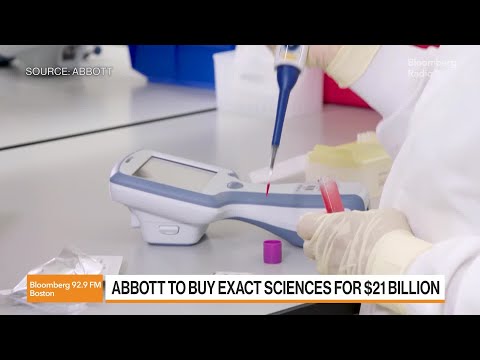
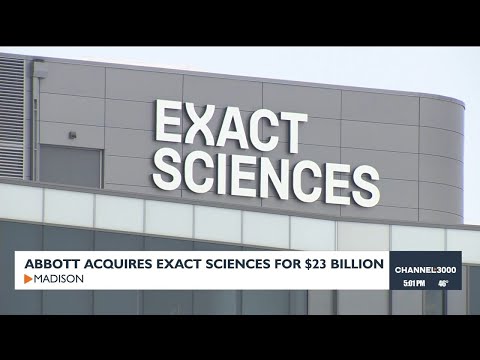
Abbott Laboratories closed its $21 billion acquisition of Exact Sciences on March 23, making the maker of the Cologuard colorectal cancer screening test a wholly owned subsidiary of one of the world's largest healthcare companies. The all-cash deal, at $105 per share, passed through antitrust review without a second request from regulators—a sign of how little the two companies' product lines overlapped before this combination.

Why it matters

Cancer blood tests are approaching clinical reality, and this deal determines who controls the largest portfolio of them.

Key Indicators

$21B
Deal value (equity)
All-cash acquisition at $105 per share, a 21.8% premium over Exact Sciences' pre-announcement price
$3B
Incremental 2026 sales for Abbott
Exact Sciences contributed $3.25 billion in revenue in 2025, growing 18% year over year
$12B+
Combined diagnostics revenue
Abbott's total diagnostics business now exceeds $12 billion annually, among the world's largest
99%
Shareholder approval vote
Over 99% of votes cast at the February special meeting approved the merger
20M
Global cancer diagnoses per year
Approximately 20 million people are diagnosed with cancer annually, a number expected to rise

Interactive

Exploring all sides of a story is often best achieved with Play.

Ever wondered what historical figures would say about today's headlines?

Sign up to generate historical perspectives on this story.

Sign Up

Debate Arena

Two rounds, two personas, one winner. You set the crossfire.

People Involved

Organizations Involved

Timeline

  1. Abbott closes the acquisition

    Corporate

    The deal closed as scheduled. Exact Sciences became a wholly owned subsidiary of Abbott, with its Madison, Wisconsin headquarters maintained.

  2. All regulatory clearances received

    Regulatory

    Abbott confirmed it had obtained all required regulatory approvals, including expiration of the Hart-Scott-Rodino Act waiting period, without a second request from antitrust regulators.

  3. Exact Sciences shareholders approve the merger

    Corporate

    Over 99% of votes cast at a special meeting approved the acquisition. A separate advisory vote on executive compensation packages tied to the deal failed, with shareholders voting more than two-to-one against.

  4. Abbott announces $21 billion deal for Exact Sciences

    Corporate

    Abbott and Exact Sciences announced a definitive merger agreement at $105 per share in cash, a 21.8% premium. Both boards unanimously approved the deal.

  5. Cologuard Plus launches with sharply improved accuracy

    Product

    Exact Sciences launched Cologuard Plus, achieving 94% cancer sensitivity and 91% specificity while reducing false positives by nearly 40% compared to the original test.

  6. Exact Sciences acquires Genomic Health

    Corporate

    Exact Sciences bought Genomic Health for $2.8 billion, adding the Oncotype DX breast cancer treatment decision test and expanding beyond colorectal cancer screening.

  7. FDA approves original Cologuard test

    Regulatory

    The Food and Drug Administration approved Cologuard as the first noninvasive stool DNA screening test for colorectal cancer, with simultaneous national Medicare coverage—the first device or diagnostic to achieve both at once.

Scenarios

1

Abbott becomes the dominant force in cancer screening

Discussed by: William Blair, BTIG, and multiple Wall Street analysts covering Abbott

Abbott successfully integrates Exact Sciences, uses its presence in 160+ countries to bring Cologuard international, and pushes Cancerguard through FDA approval. The combined diagnostics business exceeds $15 billion in annual revenue within three years as cancer blood tests become routine primary care tools. Guardant Health and Grail struggle to compete against Abbott's distribution scale.

2

Integration stumbles slow Abbott's cancer diagnostics push

Discussed by: Analysts noting the ~$0.20 EPS dilution and complexity of integrating a high-growth biotech culture into a diversified conglomerate

The cultural gap between a nimble diagnostics innovator and a $44 billion conglomerate proves difficult to bridge. Key Exact Sciences talent departs, pipeline development slows, and competitors like Guardant Health gain ground with simpler blood-based alternatives. Abbott captures the revenue but loses the innovation engine it paid a premium for.

3

Blood-based cancer screening reshuffles the entire diagnostics industry

Discussed by: Industry analysts covering the multi-cancer early detection market, projected to reach $5.8–7.5 billion by 2033

The deal triggers a wave of consolidation as other large healthcare companies rush to acquire cancer diagnostics assets. Roche deepens its Foundation Medicine investment, a major player acquires Guardant Health, and new Medicare coverage legislation for multi-cancer early detection tests accelerates adoption. Within five years, annual blood-based cancer screening becomes as common as mammograms or colonoscopies, fundamentally changing when and how cancers are caught.

Historical Context

Roche acquires Foundation Medicine (2018)

June 2018

What Happened

Swiss pharmaceutical giant Roche paid $2.4 billion to acquire the remaining shares of Foundation Medicine, a cancer genomic profiling company, bringing total ownership to 100%. The deal gave Roche full control of FoundationOne CDx, an FDA-approved test that sequences tumor DNA to match patients with targeted therapies.

Outcome

Short Term

Foundation Medicine was kept as an autonomous subsidiary within Roche, preserving its culture and partnerships with other pharmaceutical companies.

Long Term

Roche built Foundation Medicine into the standard-of-care platform for companion diagnostics in oncology, validating the model of a diversified healthcare company acquiring a pure-play cancer diagnostics innovator.

Why It's Relevant Today

Abbott is running the same playbook at nearly ten times the scale. The Roche/Foundation Medicine deal showed that a large acquirer could preserve a diagnostics innovator's capabilities while adding global distribution—exactly what Abbott is betting it can do with Exact Sciences.

Illumina forced to divest Grail (2021–2023)

March 2021 – December 2023

What Happened

Illumina, the dominant maker of DNA sequencing machines, acquired Grail—developer of the Galleri multi-cancer blood test—for $7.1 billion over the objections of the Federal Trade Commission (FTC). The FTC argued Illumina could disadvantage Grail's competitors who depended on Illumina's sequencing technology. A federal court upheld the FTC's order, and Illumina announced it would divest Grail in December 2023.

Outcome

Short Term

Illumina was forced to unwind the deal at significant financial and operational cost, and Grail lost years of potential development momentum.

Long Term

The case established that vertical integration in cancer diagnostics faces serious regulatory scrutiny when the acquirer controls an essential input that competitors also need.

Why It's Relevant Today

Abbott's clean regulatory clearance stands in sharp contrast. Because Abbott and Exact Sciences had minimal product overlap—Abbott makes lab instruments and rapid tests, Exact Sciences makes cancer screening tests—regulators saw no competitive harm. The Illumina/Grail cautionary tale explains why Abbott was a better structural fit as an acquirer.

Danaher acquires GE Biopharma (2020)

March 2020

What Happened

Danaher Corporation paid $21.4 billion for General Electric's biopharma business, gaining a $3.2 billion revenue platform in bioprocessing equipment and consumables used to manufacture biological drugs. It was one of the largest healthcare deals of the decade at the time.

Outcome

Short Term

The business, renamed Cytiva, became Danaher's largest segment and immediately benefited from surging demand for vaccine and biologic manufacturing during the COVID-19 pandemic.

Long Term

The deal transformed Danaher into a life sciences powerhouse and validated the strategy of diversified companies making $20 billion-plus bets on high-growth healthcare segments.

Why It's Relevant Today

At nearly identical deal size, Abbott is making the same strategic bet Danaher made—using a single large acquisition to enter a fast-growing healthcare market where it previously had little presence. Danaher's success provides the template Abbott is following.

Sources

(10)