


Pull to refresh
Logo
Zhipu releases GLM-5.4, its first flagship model with a looped transformer

Zhipu releases GLM-5.4, its first flagship model with a looped transformer

New Capabilities

The 750-billion-parameter model runs 28 layers twice and targets coding, with API access and open weights still pending.

Overview

Updated 7 minutes ago

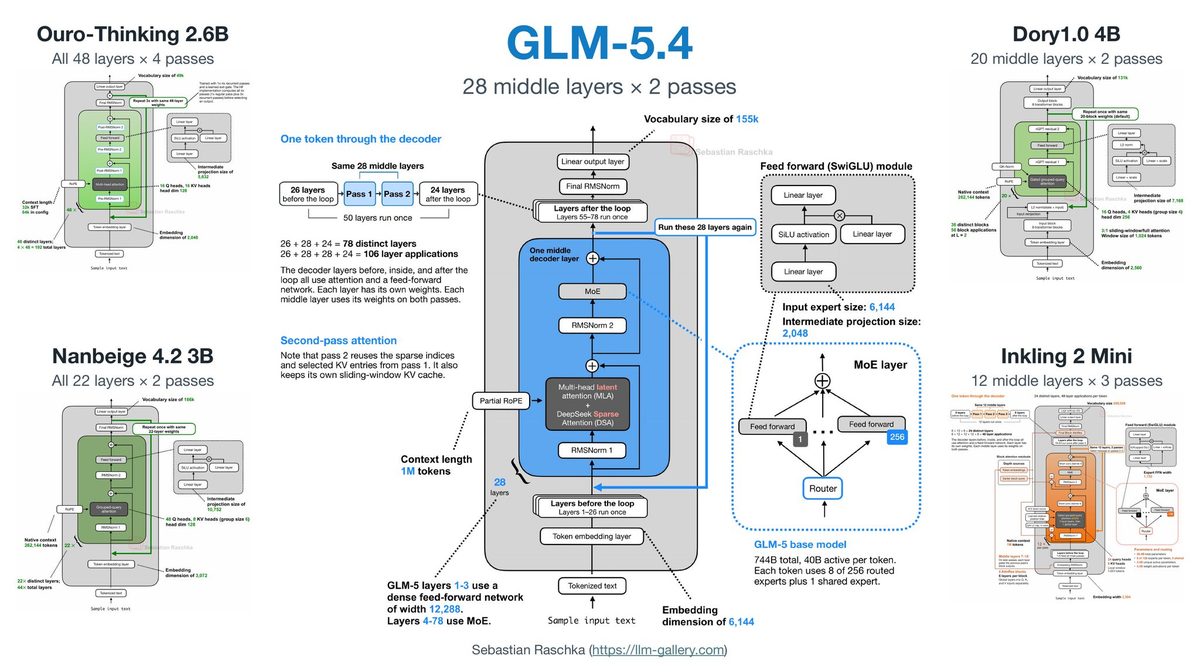
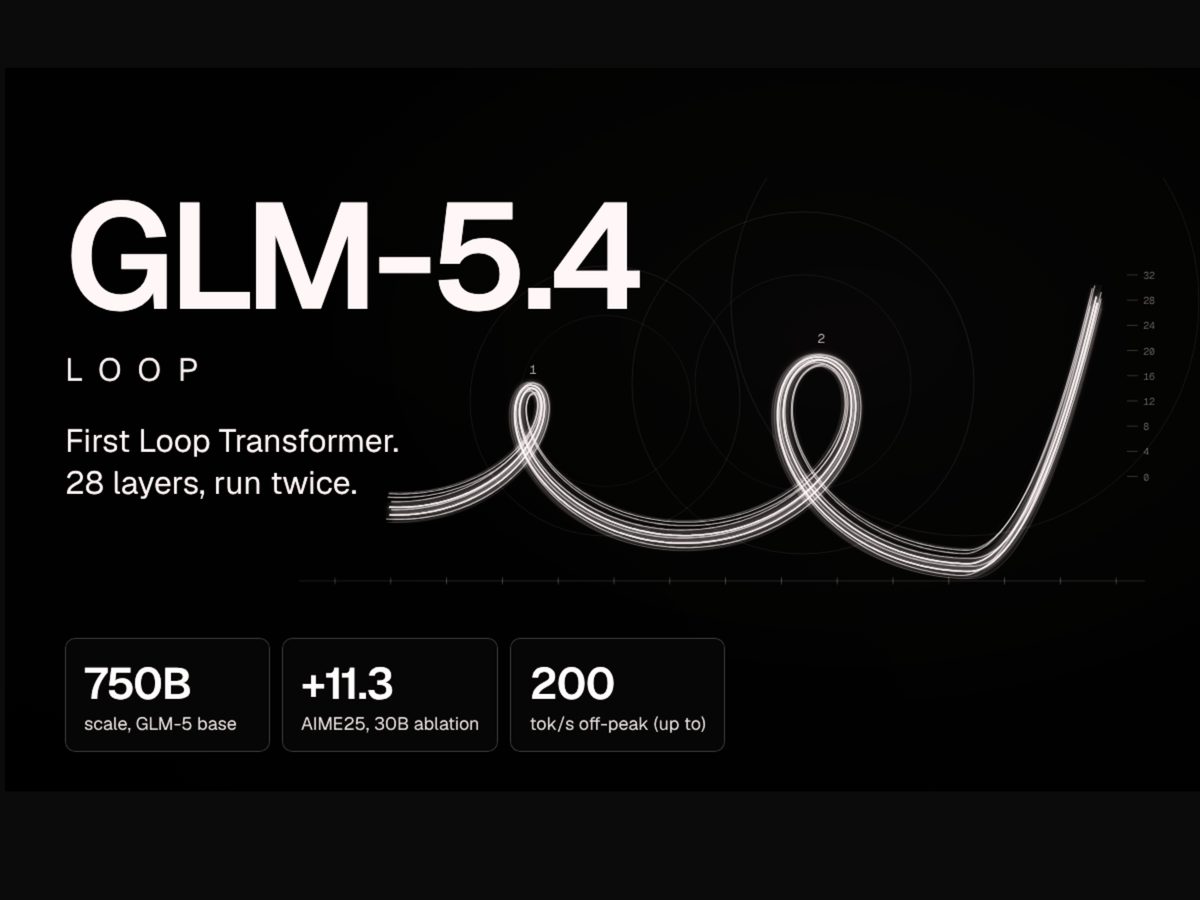
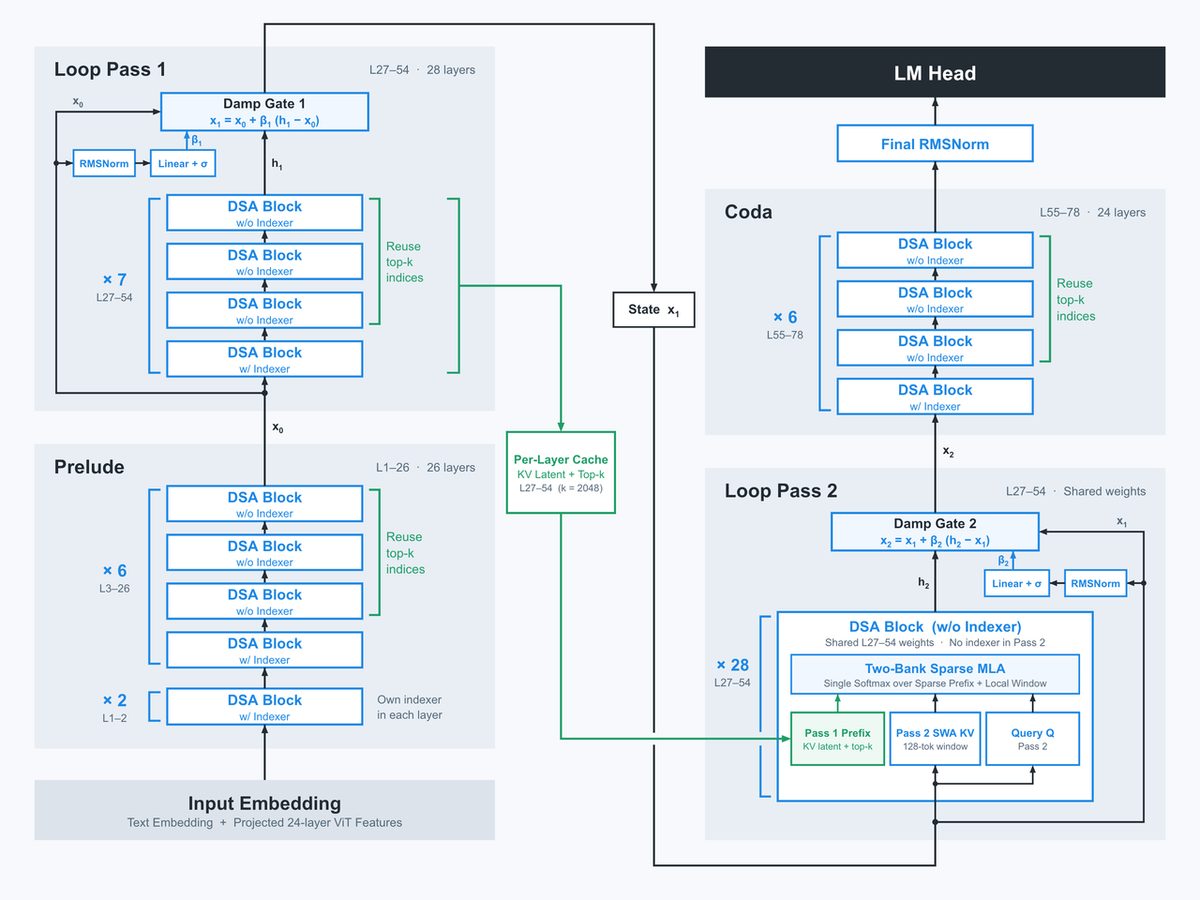
Zhipu AI's GLM-5.4 has 750 billion parameters. It runs 28 of its layers twice for every token it generates, which Zhipu says gives it the reasoning power of models with two trillion to three trillion parameters. The mechanism is a Loop Transformer: reuse the same weights for extra passes instead of adding new ones.

The design shifts the cost of deeper reasoning from model size to inference compute, the work done at answer time. Zhipu is selling GLM-5.4 for coding and cybersecurity, and says a memory-sharing scheme keeps deployment costs near its previous model. Independent benchmark results are not yet available: the controlled test ran on a 30-billion-parameter model, not the flagship.

Why it matters

If looping holds at scale, labs can add reasoning depth with inference compute instead of doubling parameter counts and memory.

Questions about this story

Free account needed to ask — your question is kept and asked for you right after sign-up. Answers are public.

No questions yet — be the first to ask.

Key Indicators

750B
Parameters in the base model
GLM-5.4 loops 28 layers of the 750-billion-parameter GLM-5 base model.
28 × 2
Layers run twice per token
The same 28 layers run twice, adding depth without new weights.
10%
Extra training compute in controlled test
A 30-billion-parameter looped model beat its unlooped twin with about 10% more compute.
1M
Token context window
Zhipu says hybrid memory caching limits the extra loop's memory cost.
7th
Rank on KingBench 4
Tester AICodeKing placed it seventh and cited slow run times.

Voices

Curated perspectives — historical figures and your fellow readers.

Sign up to generate historical perspectives on this story.

People Involved

Organizations Involved

Timeline

5 events Latest: Today
Tap a bar to jump to that date
  1. Zhipu details the Loop Transformer in a technical blog

    Today Announcement

    GLM-5.4 loops 28 layers twice and uses per-token controls to stabilize updates.

  2. Early tester ranks GLM-5.4 seventh on KingBench 4

    Today Benchmark

    AICodeKing reports 431 minutes and 1,128 steps at maximum reasoning effort.

  3. Security tester completes remote code execution chain

    Today Security

    Migel Tissera says the model broke through a private lab environment in multiple steps.

  4. Zhipu says API access awaits safety assessment

    Today Statement

    Open weights are planned after safety hardening; no release date is given.

  5. Zhipu opens GLM-5.4 to Coding Plan subscribers

    Launch

    Goes live in ZCode, Trae, WorkBuddy and Qoder with 1.5 times GLM-5.3's quota.

Scenarios

1

Zhipu publishes GLM-5.4 open weights

Likely Resolves by Q2 2027

Discussed by: Zhipu AI's release blog

Zhipu says it will open-source the weights after safety hardening. A completed safety review would trigger the release, letting outside researchers test the loop architecture directly. The company has not given a date.

2

Zhipu opens GLM-5.4 to general API access

Likely Resolves by Q1 2027

Discussed by: Z.ai developer documentation

The model is limited to Coding Plan subscribers for now. Zhipu says API access will open after a security assessment. That would let developers outside the subscription test it at scale.

3

GLM-5.4 falls outside top five on SWE-bench Verified

Possible Resolves by Jan 31, 2027

Discussed by: VentureBeat and community testers

Zhipu's parity claim rests on a 30-billion-parameter controlled test, not the 750-billion flagship. If independent leaderboards place GLM-5.4 below smaller models, the loop's advantage will look narrower than advertised.

4

Zhipu ships a successor with adaptive loop depth

Possible Resolves by End of 2027

Discussed by: Zhipu AI's technical blog

Zhipu says it is exploring adaptive compute, where harder tokens get more loop iterations. A successor with per-token loop depth would turn the fixed two-pass design into a variable one.

Historical Context

3 moments from history that rhyme with this story — and how they unfolded.

2018

Universal Transformer (2018)

A Google research paper proposed sharing weights across repeated layers. The Universal Transformer applied the same block at each step, letting depth grow without new parameters.

Then

It improved parameter efficiency on small translation and reasoning tasks.

Now

It did not become the basis of frontier models; unshared transformers scaled better under equal training compute.

Why this matters now

GLM-5.4 revives the idea at 750 billion parameters, using a pre-trained base model instead of training from scratch.

2020–2024

GPT-3 and the parameter-count race (2020–2024)

GPT-3's 175 billion parameters in 2020 set off a push toward larger models. Labs measured progress in parameter counts and trained ever-larger dense and mixture-of-experts systems.

Then

Larger models set new records on language and coding benchmarks.

Now

Training and serving costs rose, pushing labs toward sparser architectures and inference-time compute.

Why this matters now

GLM-5.4 tests whether architecture can deliver larger-model behavior without a larger parameter count.

2024

OpenAI o1 and inference-time reasoning (2024)

OpenAI released o1, which spends more compute generating internal reasoning before answering. The model traded speed for better performance on math and coding.

Then

It pushed test-time compute into the center of model design.

Now

Labs began treating inference budget as a scaling lever alongside parameters.

Why this matters now

GLM-5.4 moves that extra compute inside the network, looping layers instead of generating more visible reasoning tokens.

Sources

(10)