


Pull to refresh
Logo
Thinking Machines releases Inkling 2 Mini, an open-weight model that runs on a laptop

Thinking Machines releases Inkling 2 Mini, an open-weight model that runs on a laptop

New Capabilities

The 26.4-billion-parameter model loops its middle layers three times per token and fits in about 20 gigabytes.

Overview

Updated 43 minutes ago

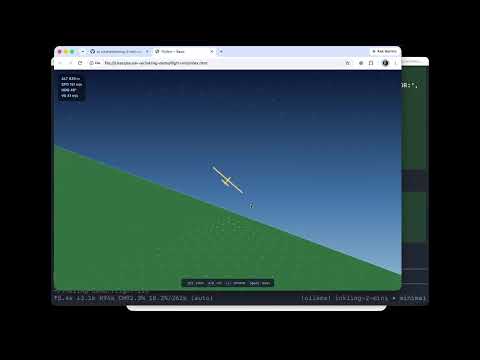
On a flight, Thinking Machines researchers ran Inkling 2 Mini offline on a MacBook Pro and built a playable flight simulator in a few minutes. The model's weights are public and fit in about 20 gigabytes, small enough for a laptop with 32 gigabytes of memory.

The model is a looped transformer: 24 layers, with the middle 12 applied three times per token. That yields 48 layer applications from 24 layers of weights, 26.4 billion total parameters, and 3.4 billion active for each token. Thinking Machines says the design lets the model reason longer without writing its reasoning down, and it scores 48.2% on DeepSWE v1.1, a coding benchmark that tests multi-step tasks.

Why it matters

A capable coding model that fits on a laptop puts multi-step AI agents in the hands of developers who cannot rent a datacenter.

Questions about this story

Free account needed to ask — your question is kept and asked for you right after sign-up. Answers are public.

No questions yet — be the first to ask.

Key Indicators

26.4B
Total parameters
Mixture-of-experts model with 128 experts per layer; 8 are active per token.
3.4B
Active parameters
Each extra loop pass adds about 1.0B effective active parameters.
~20GB
Memory footprint
Mixed 4-bit and 8-bit precision checkpoint; runs on 32GB Apple silicon.
3
Loop passes
The middle 12 of 24 layers run three times per token.
48.2%
DeepSWE v1.1
Coding benchmark that tests multi-step tasks.
46.5%
Vals Index v2.2
General capability benchmark score.
$0.15
Input price
Per million input tokens on Tinker; output is $0.50 per million.

Voices

Curated perspectives — historical figures and your fellow readers.

Sign up to generate historical perspectives on this story.

Organizations Involved

Timeline

July 2026 November 2026

4 events Latest: Today
Tap a bar to jump to that date
  1. Thinking Machines releases Inkling 2 Mini

    Today Release

    Open weights, a 20GB checkpoint, and local hardware support go public.

  2. Model card lists local hardware requirements

    Documentation

    Apple silicon with 32GB or more memory and one Nvidia DGX Spark are supported.

  3. vLLM adds day-0 serving support

    Infrastructure

    The serving library ships support for Inkling 2 Mini's looped layers.

  4. Thinking Machines releases Inkling 1.0

    Release

    The predecessor model shipped five months before Inkling 2 Mini.

Scenarios

1

Another lab ships a looped open-weight model

Possible Resolves by Q2 2027

Discussed by: Thinking Machines Lab and vLLM engineers

Thinking Machines published the architecture and a variable-loop research model alongside Inkling 2 Mini. If other labs adopt weight-sharing across depth, looping becomes a standard design rather than one lab's bet. The first evidence would be a non-Thinking Machines open-weight model that runs a middle block more than once per token.

2

Thinking Machines scales looping to a larger model

Possible Resolves by Q2 2027

Discussed by: Thinking Machines Lab

The company says looping improved reasoning on its internal scaling ladder. A larger looped model would test whether those gains survive beyond 26.4 billion parameters. Thinking Machines has not announced one.

3

Inkling 2 Mini becomes a top local coding model

Possible Resolves by Feb 28, 2027

Discussed by: Artificial Analysis and Hugging Face download charts

Its 20-gigabyte checkpoint and 48.2% DeepSWE score make it a candidate for local coding agents. Adoption would show up in Hugging Face download counts and third-party evaluations. The open weights make it easy for developers to test without a contract.

4

Runaway loops undermine agentic reliability

Uncertain Resolves by Q1 2027

Discussed by: Plotly's data-analysis benchmark

Plotly reported one hidden-pattern question where Inkling 2 Mini made 585 queries over about 48 minutes and still missed the pattern. If similar failures appear across evaluations, looping's reasoning gains may not translate into reliable long-horizon agents. That would limit use in unattended coding tasks.

Historical Context

3 moments from history that rhyme with this story — and how they unfolded.

2018

Universal Transformers (2018)

A paper by Dehghani and colleagues proposed reusing transformer layers across depth, letting the model apply more computation per token. The design did not become a standard architecture.

Then

The idea stayed a research curiosity.

Now

It established the intuition that repeating layers can buy reasoning, which later looped models build on.

Why this matters now

Inkling 2 Mini adds a learned gate that starts by blocking the looped message, then increases its weight during training.

2021

Switch Transformer (2021)

Google researchers introduced a sparse mixture-of-experts transformer that routed each token to one expert out of many. It showed that parameter counts could grow faster than per-token compute.

Then

Sparse mixture-of-experts became a common design for large models.

Now

It set the template for models with high total parameters and low active parameters.

Why this matters now

Inkling 2 Mini routes each token to 8 of 128 experts, keeping active parameters at 3.4 billion.

July 2023

Llama 2 open-weight release (2023)

Meta released Llama 2 with open weights, offering models from 7 billion to 70 billion parameters. The largest versions needed multiple high-memory GPUs.

Then

Open-weight models became a common base for local experimentation and fine-tuning.

Now

Labs began competing on smaller, more efficient models that could run outside datacenters.

Why this matters now

Inkling 2 Mini pushes that size curve down: a 26.4-billion-parameter model in a 20-gigabyte checkpoint.

Sources

(10)