



Pull to refresh
Logo
Daily Brief
Following
Why Sign Up
Alice Springs unrest after Indigenous girl's killing

Alice Springs unrest after Indigenous girl's killing

Force in Play
By Newzino Staff |

Murder charge follows riots demanding traditional Warlpiri justice for a five-year-old

In 2 days: First court appearance scheduled

Overview

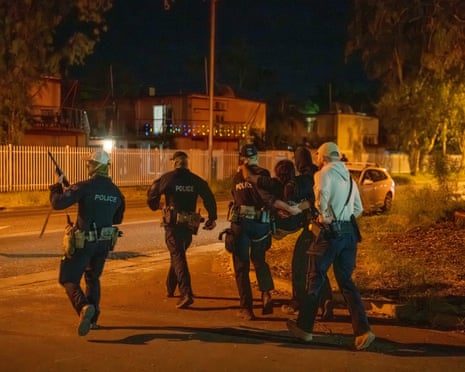
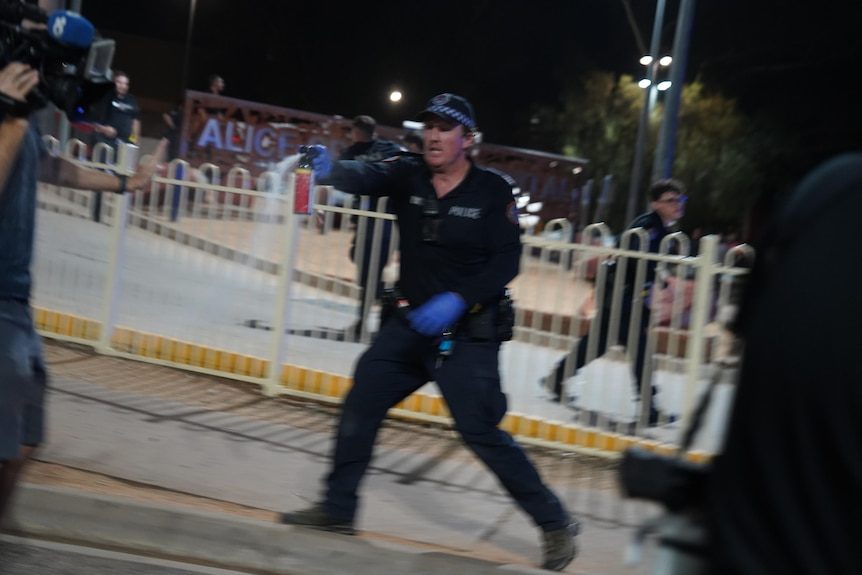
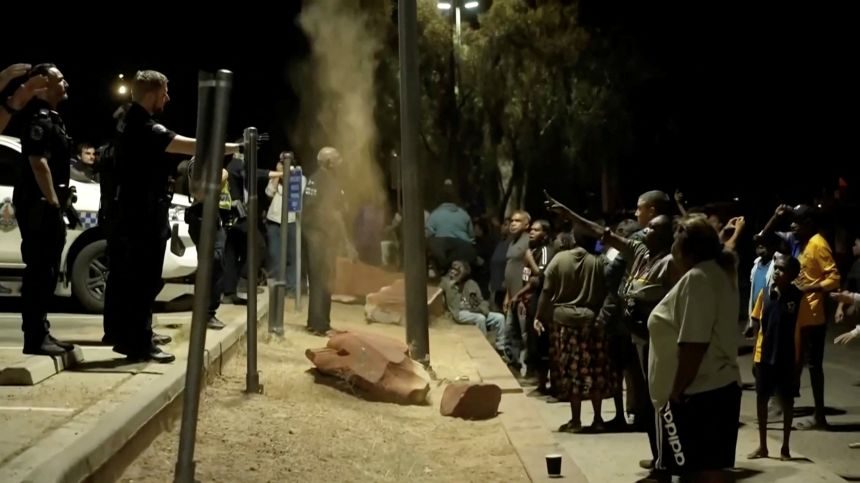
A five-year-old Warlpiri girl who could communicate only by hand gestures disappeared from a town camp on the edge of Alice Springs late on a Saturday night. A search party of roughly 300 volunteers found her body in the bush five days later. By that evening, around 400 of her relatives and neighbours had surrounded the hospital where the suspect was being treated, demanding he be handed over for traditional payback. Police drove the crowd back with tear gas; four of the town's five ambulances were disabled before dawn.

Why it matters

Australia's outback policing model strains when Indigenous communities reject the formal courts—each case forces a choice between state law and customary justice.

Key Indicators

400
Protesters at hospital
Crowd surrounded Alice Springs Hospital demanding the suspect be handed over for traditional payback.
$200K
Damage in one night
Police cars, ambulances and a fire truck burned or wrecked during the unrest.
5 days
Length of search
Volunteers covered roughly 5 km² on foot and 80 km² by vehicle and air before the body was found.
94%
NT youth detention that is Aboriginal
Aboriginal children make up 42% of the Northern Territory's child population but 94% of those locked up.

Interactive

Exploring all sides of a story is often best achieved with Play.

Ever wondered what historical figures would say about today's headlines?

Sign up to generate historical perspectives on this story.

Sign Up

Debate Arena

Two rounds, two personas, one winner. You set the crossfire.

People Involved

Organizations Involved

Timeline

  1. First court appearance scheduled

    Legal

    Lewis is due to appear at Darwin Local Court, around 1,500 km from Alice Springs.

  2. Charges announced publicly

    Legal

    Northern Territory Police publicly named Lewis and confirmed the murder charge. Court appearance set for Tuesday in Darwin Local Court.

  3. Lewis charged with murder

    Legal

    Police laid a murder charge plus two further offences whose details cannot be publicly reported.

  4. Suspect flown to Darwin; alcohol ban imposed

    Government Response

    Lewis was transferred to Royal Darwin Hospital under guard. Chief Minister Lia Finocchiaro ordered a day-long takeaway alcohol ban and dispatched extra police to Alice Springs.

  5. Body found in bushland

    Investigation

    A search party of around 300 volunteers found the girl's body in dense bush after covering roughly 80 km² by vehicle and air.

  6. Suspect found and beaten by residents

    Arrest

    Lewis was located at Charles Creek town camp on the outskirts of Alice Springs, beaten unconscious by residents, and taken to Alice Springs Hospital.

  7. Crowd storms Alice Springs Hospital

    Unrest

    Around 400 people surrounded the hospital demanding the suspect be handed over for traditional payback. Police used tear gas; ambulances, patrol cars and a fire truck were damaged.

  8. Reported missing; warrant issued

    Investigation

    Family reported the girl missing. Police later found a shirt, child's underwear and a bedcover in the Todd River bed and issued an arrest warrant for Jefferson Lewis.

  9. Girl last seen at family home

    Disappearance

    Kumanjayi Little Baby was last seen at the Ilyperenye Old Timers town camp on the edge of Alice Springs.

Scenarios

1

Lewis convicted and given life sentence in NT

Discussed by: ABC News legal analysts; Northern Territory legal commentators

Forensic evidence collected from the Todd River, the body, and the camp where Lewis was found points toward an evidence-heavy prosecution. Northern Territory murder convictions carry mandatory life sentences. Most observers expect a guilty verdict within 12-18 months and a life term, with the trial almost certainly held in Darwin to avoid further unrest in Alice Springs.

2

Federal government tightens alcohol and youth-detention rules

Discussed by: The Guardian Australia; Sydney Morning Herald political reporters

The Albanese government has limited room to act after the failed Voice referendum, but Alice Springs has repeatedly drawn federal intervention since 2007. The most likely federal response is funding tied to renewed alcohol restrictions, expanded youth detention capacity, and remote-community policing — measures the NT government will welcome but Indigenous legal services will challenge in court.

3

Verdict triggers a fresh round of unrest

Discussed by: Central Land Council figures; Warlpiri elders quoted in NITV coverage

If Lewis pleads not guilty or evidence is excluded on procedural grounds, the gap between the Warlpiri expectation of swift punishment and the Australian system's rules of admissibility could ignite a second confrontation. The 2022 acquittal of Constable Zachary Rolfe in the Walker case showed how fast a courtroom outcome can travel back to a remote community.

4

Coronial or judicial inquiry expanded into broader NT review

Discussed by: Human Rights Law Centre; National Aboriginal and Torres Strait Islander Legal Services

Pressure is building for an inquiry that goes beyond the Lewis prosecution to examine why a man with four prior assault sentences was released into a town camp with limited supervision, and how emergency services should respond when a hospital becomes a flashpoint. A standalone coronial inquest is near-certain; a wider judicial review is less so.

Historical Context

Killing of Kumanjayi Walker (2019)

November 2019 – July 2025

What Happened

Constable Zachary Rolfe shot 19-year-old Warlpiri man Kumanjayi Walker three times during an attempted arrest in Yuendumu, 290 km north-west of Alice Springs. Walker had stabbed Rolfe in the shoulder with a pair of scissors. Rolfe was charged with murder three days later — the first NT officer charged with murder for an on-duty death in modern memory.

Outcome

Short Term

A Darwin jury acquitted Rolfe of murder, manslaughter and engaging in violent conduct in March 2022 after seven hours of deliberation. Rolfe was dismissed from the force in 2023 over separate disciplinary breaches.

Long Term

A coronial inquest concluded in July 2025 that Rolfe was racist and that NT Police suffered from "structural and entrenched racism." Yuendumu and other Warlpiri communities maintain the case was never resolved on their terms.

Why It's Relevant Today

The Walker case set the template for the current confrontation: a Warlpiri death, a state legal process that ran for six years, and a community whose sense of justice is still unsettled. Many of the Alice Springs hospital protesters were Walker's relatives or neighbours.

Northern Territory Emergency Response (2007)

June 2007 – 2017

What Happened

Prime Minister John Howard and Indigenous Affairs Minister Mal Brough deployed the Australian Defence Force and federal police into 73 remote NT Aboriginal communities after the "Little Children are Sacred" report described widespread child sexual abuse. The Racial Discrimination Act was suspended, alcohol bans imposed, welfare income quarantined, and prescribed-area signs erected at community entrances.

Outcome

Short Term

Communities were placed under federal control overnight. Reported child-protection notifications rose; alcohol-related hospital admissions in some communities fell. The intervention was widely condemned by Indigenous leaders as paternalistic and racially targeted.

Long Term

The measures were extended by Labor as the "Stronger Futures" laws and finally lapsed in 2022. Remote-community alcohol restrictions ended in 2022 — followed within months by the 2023 Alice Springs crime surge that brought the curfews of 2024.

Why It's Relevant Today

The 2007 intervention is the standing precedent for federal action triggered by violence against Indigenous children. Any federal response to the 2026 case will be measured against — and constrained by — its mixed legacy.

Alice Springs youth curfew (2024)

March – July 2024

What Happened

Then-Chief Minister Eva Lawler imposed a two-week curfew on under-18s in the Alice Springs central business district from 6 pm to 6 am, after an Indigenous teenager's death triggered street fights involving hundreds of people. The curfew was extended once and reimposed in July following further attacks.

Outcome

Short Term

Police recorded a short-term drop in property crime in the CBD. Indigenous legal services said the curfew disproportionately hit Aboriginal children whose families lived in town camps and could not safely keep them at home.

Long Term

Lawler's Labor government lost the August 2024 NT election to Lia Finocchiaro's CLP, which promised tougher policing, lowered the age of criminal responsibility to ten, and abolished the territory's treaty department.

Why It's Relevant Today

The 2024 curfew showed that a single incident in Alice Springs can flip the territory's politics. Finocchiaro now governs in the shadow of that lesson and is responding accordingly.

Sources

(11)