
Pull to refresh
Logo
Daily Brief
Following
Why Ranks Sign Up
Drug Farm advances first potential therapy for rare ROSAH syndrome

Drug Farm advances first potential therapy for rare ROSAH syndrome

New Capabilities

A $55 million round pushes an oral ALPK1 inhibitor toward a late-stage trial for a genetic disease with no approved treatment

Yesterday: Drug Farm raises $55 million

Overview

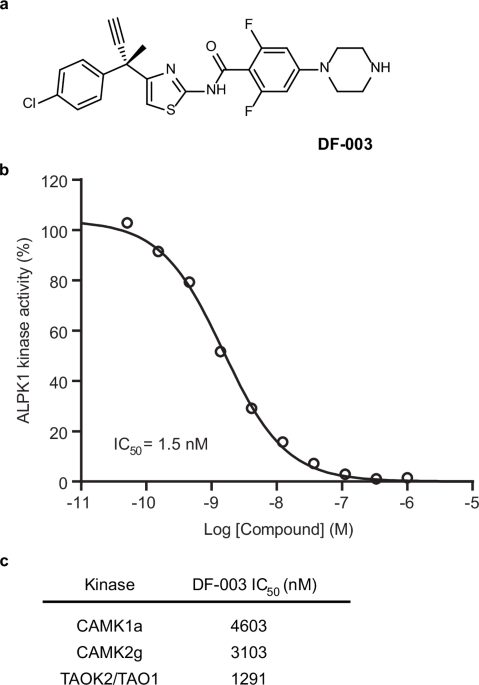
A few dozen families worldwide carry a gene mutation that slowly steals their sight and floods their bodies with inflammation. There is no approved drug that treats the cause. On July 13, 2026, Drug Farm said it raised $55 million to move its candidate for that disease, ROSAH syndrome, toward a Phase 3 trial.

The drug, DF-003, blocks a protein called ALPK1 that the mutation leaves stuck in the on position. In a small early trial, all six treated patients improved on at least one measure, from vision to headaches. If a larger trial confirms that, ROSAH patients would have their first real treatment.

Why it matters

The first drug aimed at the cause of ROSAH syndrome is one trial away from possible approval, offering treatment where none exists today.

Questions about this story

No questions yet — be the first to ask.

Key Indicators

$55M
Series D raised
Funds a late-stage trial for DF-003 and a second immune-modulating drug.
6 of 6
Patients improved in Phase 1b
Every treated patient improved on at least one clinical measure.
0
Approved ROSAH therapies
No drug currently treats the underlying disease.
Phase 3
Next trial stage
DF-003 is moving from early testing toward a pivotal study.

Voices

Curated perspectives — historical figures and your fellow readers.

Ever wondered what historical figures would say about today's headlines?

Sign up to generate historical perspectives on this story.

Play

Exploring all sides of a story is often best achieved with Play.

Log in to play. Track your picks, climb the leaderboards. Log in Sign Up
Predict 3 ways this could play out. Contrarian picks score more — points lock when the scenario resolves. Log in to play
Higher or Lower Two numbers from this story. Guess which is bigger. 5 rounds to set a streak. Log in to play
Connections Sixteen names from the news. Find the four hidden groups of four. Log in to play

People Involved

Organizations Involved

Timeline

May 2024 July 2026

5 events Latest: Yesterday
Tap a bar to jump to that date
  1. Drug Farm raises $55 million

    Latest Funding

    A Series D round funds the DF-003 Phase 3 trial and a second drug, DF-006, for hepatitis B and liver cancer.

  2. Early data shows patients improving

    Clinical

    At the ARVO 2026 meeting, Drug Farm reports all six treated patients improved on at least one measure, with no serious side effects.

  3. DF-003 wins orphan drug designation

    Regulatory

    The FDA grants DF-003 orphan status, adding development incentives for the rare disease.

  4. FDA opens flexible evidence path

    Regulatory

    The FDA accepts DF-003 into its Rare Disease Evidence Principles process, which tailors data requirements to very small patient groups.

  5. Phase 1b trial opens for ROSAH patients

    Clinical

    Drug Farm begins testing oral DF-003 in people with ROSAH syndrome after FDA clearance.

Historical Context

3 moments from history that rhyme with this story — and how they unfolded.

March 2007

Soliris approved for PNH (2007)

The FDA approved Alexion's Soliris for paroxysmal nocturnal hemoglobinuria, a blood disorder affecting a few thousand US patients. It was the first drug to treat the disease. Alexion priced it near $400,000 a year.

Then

Patients gained a treatment that cut life-threatening blood clots and transfusion needs.

Now

The drug became a multibillion-dollar franchise and set a template for building a business around one ultra-rare disease.

Why this matters now

It shows how a first-in-class drug for a tiny population can reach patients and pay off, the path Drug Farm is now attempting for ROSAH.

January 2012

Kalydeco approved for cystic fibrosis (2012)

The FDA approved Vertex's Kalydeco, the first drug to treat the root genetic cause of cystic fibrosis rather than its symptoms. It worked for a small subset of patients with a specific mutation, roughly 4% of cases.

Then

Patients with the target mutation saw major gains in lung function.

Now

It proved that fixing a specific broken protein could transform a genetic disease, opening a wave of precision therapies.

Why this matters now

DF-003 also targets a single disease-causing mutation, aiming to correct the mechanism instead of managing symptoms.

December 2017

Luxturna approved for inherited blindness (2017)

The FDA approved Spark Therapeutics' Luxturna, the first gene therapy for an inherited retinal disease. It treated patients losing vision from mutations in the RPE65 gene, a group numbering in the low thousands.

Then

Treated patients regained meaningful vision, some navigating in dim light for the first time.

Now

It established that regulators would approve therapies for rare, vision-threatening genetic disorders on small trials.

Why this matters now

ROSAH also threatens sight through a genetic defect, and DF-003 is being judged, like Luxturna, on data from very few patients.

Sources

(6)