



Pull to refresh
Logo
Bumble agrees to $1.3 billion take-private deal with Ithaca Holdings

Bumble agrees to $1.3 billion take-private deal with Ithaca Holdings

Money Moves

Dating app sells for a fraction of its 2021 IPO valuation as paying users keep leaving

Today: Deal announced publicly

Overview

Updated 40 minutes ago

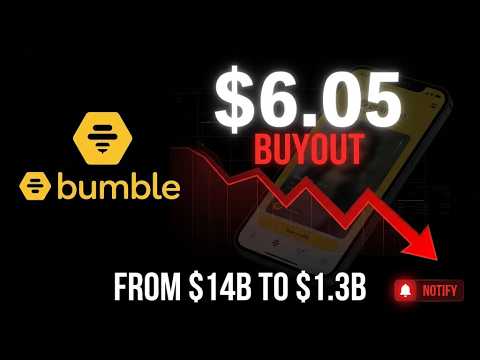
Bumble went public in February 2021 at a valuation near $14 billion. Five and a half years later, the dating app operator has agreed to sell itself to Ithaca Holdings for $1.3 billion — roughly 90% below its IPO value.

The all-cash deal pays Bumble shareholders $6.05 per share of Class A stock, a 138% premium to the closing price on October 9. It caps a long slide: paying users fell 16.4% to 3.2 million in the second quarter of 2026, and revenue has dropped for nearly two years straight. Going private gives the company room to experiment with AI features and offline dating — and builds a test case for the entire swipe-based dating industry.

Why it matters

Bumble's fall from $14 billion to $1.3 billion signals a generation is walking away from swipe-based dating apps — and the way people meet is changing.

Questions about this story

Free account needed to ask — your question is kept and asked for you right after sign-up. Answers are public.

No questions yet — be the first to ask.

Key Indicators

$1.3B
Acquisition price
Ithaca Holdings pays $6.05 per share of Class A common stock in cash.
~$14B
2021 IPO valuation
Bumble's market value at its initial public offering in February 2021.
3.2M
Paying users, Q2 2026
Down 16.4% from a year earlier; quarterly revenue fell 15.2% to $211 million.
138%
Premium to unaffected close
The $6.05 offer tops Bumble's October 9, 2026 closing price by 138%.

Voices

Curated perspectives — historical figures and your fellow readers.

Ever wondered what historical figures would say about today's headlines?

Sign up to generate historical perspectives on this story.

People Involved

Organizations Involved

Timeline

2014 October 2026

7 events Latest: Today
Tap a bar to jump to that date
  1. Deal announced publicly

    Today Announcement

    Bumble and Ithaca Holdings announce the $1.3 billion all-cash acquisition; shares jump 57% premarket.

  2. Merger agreement signed

    Deal

    Bumble's board signs an agreement with Ithaca Holdings at $6.05 per share.

  3. Reuters reports Bumble exploring a sale

    Report

    News that Bumble is weighing strategic options pushes the stock up.

  4. Wolfe Herd returns as CEO

    Leadership change

    The founder comes back to run a turnaround focused on AI and group dating.

  5. Wolfe Herd steps down as CEO

    Leadership change

    The founder leaves the chief executive role after four years leading the public company.

  6. Bumble goes public at ~$14 billion

    IPO

    Bumble lists on Nasdaq at a valuation near $14 billion during the dating app boom.

  7. Bumble founded

    Founding

    Whitney Wolfe Herd launches Bumble in Austin, Texas, with women making the first move.

Scenarios

1

Bumble closes $1.3 billion sale to Ithaca Holdings

Likely Resolves by Jul 12, 2027

Discussed by: Bloomberg, TechCrunch, and BBC report the deal as likely to close

The merger agreement carries no financing condition, and the principal stockholders already delivered written consent approving the deal. The remaining hurdles are regulatory — chiefly the Hart-Scott-Rodino antitrust waiting period — plus the mailing of an information statement to shareholders. Given the deal's structure, a clean close is the expected path.

2

Competing offer tops Ithaca's $6.05 per share bid

Unlikely Resolves by End of 2026

Discussed by: DealStreetAsia notes the jump in Bumble's stock and the 90% discount to IPO value

Bumble's board ran a strategic alternatives review through a special committee. A rival could see the low absolute valuation as an opening and offer more than $6.05 per share. Bumble would owe a $29 million termination fee in certain circumstances if it walked away, which a higher bidder could cover. No such bid has surfaced, and the low premium to recent trading suggests limited auction dynamics.

3

Regulatory block or failed close kills the deal

Unlikely Resolves by Jul 12, 2027

Discussed by: No public analyst predicts this; the agreement's no-financing-condition structure reduces the risk

The main regulatory hurdle is the Hart-Scott-Rodino antitrust review. A dating app acquisition at this scale is unlikely to raise competition concerns. Ithaca faces a $102 million parent termination fee if it fails to close when required, a strong disincentive to walk. This path would require an unforeseen regulatory or legal obstacle.

Historical Context

2 moments from history that rhyme with this story — and how they unfolded.

February 2013

Dell goes private (2013)

Michael Dell and Silver Lake bought Dell for about $25 billion, or $13.75 per share — a fraction of the company's peak market value near $150 billion in the dot-com era. Dell had struggled to pivot from PCs as the market shifted.

Then

Dell closed the buyout in October 2013 and restructured away from quarterly earnings pressure, using the private years to shift into enterprise software and services.

Now

Dell returned to public markets in 2018. The take-private is seen as a successful example of fixing a business away from Wall Street's scrutiny.

Why this matters now

Like Bumble, Dell sold at a deep discount to its peak value to buy time for a strategic pivot, betting that public-market pressure was making the turnaround harder, not easier.

June 2017 to January 2024

Blue Apron's collapse and fire sale (2017-2023)

Meal-kit company Blue Apron went public in June 2017 at a valuation around $2 billion. Subscriber losses mounted as competitors arrived and marketing costs soared, eroding its value over several years.

Then

Wonder Group acquired Blue Apron's assets for roughly $103 million in a deal announced in late 2023, about 95% below the IPO valuation.

Now

Blue Apron became a cautionary tale of a consumer subscription business that peaked at its IPO and never found a durable growth model.

Why this matters now

Blue Apron shows what happens to a consumer subscription company when its core offering loses appeal: the value falls toward the cost of the brand and customer base, not the growth story.

Sources

(9)