



Pull to refresh
Logo
Columbia Financial goes fully public and buys Northfield Bank

Columbia Financial goes fully public and buys Northfield Bank

Money Moves

A New Jersey lender raised $1.67 billion selling stock, then used part of it to acquire a 139-year-old rival

July 20th, 2026: Conversion and merger scheduled to close

Overview

Updated Jul 17

Columbia Financial sold about 167.2 million new shares at $10 each on July 17, raising roughly $1.67 billion. The sale ends its half-mutual, half-public ownership and turns it into an ordinary public company.

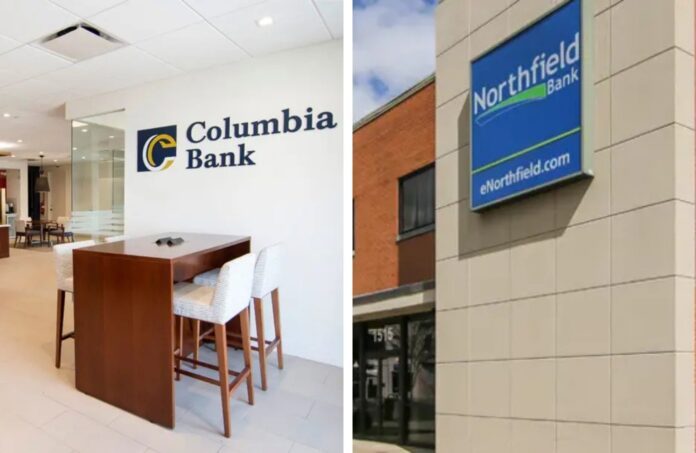
Part of that cash immediately pays for Northfield Bancorp, a $580 million deal that folds a 139-year-old Staten Island lender into Columbia. The combined bank will hold about $18 billion in assets, the third-largest based in New Jersey. Both deals close July 20.

Why it matters

Two familiar New Jersey and New York banks are becoming one, and the new owner is now answerable to public shareholders instead of a member-owned trust.

Questions about this story

Free account needed to ask — your question is kept and asked for you right after sign-up. Answers are public.

No questions yet — be the first to ask.

Key Indicators

$1.67B
Stock offering proceeds
Raised by selling about 167.2 million shares at $10 each.
$580M
Northfield purchase price
Final consideration for Northfield Bancorp, paid in stock and cash.
$18B
Combined assets
Pro forma total assets, third-largest of any bank based in New Jersey.
108
Branch offices
Columbia's 71 offices plus Northfield's 37 across New Jersey and New York.
2.20x
Share exchange ratio
Each existing minority share converts into 2.20 shares of the new company.

Voices

Curated perspectives — historical figures and your fellow readers.

Ever wondered what historical figures would say about today's headlines?

Sign up to generate historical perspectives on this story.

People Involved

Organizations Involved

Timeline

February 2026 July 2026

5 events Latest: July 20th, 2026 · 2 months ago
Tap a bar to jump to that date
  1. Conversion and merger scheduled to close

    Latest Closing

    The second-step conversion and the Northfield merger are set to complete. Columbia Bank's mutual holding company ceases to exist. Trading is expected to resume July 21 on Nasdaq as CLBK.

  2. Offering priced at $1.67 billion

    Financial

    Columbia reports selling about 167.2 million shares at $10 each. It sets final Northfield consideration at roughly $580 million and a July 20 closing.

  3. Northfield shareholders pick cash or stock

    Corporate

    Northfield holders face the deadline to elect $14.25 in cash or 1.425 Columbia shares per share. Unelected shares default to a 70% stock, 30% cash mix.

  4. Stock offering opens with approvals in hand

    Regulatory

    Columbia begins its second-step stock offering at $10 a share after receiving regulatory sign-off for both the conversion and the Northfield purchase.

  5. Columbia unveils conversion and Northfield deal

    Announcement

    Columbia announces it will fully convert to public ownership and, at the same time, buy Northfield Bancorp. The deal was valued near $597 million at signing.

Scenarios

1

Both deals close July 20, CLBK resumes trading July 21

Likely Resolves by Jul 27, 2026

Discussed by: Columbia Financial's July 17 press release; Keefe, Bruyette & Woods as lead underwriter

With regulatory approvals already granted, shareholder votes passed, and the offering fully priced, the conversion and Northfield merger complete on schedule. Columbia's mutual holding company dissolves and the fully public company begins trading on Nasdaq under CLBK the next morning. This is the base case the company itself has laid out.

2

CLBK trades below its $10 offering price at year-end

Possible Resolves by End of 2026

Discussed by: Common pattern in thrift second-step conversions tracked by bank analysts at Piper Sandler and KBW

Newly converted thrifts often carry more capital than they can quickly deploy, and their shares frequently drift below the $10 issue price in the months after conversion. If that pattern holds, Columbia closes 2026 under $10 despite the Northfield deal putting some capital to work. Buyers who took stock in the offering would be underwater on paper.

3

Columbia announces another bank acquisition within 18 months

Possible Resolves by Jan 20, 2028

Discussed by: Banking Dive and NJBIZ coverage of New Jersey bank consolidation

The conversion leaves Columbia with excess capital, the classic fuel for a buyer. Newly converted thrifts have historically used their war chests to roll up smaller lenders. If Columbia follows that path, it announces a further acquisition of a bank or branch network in New Jersey or New York before the end of 2027.

Historical Context

2 moments from history that rhyme with this story — and how they unfolded.

May 2014

Investors Bancorp second-step conversion (2014)

Investors Bancorp, a Short Hills, New Jersey thrift, completed the largest-ever second-step conversion, raising about $2.2 billion by selling stock to the public. Like Columbia, it shed a mutual holding company structure to become fully public.

Then

The shares traded near the offering price at first, and the bank sat on a large capital cushion.

Now

Investors used the capital to keep growing and buying, then agreed to sell itself to Citizens Financial Group in a deal that closed in 2022.

Why this matters now

It is the closest recent template for what Columbia is doing: a New Jersey thrift raising a giant sum through the same conversion mechanism, then deploying it on deals.

May 2015

Kearny Financial second-step conversion (2015)

Kearny Financial, another New Jersey thrift, converted to full public ownership and raised roughly $1.2 billion in its second-step offering. Its stock opened to public trading with a heavy capital base.

Then

Kearny's shares spent stretches below the $10 offering price as investors questioned how fast it could put the money to work.

Now

The bank used buybacks and dividends to return capital and made acquisitions to build scale over the following years.

Why this matters now

It shows the risk in Columbia's plan: converted thrifts often trade below their issue price until they prove they can use the cash productively.

Sources

(4)