

Pull to refresh
Logo
Drug combo leaves tumors undetectable in one in 12 advanced pancreatic cancer patients

Drug combo leaves tumors undetectable in one in 12 advanced pancreatic cancer patients

New Capabilities

In a 61-patient early trial, daraxonrasib plus chemotherapy shrank tumors in 60.7%. A Phase 3 study will test whether it extends survival.

Overview

Updated 1 hour ago

Five of 61 people with newly diagnosed metastatic pancreatic cancer had no detectable tumor on scans after taking a daily pill, daraxonrasib, alongside standard chemotherapy. That is one in 12, in a cancer where past trials of chemotherapy alone kept median survival under a year.

The findings come from a single-arm Phase 1/2 study with no comparison group, so they cannot show the pill beats chemotherapy by itself. Tumors shrank in 60.7% of patients and stopped growing in 90.2%. Median progression-free survival was 12.8 months, and 76.6% of patients were alive at one year.

Why it matters

If Phase 3 confirms it, newly diagnosed patients would get a first-line option that shrinks tumors in 61%, against 23% to 42% for chemotherapy alone.

Questions about this story

Free account needed to ask — your question is kept and asked for you right after sign-up. Answers are public.

No questions yet — be the first to ask.

Key Indicators

60.7%
Confirmed objective response rate
Share of 61 first-line patients whose tumors shrank on daraxonrasib plus chemotherapy.
8.2%
Complete response rate
Patients with no detectable tumor on scans, or five of 61.
90.2%
Disease control rate
Tumors that shrank or stopped growing.
12.8 months
Median progression-free survival
Time before tumors resumed growing, in the 61-patient cohort.
76.6%
Alive at 12 months
Overall survival at one year, with median follow-up of 18.3 months.
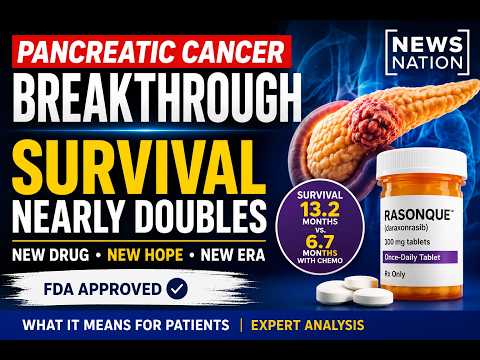
13.2 months
Median survival, daraxonrasib alone
In previously treated patients in the RASolute 302 trial, against 6.7 months on chemotherapy.

Voices

Curated perspectives — historical figures and your fellow readers.

Sign up to generate historical perspectives on this story.

People Involved

Organizations Involved

Timeline

April 2026 November 2026

4 events Latest: 2 days ago
Tap a bar to jump to that date
  1. One in 12 patients had no detectable tumor

    Latest Results

    Reported results show tumors vanished on scans for a subset of patients; investigators say durability and survival remain unproven.

  2. Updated results released ahead of Barcelona symposium

    Results

    Company reports 60.7% response rate and 8.2% complete responses across 61 first-line patients.

  3. FDA approves daraxonrasib as a standalone pill

    Regulatory

    Approval covers previously treated metastatic pancreatic cancer; median survival was 13.2 months versus 6.7 on chemotherapy.

  4. First daraxonrasib-plus-chemotherapy data shown

    Results

    Revolution Medicines presents early Phase 1/2 findings at the American Association for Cancer Research annual meeting.

Scenarios

1

Phase 3 confirms the survival benefit and the combination wins first-line approval

Possible Resolves by Q2 2030

Discussed by: Revolution Medicines and trial investigators, who designed RASolute 303 to answer this question

RASolute 303 compares daraxonrasib alone and daraxonrasib plus gemcitabine and nab-paclitaxel against chemotherapy alone in treatment-naive metastatic patients. If the combination arm lives meaningfully longer, the company would file for first-line approval and the regimen would move into routine use. The FDA's Breakthrough Therapy Designation for this setting makes a faster review plausible.

2

Phase 3 finds no overall survival benefit and the combination stays experimental

Possible Resolves by Q2 2030

Discussed by: Oncologists quoted in coverage of the early trial, who noted that response rates do not always translate into longer life

The Phase 1/2 study had no control group, and its patients were healthier and more closely monitored than a typical clinic population. If RASolute 303 shows the combination does not beat chemotherapy on overall survival, the high response rate becomes a cautionary data point and daraxonrasib remains a second-line monotherapy only.

3

Long-term follow-up puts median survival for the 61 patients above two years

Uncertain Resolves by End of 2028

Discussed by: Trial investigators, who say longer follow-up is needed to know how long responses last

With 76.6% of patients alive at one year, the cohort's median overall survival could land well above the 8.5 to 11.1 months seen with chemotherapy in past studies. A later publication reporting a median above 24 months would suggest the benefit lasts, not just that tumors shrink early.

Historical Context

3 moments from history that rhyme with this story — and how they unfolded.

2021

KRAS targeted for the first time (2021)

For four decades, mutations in RAS genes were considered undruggable: the proteins are smooth and lack the pockets most drugs need. Sotorasib changed that in 2021 when it won FDA approval for lung cancer driven by one specific mutation, KRAS G12C.

Then

The drug shrank tumors in a minority of heavily pretreated lung cancer patients, and responses lasted months rather than years.

Now

It opened a drug class. Later compounds target other RAS variants and, like daraxonrasib, are designed to work without requiring one particular mutation.

Why this matters now

Daraxonrasib belongs to that second generation. Its broad RAS reach is what makes it testable in pancreatic cancer, where most tumors are driven by RAS mutations but not the G12C variant.

2011-2013

Two chemotherapy regimens set the current standard (2011 and 2013)

Two combination chemotherapy regimens became standard first-line treatment for metastatic pancreatic cancer in the early 2010s. In the trials cited as historical comparison, they extended median survival to between 8.5 and 11.1 months and shrank tumors in 23% to 42% of patients.

Then

Median survival roughly doubled from the older single-drug standard, but most patients still died within a year.

Now

Those regimens remained the backbone of first-line treatment into 2026, with no targeted drug approved alongside them.

Why this matters now

The new trial adds daraxonrasib to one of those regimens. Its 60.7% response rate is measured against a 23% to 42% range from different trials with different patients, not a direct comparison.

2001

Imatinib turns chronic myeloid leukemia into a manageable condition (2001)

Imatinib was approved in 2001 for chronic myeloid leukemia after targeting the specific protein driving the disease. It was among the first drugs to prove that shutting off one molecular switch could control a cancer.

Then

Most patients in the chronic phase of the disease went into remission, and the drug became the standard of care within a few years.

Now

It established the template for targeted cancer therapy: identify the driver, block it, and convert a fatal disease into a long-term condition for many patients.

Why this matters now

Pancreatic cancer has resisted that template for 25 years. Daraxonrasib is the first RAS-targeting drug approved for it, and the question now is whether blocking the driver produces the kind of durable control imatinib did.

Sources

(7)