


Pull to refresh
Logo
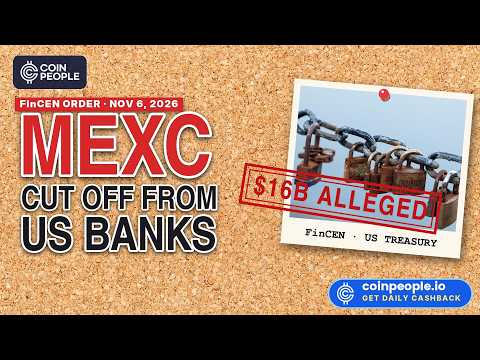
FinCEN cuts MEXC off from U.S. dollar rails

FinCEN cuts MEXC off from U.S. dollar rails

Rule Changes

The order bars U.S. financial institutions from processing transfers with the Seychelles-based crypto exchange, citing $16 billion in illicit-linked transactions.

Overview

Updated 45 minutes ago

The Financial Crimes Enforcement Network ordered U.S. financial institutions on November 6 to stop sending or receiving funds to MEXC Global, a Seychelles-based crypto exchange. FinCEN says the platform moved at least $16 billion tied to sanctions evasion and cybercrime between May 2021 and May 2026.

The order does not shut MEXC down. It cuts the exchange off from the dollar plumbing that most crypto trading ultimately settles through. It is the largest crypto exchange targeted under this authority.

Why it matters

One of the 20 largest crypto exchanges would lose U.S. dollar access, forcing users and trading partners to reroute funds.

Questions about this story

Free account needed to ask — your question is kept and asked for you right after sign-up. Answers are public.

No questions yet — be the first to ask.

Key Indicators

$16.7B
Illicit-linked transaction volume
FinCEN's finding covering May 2021 to May 2026.
$1.5B
Russian sanctions-evasion volume
Transactions FinCEN ties to Russian illicit finance.
$232M
Direct dealings with sanctioned entities
Transfers with U.S.-, EU- and UK-sanctioned parties.
$1B
Transactions with Iranian exchangers
Direct transfers with more than 40 identified Iranian crypto exchangers.
30 days
Delay before the order takes effect
Counted from publication in the Federal Register, which had not happened as of the order's release.
$5B
MEXC reserves, September 2026
Treasury's estimate of the exchange's held assets.

Voices

Curated perspectives — historical figures and your fellow readers.

Sign up to generate historical perspectives on this story.

People Involved

Organizations Involved

Timeline

2018 November 2026

11 events Latest: Today Showing 8 of 11
Tap a bar to jump to that date
  1. Federal Register publication still pending

    Today Status

    The order is not yet in force; the 30-day clock has not started.

  2. MEXC says assets secure, starts review

    Statement

    The exchange says it is operating normally and reviewing the order with lawyers.

  3. OKX freezes MEXC-linked deposits

    Consequence

    A rival exchange applies sanctions-style caution before the order takes effect.

  4. Operation Economic Outcast launched

    Policy

    Treasury begins a campaign to cut Iran off from global finance.

  5. MEXC still processing Garantex transactions

    Finding

    Treasury says MEXC was transacting with Garantex and successor Grinex four years after designation.

  6. OFAC designates Russian exchange Garantex

    Sanctions

    The Treasury sanctions office adds Garantex to its list of sanctioned entities.

  7. MEXC Global founded

    Background

    The exchange begins operating and grows into one of the 20 largest crypto platforms.

Scenarios

1

Order takes effect and MEXC loses dollar access

Likely Resolves by Feb 15, 2027

Discussed by: FinCEN's order and CoinDesk reporting

The order becomes operative 30 days after it appears in the Federal Register. Once in force, U.S. banks, payment processors and crypto intermediaries must block transfers to and from MEXC and its named affiliates in Seychelles, Estonia, Switzerland and the United Kingdom.

2

MEXC negotiates a narrower order

Unlikely Resolves by Aug 31, 2027

Discussed by: MEXC's statement and compliance-review plans

MEXC has said it will engage with FinCEN and has started an independent review of its anti-money-laundering and sanctions controls. If those fixes satisfy the bureau, FinCEN could issue a superseding order that narrows the prohibition or lifts it.

3

More exchanges cut MEXC off

Possible Resolves by Feb 28, 2027

Discussed by: OKX's precautionary deposit freeze

OKX froze MEXC-linked deposits a day after the order, before the prohibition even took effect. Other large exchanges could follow the same logic, treating a FinCEN special measure like a sanctions flag and isolating MEXC from shared liquidity pools.

Historical Context

3 moments from history that rhyme with this story — and how they unfolded.

January 2023

Bitzlato special measure (2023)

FinCEN invoked Section 9714 for the first time against Bitzlato, a small crypto exchange it accused of moving Russian illicit finance. U.S. authorities arrested the platform's founder the same week.

Then

Bitzlato's operations were disrupted and its founder faced U.S. charges.

Now

The action established the template FinCEN now applies to a far larger target.

Why this matters now

The same statutory tool used against a minor exchange is now aimed at a top-20 platform, which is why the scale of this order is different.

April 2022

Garantex designation (2022)

The Treasury's Office of Foreign Assets Control designated Garantex, a Russian crypto exchange, for facilitating sanctions evasion. Treasury says MEXC kept processing Garantex transactions until June 2026, more than four years after the designation.

Then

Garantex was cut off from U.S.-linked counterparties.

Now

The designation did not stop all exchanges from routing funds through it.

Why this matters now

It shows why FinCEN reached for a stricter tool: naming a sanctioned exchange did not stop MEXC from transacting with it.

May 2013

Liberty Reserve finding (2013)

FinCEN named Liberty Reserve, a Costa Rica-based digital currency service, a primary money laundering concern under Section 311 of the USA PATRIOT Act. U.S. authorities shut the service down and its founder was later sentenced to 20 years in prison.

Then

The service closed and its funds were frozen.

Now

The case set a precedent that a money-laundering finding can isolate a platform before any criminal case concludes.

Why this matters now

A different statute, same logic: a regulatory finding can sever an exchange from the regulated financial system on its own.

Sources

(6)