


Pull to refresh
Logo
Google releases MedGemma, open medical vision-language models

Google releases MedGemma, open medical vision-language models

New Capabilities

Open models match or beat closed rivals on medical benchmarks, enabling on-prem hospital AI

Today: Google publicly releases MedGemma

Overview

Updated 45 minutes ago

Google published MedGemma, an open family of medical AI models, in Nature Medicine this month. The largest model scored 86.2% on the MedQA medical question benchmark—the best result from any open model at release.

The release moves medical AI from closed APIs to self-hosted models. Hospitals that can't send patient data across an API boundary can now run capable models on their own servers.

Why it matters

Hospitals can run state-of-the-art medical AI on their own servers, keeping patient data in-house instead of sending it to a closed API.

Questions about this story

Free account needed to ask — your question is kept and asked for you right after sign-up. Answers are public.

No questions yet — be the first to ask.

Key Indicators

86.2%
MedQA score
Best open-model result at release on the MedQA medical question benchmark.
81%
Clinically equivalent or superior reports
Share of MedGemma 27B chest X-ray reports rated clinically equivalent or superior to originals in a 306-case evaluation.
4
Model variants
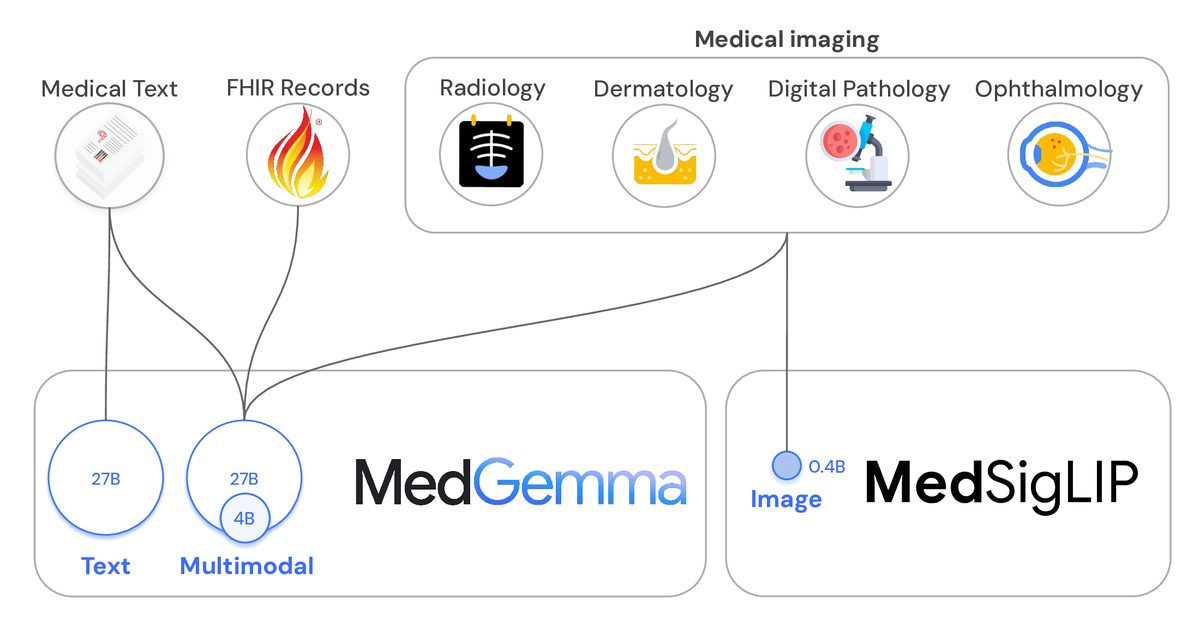
4B and 27B multimodal models, a 27B text model, and the MedSigLIP vision encoder.
400M
MedSigLIP parameters
Size of the medically tuned vision encoder derived from SigLIP.

Voices

Curated perspectives — historical figures and your fellow readers.

Ever wondered what historical figures would say about today's headlines?

Sign up to generate historical perspectives on this story.

Organizations Involved

Timeline

2 events Latest: Today
  1. Google publicly releases MedGemma

    Today Release

    Google announces the open model family: 4B and 27B multimodal variants, a 27B text model, and the MedSigLIP encoder.

  2. Nature Medicine publishes MedGemma paper

    Publication

    Peer-reviewed paper describes the model family, benchmark results, and the MedSigLIP vision encoder.

Scenarios

1

Hospitals deploy MedGemma on-premises for radiology

Likely Resolves by End of 2027

Discussed by: AI Weekly and healthcare technology analysts

Hospitals handling protected health information that can't cross API boundaries adopt MedGemma for chest X-ray and pathology workflows. The open weights allow on-prem deployment and fine-tuning on local data. The paper's 81% clinically equivalent or superior report rate gives radiology departments a concrete quality benchmark to justify adoption.

2

MedGemma-based tools enter FDA regulatory pathway

Possible Resolves by Q2 2028

Discussed by: Healthcare regulatory analysts

Companies build MedGemma-based diagnostic tools and submit them for FDA clearance. The open weights and published validation data could accelerate the regulatory process, since the model's performance is already documented in a peer-reviewed journal.

3

MedGemma becomes the base for a wave of fine-tuned medical models

Likely Resolves by Q2 2027

Discussed by: The Nature Medicine paper authors

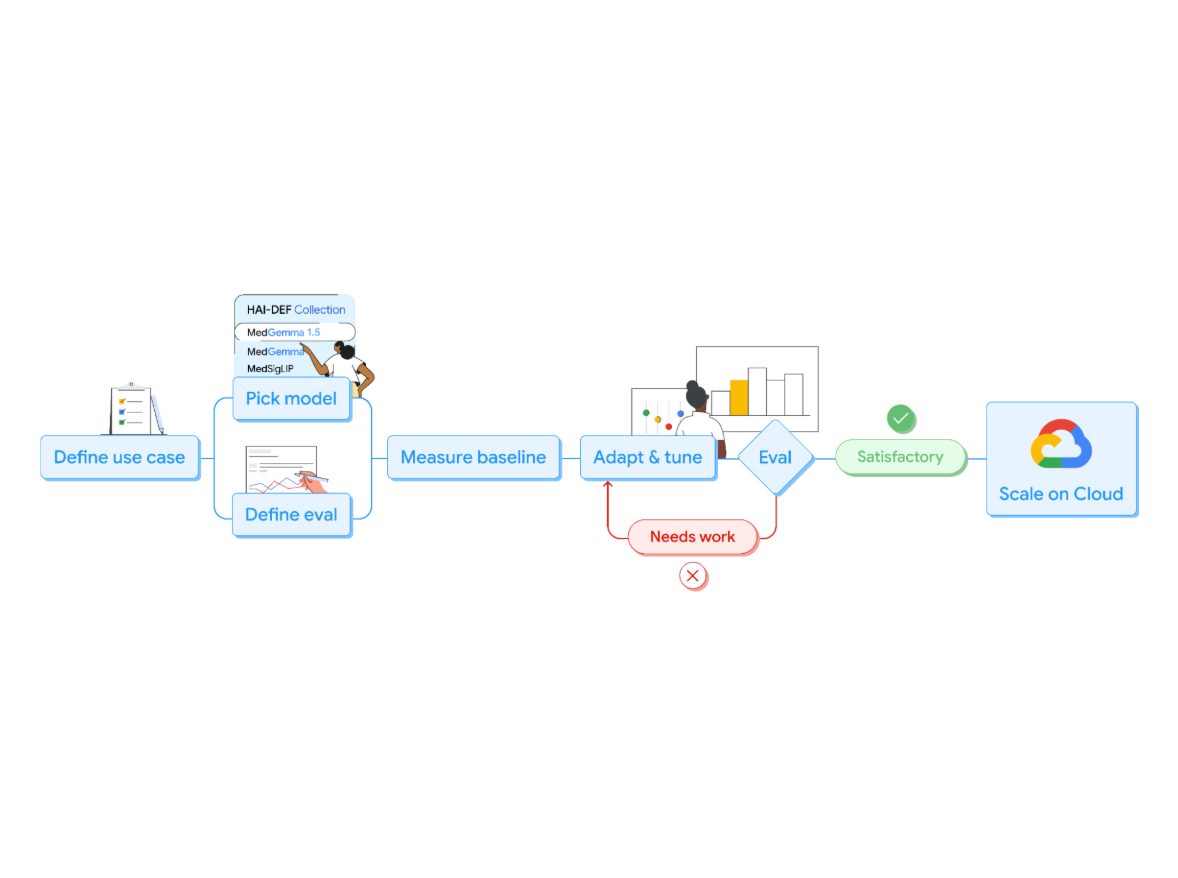
The paper's central claim is data efficiency: fine-tuning MedGemma beats fine-tuning base Gemma 3 for medical tasks, especially with limited training data. If that holds, MedGemma becomes the default starting point for specialized medical models, from pathology classifiers to EHR information retrieval systems.

Historical Context

2 moments from history that rhyme with this story — and how they unfolded.

May 2023

Med-PaLM 2 (2023)

Google unveiled Med-PaLM 2, a medical AI model that scored 86.5% on MedQA, but kept it behind a closed API for a limited test group of clinicians.

Then

Clinicians could test the model but not deploy it on their own infrastructure or fine-tune it on local data.

Now

Set the pattern of closed medical AI that MedGemma now breaks.

Why this matters now

MedGemma is Google's open answer to its own closed Med-PaLM 2, achieving a comparable MedQA score while being freely downloadable.

November 2023

LLaVA-Med (2023)

Researchers released LLaVA-Med, an early open vision-language model for medical imaging, built by fine-tuning the LLaVA model on biomedical image-text data.

Then

Demonstrated that open medical VLMs were feasible, though accuracy lagged far behind closed models.

Now

Established the open medical VLM research line that MedGemma extends with production-grade performance.

Why this matters now

Shows the progression from research prototype to production-grade open medical model in roughly three years.

Sources

(7)