
Pull to refresh
Logo
GVSU begins construction on Blue Dot Innovation Lab in Grand Rapids

GVSU begins construction on Blue Dot Innovation Lab in Grand Rapids

Built World Grand Rapids, MI local

The $166 million tech hub, set to open in 2029, will house the College of Computing and anchor the university's digital literacy push

Overview

Updated 1 hour ago

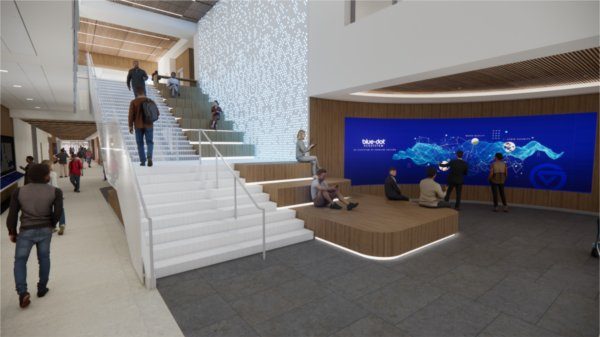
Grand Valley State University broke ground Oct. 27 on the Blue Dot Innovation Lab, a $166 million technology hub in downtown Grand Rapids. The roughly 224,000-square-foot building, expected to open in summer 2029, will house the university's new College of Computing.

The project is the physical centerpiece of GVSU's Blue Dot Ecosystem, a push to embed digital skills in every major and expand West Michigan's tech workforce. It also carries a $139 million bond, and some faculty question whether the cost and debt are justified.

Why it matters

GVSU's $166 million bet to triple West Michigan's tech workforce — the outcome shapes Grand Rapids' economy and the university's debt load.

Monday: what changed in Grand Rapids, MI

One short email a week with the openings, closings, permits and council votes we covered. Free. Unsubscribe in one click.

Questions about this story

Free account needed to ask — your question is kept and asked for you right after sign-up. Answers are public.

No questions yet — be the first to ask.

Key Indicators

$166M
Total project cost
Includes a $101.4 million Eberhard Center renovation and a $64.6 million addition.
224,000 sq ft
Building size
Approximate total square footage of the new building.
$139M
Bond debt
GVSU signed off on this bond to cover construction costs.
3X
Tech talent gap
The Right Place says Grand Rapids needs three times its current tech talent.

Voices

Curated perspectives — historical figures and your fellow readers.

Sign up to generate historical perspectives on this story.

People Involved

Organizations Involved

Timeline

September 2022 October 2026

7 events Latest: Today
Tap a bar to jump to that date
  1. Construction begins on Blue Dot Innovation Lab

    Today Milestone

    GVSU breaks ground on the downtown Grand Rapids tech hub, set to open in 2029.

  2. GVSU reveals Blue Dot cost estimates

    Financial

    University shares $101.4 million renovation and $64.6 million addition cost estimates.

  3. GVSU signs off on $139M bond

    Financial

    University approves a $139 million bond to fund the Blue Dot Lab construction.

  4. GVSU debuts AI, software engineering degrees

    Academic

    New undergraduate degrees in artificial intelligence and software engineering launch.

  5. GVSU announces Blue Dot Ecosystem

    Announcement

    GVSU formally introduces its Blue Dot Ecosystem for digital literacy and tech workforce development.

  6. GVSU creates College of Computing

    Institutional

    The university establishes a computing college to anchor its technology education push.

  7. The Right Place launches tech strategy

    Plan

    Economic group launches 10-year plan to make Grand Rapids a major tech hub.

Scenarios

1

Blue Dot Lab opens on schedule in summer 2029

Likely Resolves by Q3 2029

Discussed by: GVSU leaders, The Right Place, and economic development advocates

Construction proceeds through 2027 and 2028 without major delay. The College of Computing moves into the building in summer 2029, and the lab's classrooms, immersive cube and technology showcase open to students and the community. GVSU then works on the broader Blue Dot Ecosystem goal of expanding West Michigan's tech workforce.

2

Cost overruns or delays push opening past summer 2029

Possible Resolves by End of 2029

Discussed by: Faculty critics and higher education observers

Construction costs rise beyond the $166 million budget, or supply chain and labor issues slow the work. GVSU either announces a delay to the opening or takes on additional debt. The $139 million bond, which officials said would stay within the university's debt limits, grows.

3

Faculty pressure prompts formal scope or program changes

Uncertain Resolves by End of 2027

Discussed by: GVSU faculty and staff who signed letters questioning the project

Ongoing faculty concerns about transparency and the project's centrality lead to formal changes. GVSU's board or administration revises Blue Dot Lab plans or programming, such as increasing faculty governance over curricula or adjusting the building's scope. The university could also slow the project's role as the centerpiece of its identity.

Historical Context

2 moments from history that rhyme with this story — and how they unfolded.

1996-2010s

Van Andel Institute and the Medical Mile (1996 onward)

Jay and Betty Van Andel founded the Van Andel Institute, a biomedical research center, in downtown Grand Rapids in 1996. It sparked a wave of health-care investment that became known as the Medical Mile, with hospitals and research facilities clustering along the Grand River.

Then

The institute drew researchers and grant funding, and the surrounding district filled with health-care buildings.

Now

The Medical Mile helped transform Grand Rapids from a furniture-manufacturing town into a regional health-care and research hub.

Why this matters now

It is the same city's previous anchor-led transformation, showing how a single institution can reshape Grand Rapids' economy. Blue Dot's leaders are aiming to repeat that pattern with technology.

December 2011-2017

Cornell Tech on Roosevelt Island (2010-2017)

New York City held a competition in 2010 for a new applied sciences campus. Cornell University and Technion won in December 2011 with a $2 billion proposal to build on Roosevelt Island. The first academic building opened in 2017.

Then

Cornell Tech drew tech companies and students to a formerly underused island in the East River.

Now

It became a model for university-led tech districts, though its effect on New York City's tech economy is still debated.

Why this matters now

Like Blue Dot, Cornell Tech is a university-built tech hub meant to drive regional economic growth, with similar promises and open questions about whether it pays off.

Sources

(3)