



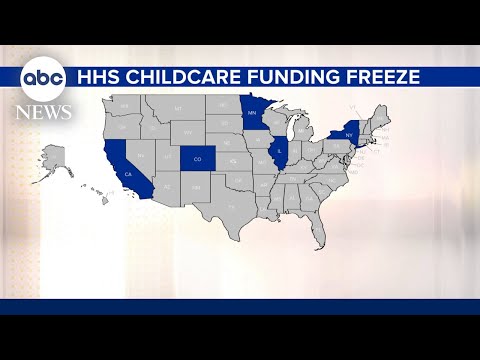

HHS drops $10 billion funding freeze against five Democratic-led states
Rule ChangesA six-month standoff over child care and family-aid money ends after repeated court losses
July 14th, 2026: HHS drops the freezeNew here? Follow stories to track developments over time. Create a free account to get updates when stories you care about change.
Overview
The Department of Health and Human Services ended its six-month freeze on $10 billion in child care and family-aid money for five states on July 14. The funds, meant for low-income families in California, Colorado, Illinois, Minnesota, and New York, are flowing again.
But the lawsuit isn't over. Government lawyers immediately told the judge the case was moot and asked for dismissal before the states could see internal records about who ordered the freeze. The states are fighting that, and they plan to add the White House budget office as a defendant and file an amended complaint.
Why it matters
About $10 billion for child care and cash aid in five states is flowing again, ending a fight that tested whether Washington can withhold money Congress already approved.
Questions about this story
No questions yet — be the first to ask.
Key Indicators
Voices
Curated perspectives — historical figures and your fellow readers.
Play
Exploring all sides of a story is often best achieved with Play.
WHO SAID WHAT?
Can you match the quotes to the right people?
- points for each correct match.
- time bonus when you answer in under seconds.
- streak bonus once you hit correct in a row.
— Who said this?
Tip: press 1– to answer.
points — sign up to put that on the leaderboard.
Higher or Lower
A number from this story, against one from elsewhere in the news — guess which is bigger, then keep the chain going. 5 rounds, 3 strikes; a miss costs a strike and resets your streak.
Keyboard: ↓/L lower · ↑/H higher
0 points — sign up to put that on the leaderboard.
Timeline
Order five events from this story, oldest at top. Each in the right slot scores 1 — neighbours within one slot count too. Your previous result — green ✓ for exact slots, yellow ~ for off by one. Cards now in true chronological order.
Sign up to save your score and track a streak across stories.
Connections
Sixteen names from the news. Find the four hidden groups of four. Four mistakes max.
Sign up to keep a daily streak — a new puzzle lands every day.
Exit debate?
Your progress in this debate will be lost.
- 1 Two AI personas square off on this story.
- 2 You predict who'll win each round — correct picks earn XP.
- 3 One crossfire question is yours to fire. Pick it carefully.
Couldn't generate a topic
Select Your Champions
Choose one persona for each side of the debate
DEBATE TOPIC
Choose personas with different perspectives for a more dynamic debate.
Select debater for this side:
No debate personas available right now.
Select debater for this side:
No debate personas available right now.
Who's Got This Round?
Make your prediction before the referee scores
The referee scores both sides on
Round Results
Set the Crossfire
Pick the question both personas must answer in the final round
Debate Oracle! You called every round!
Sharp Instincts! You know your debaters!
The Coin Flip Strategist! Perfectly balanced!
The Contrarian! Bold predictions!
Inverse Genius! Try betting the opposite next time!
XP Breakdown
Prediction History
People Involved
Organizations Involved
The federal agency that distributes child care, cash-aid, and social services money to the states.
The Manhattan federal court where the five states sued to unfreeze their funds.
Timeline
January 2026 July 2026
-
HHS drops the freeze
Latest ResolutionCourt filings show HHS withdrew its January letters, data demands, and the enforcement mechanism, restoring full access to the funds.
-
Government seeks dismissal; states fight to keep case alive
LegalAfter HHS filed its rescission letters, government lawyers told Judge Subramanian the case was moot and sought dismissal. The five states opposed, arguing HHS could reinstate the freeze if the suit were dropped, and said they plan to add the Office of Management and Budget as a defendant.
-
Court keeps the freeze on hold
LegalFurther orders extend the block, leaving HHS unable to enforce its restrictions through the spring.
-
Judge blocks the freeze
LegalJudge Arun Subramanian issues a 14-day restraining order, keeping the money flowing while the case proceeds.
-
Five states sue
LegalCalifornia, Colorado, Illinois, Minnesota, and New York sue in Manhattan, saying HHS lacked authority and targeted them politically.
-
Freeze goes public
Policy ActionHHS confirms it is withholding about $10 billion across TANF, child care, and social services grants, citing fraud concerns.
-
HHS sends the first freeze letters
Policy ActionThe department tells five Democratic-led states it will restrict their access to federal aic funds, demanding data first.
Historical Context
3 moments from history that rhyme with this story — and how they unfolded.
Trump administration's OMB funding-freeze memo (2025)
The White House budget office ordered a government-wide pause on federal grants and loans. The memo triggered immediate confusion at agencies and states over what money was still flowing. Courts stepped in within days.
A federal judge blocked the pause, and OMB rescinded the memo amid the backlash.
It set the template for later, narrower freezes and the legal fights that followed them.
The HHS freeze used the same tool, withholding approved money, and met the same fast judicial block.
Feeding Our Future fraud case (2022)
Federal prosecutors charged dozens of people in Minnesota with stealing more than $250 million from federally funded child-nutrition programs during the pandemic. It became one of the largest pandemic-aid fraud cases in the country.
Roughly 70 defendants were charged; many were later convicted.
The case became a go-to example for officials arguing that state-run aid programs invite fraud.
HHS pointed to this Minnesota case as its main concrete justification, then applied the freeze to four other states.
Nixon's impoundment fights (1973–1974)
President Nixon refused to spend money Congress had appropriated for programs he opposed. States and agencies sued, and courts repeatedly ordered the funds released. Congress then passed a law limiting the practice.
Courts forced the money out, ruling the president could not simply refuse to spend it.
The 1974 Impoundment Control Act set rules for when a president can withhold appropriated funds.
The core question is the same: how far the executive branch can go in withholding money Congress already approved.
