Anchor

Insilico Medicine releases AI models that beat dedicated drug-discovery software
New CapabilitiesLanguage-model specialists trained through MMAI Gym match or surpass established computational methods across 50+ benchmarks
2 days ago: Frontier specialist AI models releasedNew here? Follow stories to track developments over time. Create a free account to get updates when stories you care about change.
Overview
Updated 47 minutes agoInsilico Medicine released AI models Sept. 2 that it says outperform the dedicated software drug companies have used for years. The language-model specialists cover chemical synthesis, drug-safety prediction, and target-binding strength.
The Hong Kong-listed company reports state-of-the-art or better scores on more than 50 benchmark tasks, including 28 drug-safety endpoints covering absorption, distribution, metabolism, excretion, and toxicity. Insilico licenses its platform to 13 of the world's top 20 pharmaceutical firms, so the models face real-world testing quickly.
The open question is whether benchmark wins survive real drug programs. Insilico's lead drug, the AI-discovered rentosertib, is in Phase III trials for a lung disease. The company nominated nine development candidates in the first nine months of 2026.
Why it matters
If language-model AI reliably predicts drug safety and potency before lab work, early discovery gets faster and cheaper — and more candidates reach human trials sooner.
Questions about this story
Free account needed to ask — your question is kept and asked for you right after sign-up. Answers are public.
No questions yet — be the first to ask.
Key Indicators
50+
Benchmark tasks with state-of-the-art or better scores
Across chemistry and biology, verified on the company's DDD Bench framework.
13 of 20
Top pharmaceutical firms licensing Insilico's platform
Licensing gives the new models a fast path to commercial use.
9
Development candidates nominated in nine months of 2026
A company record for annual pipeline productivity, driven by the Pharma.AI platform.
$600M
Potential total value of Takeda collaboration
Includes initiation fees, near-term payments, milestones, and tiered royalties.
Related Media
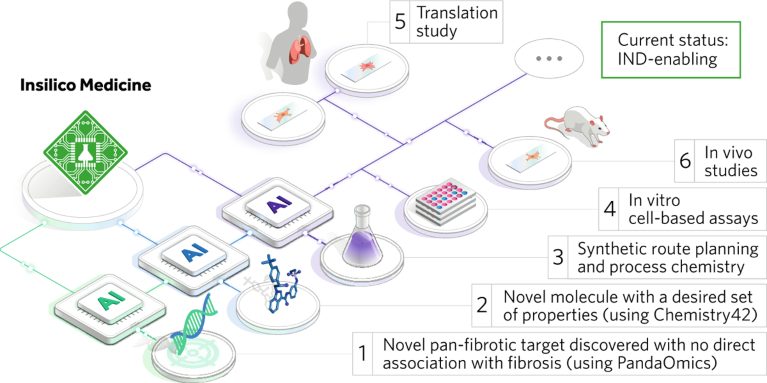
Insilico: linking target discovery and generative chemistry AI platforms for a drug discovery breakthrough | Biopharma Dealmakers
1.0K views
7:32
Insilico CEO explains how AI-powered drug discovery ...
CNBC International Live

700 views
2:29
Revolutionizing Drug Discovery with AI-Powered Innovation
Insilico Medicine
158 views
13:01
General AI Outperforms Specialized Clinical Tools in Medicine
Open Life Science AI
Images from Openverse under Creative Commons licenses. Videos from YouTube.
Voices
Curated perspectives — historical figures and your fellow readers.
Play
Exploring all sides of a story is often best achieved with Play.
Most of these play right now — no account needed. Sign up to save scores, keep a streak, and unlock Debate and Predict.
Log in
Sign Up
Higher or Lower
A number from this story, against one from elsewhere in the news — guess which is bigger, then keep the chain going. 5 rounds, 3 strikes; a miss costs a strike and resets your streak.
Example
Anchor
EU tariff revenue
$52B
Big for this kind of number
Mystery
Pentagon AI contract
?
Round 1
Streak: 0
Mystery
?
Keyboard: ↓/L lower · ↑/H higher
0 pts
Best streak: 0 · Rounds: 0
0 points — sign up to put that on the leaderboard.
Now try on this story
Connections
Sixteen names from the news. Find the four hidden groups of four. Four mistakes max.
Loading today's puzzle…
0/4 groups
Mistakes
Sign up to keep a daily streak — a new puzzle lands every day.
Now try on this story
Exit debate?
Your progress in this debate will be lost.
How it works
- 1 Two AI personas square off on this story.
- 2 You predict who'll win each round — correct picks earn XP.
- 3 One crossfire question is yours to fire. Pick it carefully.
Couldn't generate a topic
Select Your Champions
Choose one persona for each side of the debate
DEBATE TOPIC
Choose personas with different perspectives for a more dynamic debate.
SIDE A (PRO)
Select debater for this side:
No debate personas available right now.
SIDE B (CON)
Select debater for this side:
No debate personas available right now.
VS
Get ready to make your prediction...
Round of
Claim
Evidence
Stakes
Crossfire Answer
Closing Statement
Claim
Evidence
Stakes
Crossfire Answer
Closing Statement
Your Crossfire Question
Generating arguments...
Who's Got This Round?
Make your prediction before the referee scores
The referee scores both sides on
Correct predictions earn +20 XP
· Press 1 or 2 to pick
Evidence
40%
Logic
30%
Detail
20%
Style
10%
Round Results
Your Pick
Not this time
(%)
Overall Score
/10
Your Pick
Not this time
(%)
Overall Score
/10
Set the Crossfire
Pick the question both personas must answer in the final round
Crafting crossfire questions...
Choosing a question earns +10 XP crossfire bonus
🏆
Total XP Earned
Cred Change
Predictions
Debate Oracle! You called every round!
Sharp Instincts! You know your debaters!
The Coin Flip Strategist! Perfectly balanced!
The Contrarian! Bold predictions!
Inverse Genius! Try betting the opposite next time!
XP Breakdown
Base completion
+20 XP
Rounds played ( rounds x 5 XP)
+ XP
Correct predictions ( correct x 20 XP)
+ XP
Crossfire bonus
+10 XP
Accuracy
%
Prediction History
Round
You picked:
✓
✗
Now try on this story
Keep debating to level up your credibility and unlock achievements
People Involved
Organizations Involved
Insilico Medicine
Clinical-stage generative AI drug-discovery company
Publicly listed on the Hong Kong exchange; releasing frontier specialist AI models
A clinical-stage generative AI drug-discovery company listed on the Hong Kong exchange (HKEX:3696).
Liquid AI
Foundation-model company
Technology partner supplying model architecture
An MIT spinoff building lightweight foundation models for enterprise applications.
Timeline
June 2014 September 2026
3 events
Latest: 2 days ago
-
Frontier specialist AI models released
Latest Product ReleaseInsilico releases chemistry and biology specialists trained via MMAI Gym, claiming state-of-the-art performance on more than 50 benchmark tasks.
-
Insilico and Liquid AI announce partnership
PartnershipThe companies unveil LFM2-2.6B-MMAI, a lightweight scientific foundation model for pharmaceutical research.
-
Insilico Medicine founded
FoundingAlex Zhavoronkov founds the company in Baltimore to apply AI to aging research and drug discovery.
Historical Context
2 moments from history that rhyme with this story — and how they unfolded.
1980-2000
Computer-aided drug design, 1980s-1990s
Molecular-modeling and docking software met deep skepticism from bench chemists who trusted wet-lab instincts, and early failures slowed acceptance.
Then
One tool at a time, computational methods earned niches in lead optimization and scoring.
Now
CADD became a standard part of discovery, not a replacement for experiments, shaping what the industry expects from new methods.
Why this matters now
The adoption curve for today's AI mirrors this: breakthrough claims get tested against real programs, and survivors become standard tools rather than wholesale replacements for lab work.
November 2020
AlphaFold (2020)
DeepMind's AlphaFold burst onto protein-structure prediction with results that stunned structural biologists, matching or beating experimental methods after decades of slow progress.
Then
AlphaFold triggered a wave of adoption, with millions of structures predicted and later folded into biology toolkits.
Now
It proved a general AI method could outperform purpose-built scientific software and reset expectations for the field.
Why this matters now
Like AlphaFold, Insilico's models claim to beat tools built specifically for a scientific task. The parallel is also a caution: AlphaFold took years of independent validation before its real limits and uses were understood.
Sources
(7)Related Stories
AI transforms drug discovery from years to hours
New Capabilities
Updated Jun 27
The AI science rush
New Capabilities
Updated May 19
AI models learn to read, predict, and write the genetic code of life
New Capabilities
Updated May 30
AI transforms cancer drug development from trial-and-error to targeted selection
New Capabilities
Updated May 27
Apple builds its own AI model for China with Alibaba
New Capabilities
Updated Aug 14
AI closes in on biology's last structural puzzles
New Capabilities
Updated May 30