



Pull to refresh
Logo
Kenya begins shutting down foreign-owned small retail businesses

Kenya begins shutting down foreign-owned small retail businesses

Rule Changes

President Ruto's directive reserves hawking and small shops for Kenyans while Parliament weighs the Local Content Bill, 2025

Today: Kenya begins shutting down foreign-run small businesses

Overview

Updated 1 hour ago

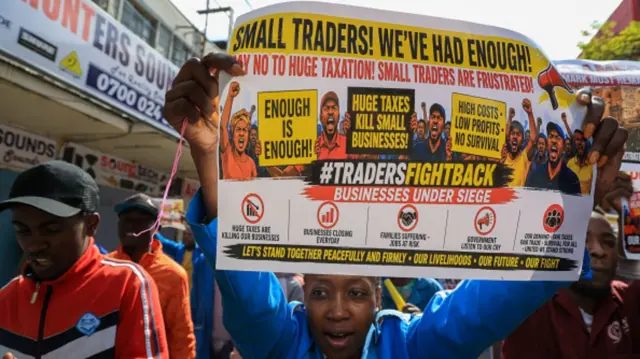
Kenya began enforcing President William Ruto's directive to close small retail shops and hawking operations run by foreign nationals, effective September 7. Ruto announced the measure on September 2 at State House in Nairobi, saying petty trade and neighborhood retail should be reserved for Kenyan citizens while the country stays open to large-scale foreign investment.

The administrative action runs ahead of the proposed Local Content Bill, 2025, which would formalize the restriction. The bill, sponsored by Laikipia Woman Representative Jane Kagiri, would require foreign companies to source at least 60 percent of goods and services locally and staff 80 percent of their workforce with Kenyan citizens. Trade Minister Lee Kinyanjui has warned that visa-free entry does not confer the right to work or trade, and foreign nationals violating immigration rules risk having their entry status revoked.

Why it matters

If the crackdown holds, thousands of foreign traders lose their livelihoods and Kenya risks retaliation from East African neighbors whose markets host Kenyan traders.

Questions about this story

Free account needed to ask — your question is kept and asked for you right after sign-up. Answers are public.

No questions yet — be the first to ask.

Key Indicators

1.458 trillion KSh ($11.27B)
Kenya's foreign direct investment stock (end of 2023)
Up 8.5 percent from 1.343 trillion shillings at end of 2022, per the Kenya National Bureau of Statistics.
60%
Local sourcing requirement in Local Content Bill
Foreign companies would need to source at least 60 percent of goods, services, and supplies from Kenyan firms.
80%
Kenyan workforce requirement in Local Content Bill
At least 80 percent of a foreign company's workforce would need to be Kenyan citizens.
2026-09-07
Enforcement start date
Ruto directed authorities to begin shutting down foreign-run small businesses on this date.

Voices

Curated perspectives — historical figures and your fellow readers.

Ever wondered what historical figures would say about today's headlines?

Sign up to generate historical perspectives on this story.

Play

Exploring all sides of a story is often best achieved with Play.

Most of these play right now — no account needed. Sign up to save scores, keep a streak, and unlock Debate and Predict. Log in Sign Up
Predict 3 ways this could play out. Back the one you believe — contrarian picks score more when a scenario has a resolution date. Log in to play

People Involved

Organizations Involved

Timeline

January 2024 September 2026

7 events Latest: Today
Tap a bar to jump to that date
  1. Reports of foreign nationals leaving Kenya

    Today Consequence

    Burundian, Rwandan, and DRC nationals reportedly seen leaving Kenya amid crackdown fears.

  2. Sing'Oei clarifies foreigners with permits can operate

    Statement

    Foreign Affairs PS said foreigners with valid work permits and licenses remain legally protected.

  3. Kinyanjui warns visa-free entry does not grant work rights

    Statement

    Trade minister said foreigners must comply with work permit and regulatory requirements.

  4. Ruto announces crackdown on foreign small traders

    Presidential Directive

    Ruto directed authorities to shut down foreign-run small retail shops and hawking from September 7.

  5. Kenya removes eTA requirements for African citizens

    Policy Change

    Kenya dropped electronic travel authorization requirements for citizens of most African countries.

  6. Kenya introduces visa-free entry

    Policy Change

    Kenya eliminated visa requirements for all visitors, allowing entry without prior application.

Historical Context

3 moments from history that rhyme with this story — and how they unfolded.

January 1983

Nigeria's expulsion of foreign traders (1983)

Nigeria's military government ordered an estimated 2 million foreign workers, mostly from Ghana, Niger, and Chad, to leave the country within two weeks. The expulsion targeted traders and laborers in the informal economy, framed as protecting Nigerian jobs.

Then

Mass exodus of foreign workers, border crises, and diplomatic tensions with neighboring states. Ghana's economy was severely disrupted by the return of hundreds of thousands of deportees.

Now

The expulsion damaged Nigeria's regional standing and deterred labor migration for years. It became a cautionary example of abrupt immigration enforcement without legal framework.

Why this matters now

Kenya's crackdown similarly targets foreign traders in the informal economy without a statutory basis, relying on presidential directive while legislation is pending. The Nigerian precedent shows the diplomatic and economic costs of abrupt enforcement.

2003-2015

South Africa's Black Economic Empowerment (2003)

South Africa introduced Black Economic Empowerment (BEE) policies requiring companies to meet ownership, management, and procurement targets for black South Africans. The policy applied to all sectors and was enforced through licensing and procurement preferences.

Then

Large companies restructured ownership and management to comply. Critics argued the policy benefited a small elite while small businesses faced compliance costs.

Now

BEE became a permanent feature of South African business, with ongoing debates about its effectiveness. It remains a model for localization policies across Africa, including Kenya's proposed bill.

Why this matters now

Kenya's Local Content Bill follows the BEE model of mandated local participation. South Africa's experience shows that such policies can persist for decades but face persistent criticism about implementation and economic impact.

2008-2010

Zimbabwe's indigenization policy (2008)

Zimbabwe enacted laws requiring foreign-owned businesses to cede 51 percent ownership to black Zimbabweans. The policy applied to mining, banking, and retail sectors, with compliance deadlines and threats of license revocation.

Then

Foreign investment collapsed, with mining companies and retailers threatening exit. Implementation was inconsistent, with some sectors exempted and others facing forced sales.

Now

The policy deterred foreign direct investment for over a decade and contributed to Zimbabwe's economic decline. It was partially reversed in 2021 when the government allowed 100 percent foreign ownership in most sectors.

Why this matters now

Kenya's Local Content Bill, with its 60 percent local sourcing and 80 percent local workforce requirements, echoes Zimbabwe's indigenization approach. The Zimbabwe experience illustrates how localization mandates can deter investment when implemented without transition periods.

Sources

(10)