


Pull to refresh
Logo
Shanghai AI Lab releases open-weight medical model built to run on one GPU

Shanghai AI Lab releases open-weight medical model built to run on one GPU

New Capabilities

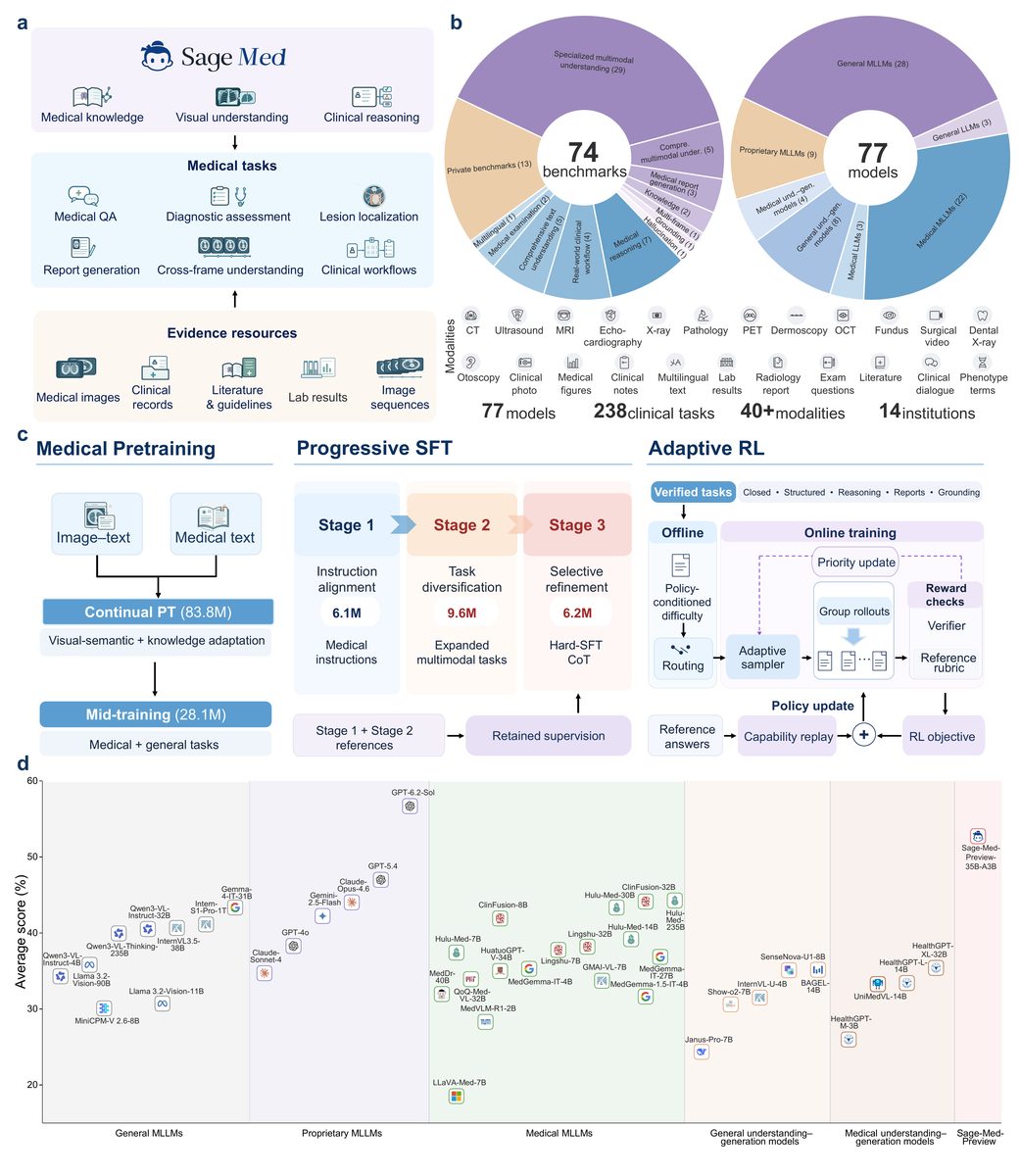
Sage-Med-Preview activates 3 billion of its 35 billion parameters per token and claims a 58.26% average across 31 public medical benchmarks — a figure no outside group has reproduced

Overview

Updated 42 minutes ago

Shanghai Artificial Intelligence Laboratory published the weights for Sage-Med-Preview on November 27, a medical model that reads scans, answers clinical questions and drafts reports. It carries 35 billion parameters and uses 3 billion of them for any given token.

The lab reports an average of 58.26% across 31 public medical multimodal benchmarks, ahead of the open-source Hulu-Med-235B-A22B at 50.99% and the lab's own general-purpose Intern-S2-Preview at 52.24%. None of those figures has been reproduced outside the collaboration. The weights also shipped with no license file in either repository, leaving commercial use legally undefined.

Why it matters

If the benchmarks hold, a hospital can run a frontier-class medical model on one GPU instead of paying per scan.

Questions about this story

Free account needed to ask — your question is kept and asked for you right after sign-up. Answers are public.

No questions yet — be the first to ask.

Key Indicators

58.26%
Average score, 31 public medical benchmarks
Reported by the lab about its own model; the paper says it 'approaches' GPT-6.2-Sol rather than beating it.
35B
Total parameters
Nominal size of the mixture-of-experts model, built on the lab's Intern-S2-Preview.
3B
Parameters active per token
The fraction that determines serving cost, and the reason a single GPU is arguable at all.
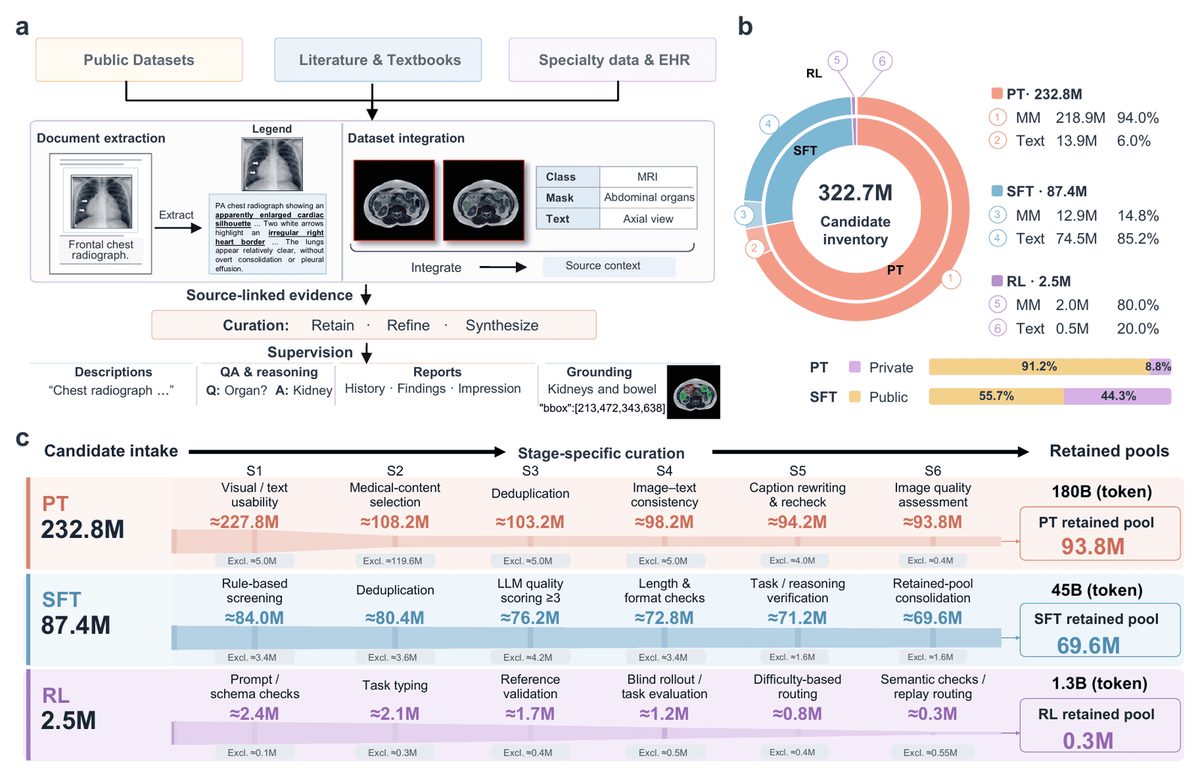
322.7M
Candidate records screened
About 164 million records and 226 billion tokens survived the lab's stage-specific filtering.
131 GiB
Download size of the weights
Tested for inference on one Nvidia H200 at BF16 with a 32,768-token context.

Voices

Curated perspectives — historical figures and your fellow readers.

Sign up to generate historical perspectives on this story.

Organizations Involved

Timeline

2 events Latest: Yesterday
  1. Weights and code published without a license

    Latest Release

    The 35B-parameter model appears on GitHub and Hugging Face at roughly 131 GiB, with inference tested on a single H200. The model card lists GPT-5.4 at 52.78% and Claude Opus 4.6 at 49.18% on the same 31 benchmarks; neither repository carries a license file.

  2. Technical report posted to arXiv

    Research

    The report describes filtering 322.7 million candidate records and a three-stage supervised fine-tuning curriculum. Its abstract says the model 'approaches' GPT-6.2-Sol, weaker wording than the model card uses.

Scenarios

1

Outside labs reproduce the 58.26% average

Possible Resolves by May 31, 2027

Discussed by: The lab's own report and release coverage, both of which single out the public benchmarks as the checkable part of the claim

The private hospital results cannot be reproduced by outsiders, so the 31 public benchmarks are where the claim stands or falls. A group with an H200 and the 131 GiB download can run the same suite. If their number lands near 58.26%, the release becomes a reference point for open medical models.

2

A hospital runs Sage-Med-Preview on its own hardware

Unlikely Resolves by Nov 30, 2027

Discussed by: No one publicly yet; the single-GPU serving claim is the precondition

Running one H200 and serving a 3B-active model is what makes an in-house deployment arguable for a hospital that already owns the hardware. No deployment has been reported, and the paper concedes that multi-step clinical workflows remain unsolved. A pilot would have to show the model handling messy records rather than single questions.

3

License ambiguity keeps the weights out of commercial products

Likely Resolves by End of 2027

Discussed by: License reviewers who flagged the missing file at release

Default copyright applies to weights published without terms. A company that embeds the model in a product has no grant of rights, and a hospital running it on patient scans has no stated permission either. Adding an explicit license later would settle the question; silence leaves it open.

Historical Context

3 moments from history that rhyme with this story — and how they unfolded.

December 2017

CheXNet (2017)

A Stanford team trained a 121-layer network on chest X-rays and reported radiologist-level accuracy at spotting pneumonia. Coverage treated it as the moment machine reading of scans arrived. Follow-up analyses argued the test set overstated real-world accuracy.

Then

The model was not deployed into clinical care.

Now

It became the standard example of the gap between a benchmark score and a working diagnostic tool.

Why this matters now

Sage-Med-Preview's paper draws the same line, conceding that complex reasoning and multi-step workflows remain unsolved.

March 2023

Med-PaLM 2 (2023)

Google reported that its medical language model answered USMLE-style questions at an expert level. Access stayed behind Google's cloud and a researcher waiting list. There were no public weights.

Then

Researchers could query the model but not inspect or host it.

Now

Frontier medical AI stayed a rented API, keeping hospital deployment dependent on a vendor.

Why this matters now

Sage-Med-Preview reverses the arrangement: downloadable weights, and a serving cost of one GPU.

July 2023

Llama 2 (July 2023)

Meta released a family of language models as downloadable weights, free for research and most commercial uses under its own license. The terms mattered as much as the weights because they set what users could legally build.

Then

Developers could run models on their own servers instead of paying per token.

Now

Open weights became a practical alternative to proprietary APIs for many workloads.

Why this matters now

Sage-Med-Preview makes the same argument for medicine, but without Llama 2's license clarity.

Sources

(6)