


Pull to refresh
Logo
Meltwater adds fact-checking for AI answers about brands

Meltwater adds fact-checking for AI answers about brands

New Capabilities

The media-intelligence firm grades ChatGPT, Gemini, Claude and Perplexity responses against a client's own approved facts, then traces each error to its source

Overview

Updated 9 hours ago

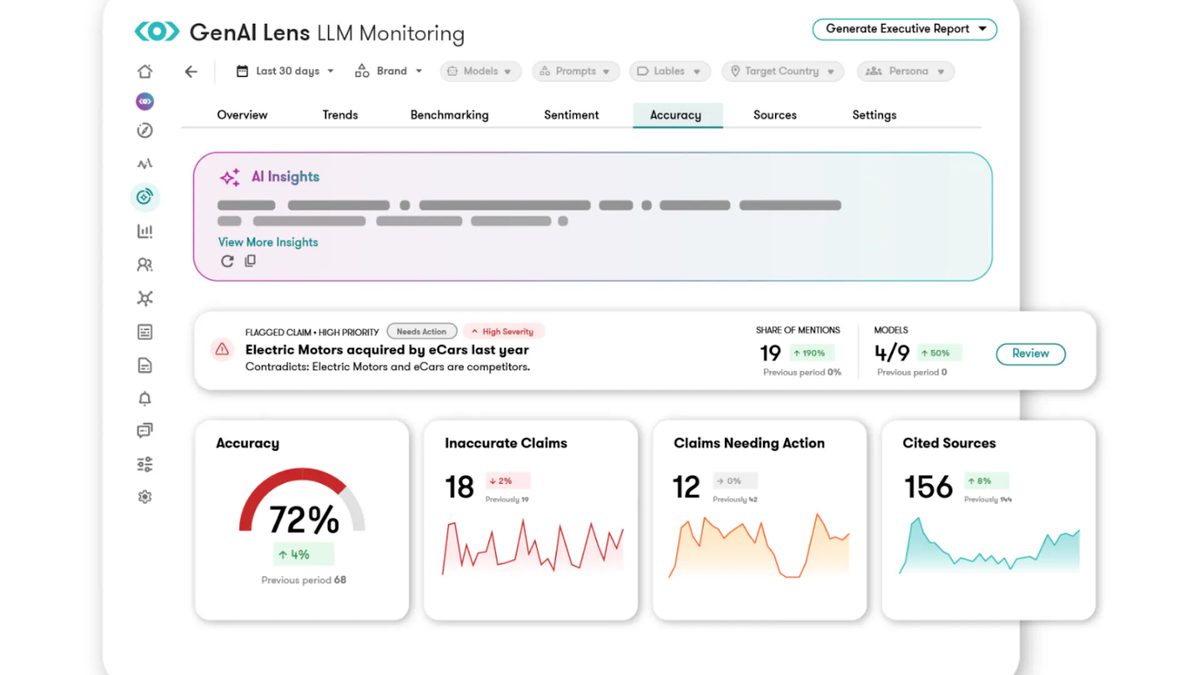
AI assistants answer questions about companies all day, and sometimes the answer is a stale price or a chief executive who left two years ago. On November 19, Meltwater began selling a way to grade those answers against a company's own approved facts and trace each error to the page behind it. The feature, called AI Accuracy Checker, runs inside GenAI Lens, the AI-visibility product Meltwater launched in July 2025.

Meltwater cannot edit what ChatGPT or Gemini says. Nobody can. Its bet is narrower: that finding the source of a wrong claim, and the journalist who wrote it, is work its existing media-monitoring platform already does. Accuracy Checker scores the answer. The client decides what to fix.

Why it matters

If buyers check facts in AI assistants, the vendor that grades those answers gains leverage over what the models say next.

Questions about this story

Free account needed to ask — your question is kept and asked for you right after sign-up. Answers are public.

No questions yet — be the first to ask.

Key Indicators

94%
B2B buyers who use AI assistants while buying
6sense research cited in Meltwater's AI visibility report.
12
AI sources tracked in GenAI Lens
Includes Meta Muse, sold as an add-on, alongside 11 others.
5
Labels applied to each claim
Accurate, Inaccurate, Disputed, Outdated, Missing Context.

Voices

Curated perspectives — historical figures and your fellow readers.

Sign up to generate historical perspectives on this story.

People Involved

Organizations Involved

Timeline

July 2025 November 2026

5 events Latest: Yesterday
Tap a bar to jump to that date
  1. AI Accuracy Checker ships

    Latest Product launch

    Meltwater announces the feature with per-model scores and day-by-day citation tracking, bundled into GenAI Lens Pro and Enterprise.

  2. Documentation details claim labels

    Product documentation

    Product notes describe an Accuracy Score, five claim labels, severity ratings and source review.

  3. Meta Muse added as a tracked source

    Product update

    Meltwater adds Meta Muse as an add-on source, bringing tracked AI systems to twelve.

  4. Year-End Release previews accuracy scoring

    Product announcement

    Meltwater's 2026 release lists GenAI Lens Accuracy Checker alongside prompt volumes and top influencers.

  5. GenAI Lens launches

    Product launch

    Meltwater begins tracking how major language models mention brands, with visibility and share-of-voice metrics.

Scenarios

1

A rival ships brand-fact grading

Likely Resolves by Q2 2027

Discussed by: Tool-comparison write-ups at Citadex and B2B Review Lab, which catalogue AI brand monitors and note most surface answers without verifying them

Accuracy scoring against a client-supplied fact base becomes table stakes. A competing media-intelligence or AI-monitoring vendor documents the same capability, and the differentiator shifts to which sources a platform can trace and how fast a correction reaches them. Meltwater's edge would be its news and journalist database, not the score itself.

2

A named client publicizes a correction campaign

Possible Resolves by Q2 2027

Discussed by: Meltwater's own positioning, which promises teams can go from a flagged claim to the journalist and pitch a correction

The feature's value is only proven when a client uses it to change a source and shows the AI answer improving. That means a case study or client announcement naming a specific wrong claim, the page that caused it, and the correction. Without one, accuracy scores stay an internal dashboard metric.

3

An AI platform opens a verified-facts channel

Possible Resolves by End of 2027

Discussed by: Independent reviewers, who note that no external tool can edit a model's internal representation and that correcting answers means changing the sources models read

Model providers could cut out the monitoring layer by letting brands submit verified facts that ground answers directly, the way business listings and structured data feed search results. That would shift the business from detection to registration, and make third-party scoring a check on the platform rather than a substitute for it.

Historical Context

3 moments from history that rhyme with this story — and how they unfolded.

May 2012

Google Knowledge Graph (2012)

Google began answering searches with a summary box drawn from public sources rather than a list of links. Companies found wrong opening hours, wrong executives and wrong product categories in a panel with no edit button. Error reports went to Google; the fix almost always sat on someone else's web page.

Then

Businesses filed correction requests and complained publicly about errors they could not reach.

Now

Structured data markup and knowledge-panel consulting became standard practice, built on the premise that the source page is the only lever.

Why this matters now

The AI answer is the new panel. Meltwater's product is an attempt to industrialize finding the source page, which is the only thing a brand can actually change.

June 2014

Wikipedia's paid-editing disclosure rule (2014)

After investigations into public relations firms quietly rewriting client articles, the Wikimedia Foundation amended its terms of use to require disclosure of paid editing. Editing a company's own entry became a governed act with rules about who may speak and how.

Then

Covert campaigns were blocked and publicized; agencies built compliance practices around disclosure.

Now

The encyclopedia kept its role as a primary source that other systems read, with correction routed through a documented process rather than a private request.

Why this matters now

When a platform becomes the factual record, correcting it stops being a private conversation with a vendor and becomes a process with visible rules.

November 2022

ChatGPT's public launch (2022)

A general-purpose chatbot reached mass use within weeks. It answered questions about companies, products and people from training data and web sources, with no mechanism for the subject to check or contest the answer.

Then

Brands discovered models misstating prices, products and leadership, with no clear channel to complain.

Now

An industry formed around measuring and influencing AI answers, initially counting mentions and later questioning accuracy.

Why this matters now

This is the gap Accuracy Checker addresses. Visibility tracking told brands they were being described. Nothing told them whether the description was true.

Sources

(8)