
Pull to refresh
Logo
Scrunch launches tool to influence the sources AI assistants cite

Scrunch launches tool to influence the sources AI assistants cite

New Capabilities

Citation Optimization ranks outside pages by how much they shape AI answers and how easily a brand can be added to them; a companion feature flags impostor sites cited as the brand

Overview

Updated 51 minutes ago

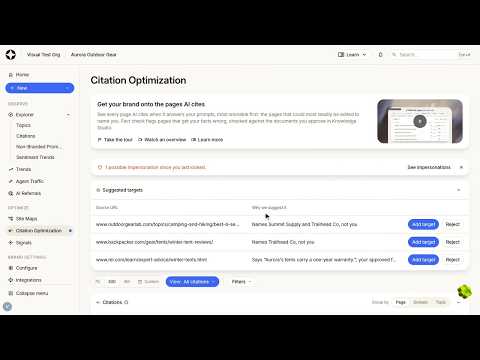
Scrunch, the answer-engine analytics firm owned by Sitecore, now sells a way to change what AI assistants read. Its Citation Optimization tool lists the outside pages cited for a brand's tracked prompts, scores each one, and drafts the email asking the author to add the brand. It launched November 12 at Sitecore Symposium in Orlando.

The same announcement carried a warning. Scrunch found that 17 percent of Fortune 500 companies had an impostor site cited in AI answers, and that three in four such answers presented the fake as the brand's own page. A companion feature, Imposter Detection, flags suspected look-alikes and lays out takedown steps.

Why it matters

If AI answers are the new storefront, the pages they cite are the shelf space, and impostors are already standing on it.

Questions about this story

Free account needed to ask — your question is kept and asked for you right after sign-up. Answers are public.

No questions yet — be the first to ask.

Key Indicators

17%
Fortune 500 companies with an impostor site cited
Share of large US companies whose AI answers pointed to a domain impersonating the brand.
1 in 1,250
AI answers that cite an impostor
Rate across the six assistants Studied: ChatGPT, Perplexity, Gemini, Google AI Overviews, Google AI Mode and Microsoft Copilot.
3 in 4
Answers presenting a fake as the brand's own source
Only 0.3 percent of answers warned readers the site might be fake.
1M+
Annual US answers citing an impersonating domain
Scrunch's estimate, based on citation data cross-referenced with public usage figures.
40%+
AI sessions that start and end inside the assistant
No open-web search before, no click out after, versus 21.5 percent for traditional search.
2.2%
Impostor pages Google ranks on page one
Other sources cited in the same AI answers appear on Google's first page 40.9 percent of the time.

Voices

Curated perspectives — historical figures and your fellow readers.

Sign up to generate historical perspectives on this story.

Organizations Involved

Timeline

May 2026 November 2026

4 events Latest: Yesterday
Tap a bar to jump to that date
  1. Citation Optimization and Imposter Detection launch

    Latest Launch

    Unveiled at Sitecore Symposium; pitches are drafted in the tool but sent by the marketer.

  2. Study finds 17 percent of Fortune 500 hit by impostors

    Research

    Scrunch reports roughly one in 1,250 sourced AI answers cites an impersonating domain.

  3. Sitecore introduces MarketingIQ

    Product

    Marketing layer built on Scrunch citation data, announced a day before Citation Optimization.

  4. Scrunch begins measuring impostor citations

    Research

    Six-month analysis of millions of AI answers across ChatGPT, Perplexity, Gemini, Google AI Overviews, AI Mode and Copilot.

Scenarios

1

Sitecore names paying brands running citation outreach

Likely Resolves by Q2 2027

Discussed by: Sitecore and Scrunch launch materials, which describe Citation Optimization as available now but give no customer names

The tool ships without public case studies. If brands adopt it, the proof would appear as a named customer, a placement count, or a disclosed revenue line from Sitecore. Adoption hinges on whether marketers accept that pitching a review site or roundup can move an AI answer at all.

2

A competing vendor ships citation outreach

Possible Resolves by Q1 2027

Discussed by: Not yet addressed in public commentary; the market for AI-visibility tools already includes several tracking products

Most AI-visibility tools stop at measurement: they show which sources are cited. Citation Optimization adds the pitch. If the outreach step becomes standard, expect a rival tracking vendor to bundle the same find-target-pitch loop, probably aimed at the same review and roundup pages.

3

An AI assistant adds source verification or impostor warnings

Possible Resolves by Q3 2027

Discussed by: Scrunch's own research, which notes that only 0.3 percent of impostor answers carry a warning

The low warning rate is a platform design choice, not a technical limit. A citation-level verification badge, an ownership signal, or an automatic impersonation notice would undercut the impostor problem without any brand involvement. It would also weaken the case for paying a third party to fix it.

4

Registrars and hosts take up AI-cited impersonation

Uncertain Resolves by Q2 2027

Discussed by: No public commitment reported; Scrunch says fewer than 1 percent of cited impostor domains appear on public threat feeds

Impostor domains mostly sit outside threat intelligence and outside Google's first page, so nothing currently removes them. A registrar, host, or assistant trust-and-safety team publishing policy on impersonation in AI answers would be the first formal enforcement layer. About a third of the known impostors Scrunch cited were still online, and most of those carried login forms, storefronts or support phone numbers.

Historical Context

3 moments from history that rhyme with this story — and how they unfolded.

2000s–2012

The link economy and Google's paid-link crackdowns (2000s–2012)

Google's ranking made inbound links a currency. Link brokers, reciprocal schemes and paid placements grew into an industry, and Google's webmaster guidelines warned against buying links. In 2012 the company pushed the Penguin update, which demoted sites that used manipulative linking.

Then

Some large sites lost rankings and hired consultants to clean up their link profiles.

Now

The work split into penalized schemes and a legitimate discipline called content marketing and public relations.

Why this matters now

Citation Optimization is the same pitch aimed at a new reader: persuade an outside page to name you. The open question is whether AI assistants will police it the way Google eventually did.

2013

Wiki-PR and paid Wikipedia editing (2013)

A consulting firm offered clients help getting Wikipedia articles written and kept. Volunteer editors investigated the accounts behind it, and Wikipedia blocked several hundred of them in October 2013.

Then

Accounts were blocked, articles deleted, and the site's terms of use were revised to require disclosure of paid editing.

Now

Paid advocacy on Wikipedia became a declared activity with enforcement, not a gray-market secret.

Why this matters now

Wikipedia is among the most-cited sources in AI answers. Paying to enter a source the assistant trusts already has a precedent, and a rulebook.

2024

FTC rule on fake reviews and testimonials (2024)

The Federal Trade Commission finalized a rule prohibiting fake reviews and testimonials, including AI-generated ones and bought reviews, and allowing civil penalties for violations.

Then

Review platforms and sellers adjusted listing and moderation practices.

Now

The line between legitimate review solicitation and deception became a matter of federal enforcement.

Why this matters now

Reviews and roundups are exactly the page types Citation Optimization targets. The regulator has already drawn a boundary around paying for favorable ones.

Sources

(5)