

Pull to refresh
Logo
Peab wins E22 Söderköping bypass under Sweden's first alliance contract

Peab wins E22 Söderköping bypass under Sweden's first alliance contract

Built World

A 10-kilometer road, 12 bridges and a new canal aqueduct, built through a shared-risk model new to Swedish civil engineering.

Overview

Updated 1 hour ago

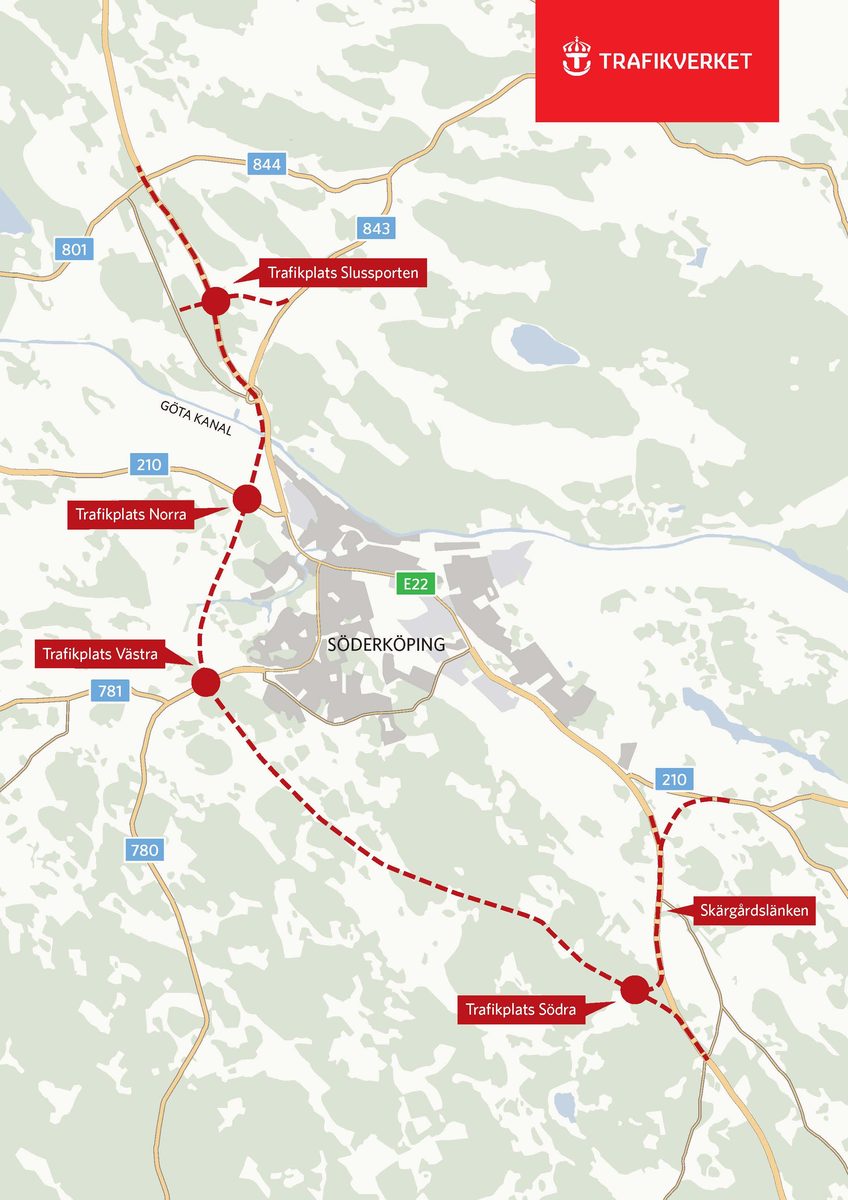
Traffic on the E22 has run straight through central Söderköping for decades. On November 6, crews began building a 10-kilometer bypass to move that traffic southwest of town. The road is Sweden's first civil engineering project delivered through an alliance contract.

Peab won the job from the Swedish Transport Administration at a contract sum of SEK 2.2 billion, about $219 million. Under the alliance, the builder, the agency and design firm ELU Konsult work in one joint organization and share responsibility for design, planning and construction. The bypass includes four interchanges, 12 bridges and an aqueduct that carries the road beneath the Göta Canal.

Why it matters

If shared-risk alliances deliver this road on time, Sweden may use them for its most complex infrastructure projects.

Questions about this story

Free account needed to ask — your question is kept and asked for you right after sign-up. Answers are public.

No questions yet — be the first to ask.

Key Indicators

SEK 2.2bn
Contract sum
Total value of the alliance contract awarded to Peab.
$219m
Contract sum in dollars
Dollar equivalent reported by World Construction Network.
10 km
Bypass length
New road running southwest of Söderköping.
12
Bridges
Bridges included in the project, per Peab.
4
Interchanges
Grade-separated junctions on the new route.
3rd
Aqueduct at Göta Canal
The new crossing is the third aqueduct at the canal.

Voices

Curated perspectives — historical figures and your fellow readers.

Sign up to generate historical perspectives on this story.

People Involved

Organizations Involved

Timeline

2023 2030

6 events Latest: Today
Tap a bar to jump to that date
  1. Bypass scheduled to open

    Upcoming Milestone

    The new road is planned to open to traffic in summer 2030.

  2. Contract award reported internationally

    Today Report

    World Construction Network reports the $219 million contract award.

  3. Peab announces SEK 2.2bn contract

    Contract

    Peab confirms the contract sum and details of the bypass.

  4. Construction phase begins

    Construction

    Trafikverket announces the project has entered its construction phase.

  5. Peab signs first-phase alliance contract

    Contract

    Peab and Trafikverket agree on planning and design under Sweden's first civil engineering alliance.

  6. Sweden studies Finland's alliance model

    Policy

    Trafikverket visits Finland's Trafikledsverket to learn from its decade of alliance contracting.

Scenarios

1

Bypass opens to traffic in summer 2030

Likely Resolves by Q3 2030

Discussed by: Trafikverket and Peab project statements

The alliance delivers the road on the schedule both partners have published. The canal aqueduct is completed, the four interchanges connect to the existing network, and through traffic moves southwest of Söderköping.

2

Project slips past 2030

Possible Resolves by End of 2030

Discussed by: Project history and engineering complexity noted by Trafikverket

Difficult ground conditions at the canal crossing, where crews must excavate under up to seven meters of water, push the opening beyond the published summer 2030 target.

3

Sweden signs a third alliance contract

Possible Resolves by End of 2028

Discussed by: Trafikverket's stated plan to evaluate the two pilot projects

After the Söderköping and Bergkvara pilots, Trafikverket applies the alliance model to another civil engineering project, making it a standing procurement option rather than an experiment.

Historical Context

2 moments from history that rhyme with this story — and how they unfolded.

2010s

Finland's alliance model (2010s)

Finland's Trafikledsverket spent more than a decade using alliance contracts, in which client and contractor share one organization, one budget and one set of risks. The model was applied to road and rail projects where uncertainty made fixed-price contracts unreliable.

Then

Finnish agencies reported closer collaboration and better cost control on complex projects.

Now

The model became an established procurement option in Finnish infrastructure.

Why this matters now

Trafikverket studied the Finnish approach in 2023 and built its Swedish variant from it, making Söderköping a direct test of whether the model travels.

2000s-2020s

Söderköping bypass false starts (2000s-2020s)

Plans for a bypass around Söderköping were announced and canceled repeatedly. Some cancellations came after logging crews had already begun clearing the route. One delay of about two calendar years followed the discovery of a smooth snake, a protected species, on the alignment.

Then

The project stalled while the municipality set aside habitat for the snake and the agency set seasonal limits on ground work.

Now

The repeated stops made schedule and cost control the central political question for any new attempt.

Why this matters now

The alliance model is meant to reduce exactly the kind of delay and rework that plagued the project's earlier attempts.

Sources

(7)