




Pull to refresh
Logo
PwnEscape Linux kernel flaw lets guest VMs read and write host memory

PwnEscape Linux kernel flaw lets guest VMs read and write host memory

New Capabilities

Critical CVE-2026-99999 in the IPv4 networking stack goes public; patches are deploying across major distributions

Today: Live patches reach major distributions

Overview

Updated 1 hour ago

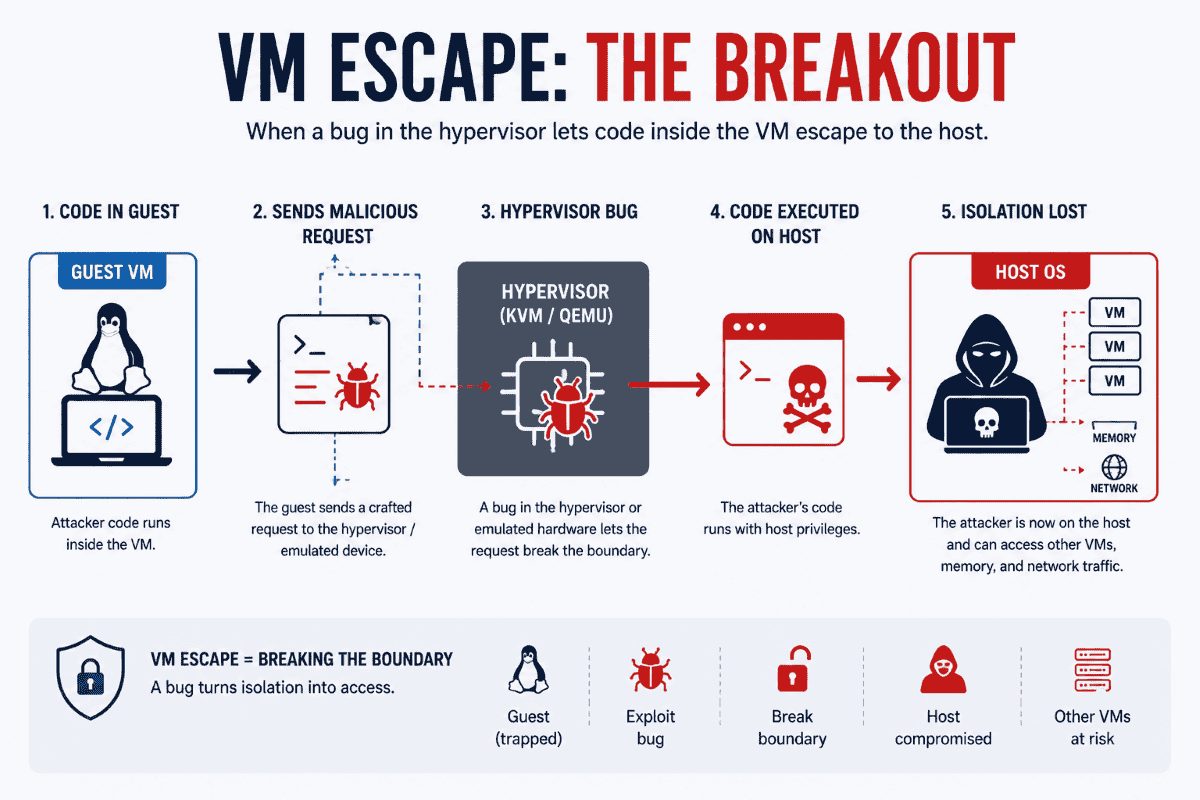
A tenant on a shared cloud server can send a crafted network packet and read host kernel memory in response — and in one researcher's lab, escalate to running code as root on the host. The flaw, tracked as CVE-2026-99999 and nicknamed PwnEscape, lives in the Linux kernel's IPv4 networking stack, not in the KVM hypervisor itself.

The vulnerable code, added in 2008, trusted guest-supplied checksum metadata without checking it against the packet's IPv4 header. Every major Linux distribution shipped it for roughly 18 years. Patches are deploying now, but the researcher has held back full technical details for a follow-up write-up.

Why it matters

A cloud tenant who controls one guest VM can compromise the host and every other virtual machine running on it.

Questions about this story

Free account needed to ask — your question is kept and asked for you right after sign-up. Answers are public.

No questions yet — be the first to ask.

Key Indicators

9.3
CVSS severity score
Rated Critical by both Red Hat and the Linux kernel CVE team.
5
IPv4 checksum consumers patched
Michael Tsirkin's fix adds an IPv4-specific guard in five affected code paths.
3
AlmaLinux releases affected
Releases 8, 9, and 10 all ship the vulnerable code.
6
Files named in the CVE record
Among them net/ipv4/ip_output.c; the flaw dates to kernel 2.6.27.

Voices

Curated perspectives — historical figures and your fellow readers.

Ever wondered what historical figures would say about today's headlines?

Sign up to generate historical perspectives on this story.

People Involved

Organizations Involved

Timeline

2008 October 2026

8 events Latest: Today
Tap a bar to jump to that date
  1. Live patches reach major distributions

    Today Mitigation

    TuxCare ships live patches for Enterprise Linux 9; EL10 patches enter testing.

  2. AlmaLinux ships patched kernels

    Mitigation

    Patches land in the testing repository for releases 8, 9, and 10.

  3. CVE-2026-99999 published

    Disclosure

    Linux kernel CNA publishes the Critical-rated CVE; the researcher's write-up follows.

  4. Fix merges into mainline

    Development

    Patch reaches Linus's tree; Vercel confirms production host-memory leak.

  5. Fix applied to net.git

    Development

    Michael Tsirkin's IPv4 checksum guard lands in the networking tree.

  6. Flaw reported privately

    Disclosure

    Paulos Yibelo reports the bug to the kernel security contact and networking maintainers.

  7. Checksum offload support widens exposure

    Development

    Checksum offload support for packet sockets extends the reach of the flaw.

  8. Vulnerable code enters the kernel

    Development

    Virtio network header support for tun/tap devices added in Linux 2.6.27.

Scenarios

1

PwnEscape exploit code goes public

Likely Resolves by Q1 2027

Discussed by: Exploitation-tracker analysts and the researcher's blog

The researcher says full technical details are held back for a follow-up write-up. When that lands, a working proof-of-concept is likely to follow, letting any attacker target the many hosts that remain unpatched. No workaround exists, so exposure depends entirely on patch speed.

2

PwnEscape added to CISA known-exploited catalog

Possible Resolves by Q2 2027

Discussed by: CISA vulnerability management teams

No active exploitation has been reported as of mid-October. Smaller and slower-patching hosts are the most likely targets. If attackers begin using the flaw in the wild, CISA typically adds it to its known-exploited catalog, forcing federal agencies to patch within set deadlines.

3

Complete input-side fix lands upstream

Likely Resolves by Q2 2027

Discussed by: Linux kernel networking maintainers

The merged fix is a defense-in-depth guard before checksum completion. Upstream states a more complete validation at input 'is forthcoming.' Merging it would close the root cause and remove reliance on the output-side check, which the current patch leaves in place for defense in depth.

Historical Context

2 moments from history that rhyme with this story — and how they unfolded.

May 2015

Venom (2015)

CrowdStrike researcher Jason Geffner found a buffer overflow in QEMU's virtual floppy disk controller. A guest could overflow the buffer and escape to the host, affecting major cloud providers including Amazon Web Services and others using the default floppy driver.

Then

Cloud providers raced to patch or disable the vulnerable controller; the bug never saw widespread exploitation.

Now

Established VM escape as a known risk for shared cloud infrastructure and pushed providers to harden hypervisor defaults.

Why this matters now

Like PwnEscape, Venom let a guest break isolation and reach the host — only through emulated hardware rather than the kernel network stack.

April 2014

Heartbleed (2014)

A missing bounds check in OpenSSL's heartbeat extension let remote attackers read 64KB chunks of server memory at a time. The bug went unnoticed for about two years, exposing passwords, session keys, and private data on millions of servers.

Then

OpenSSL 1.0.1g patched it; sites rushed to update and rotate keys.

Now

Spurred the OpenSSL foundation and industry coordinators, and became the template for memory-disclosure incidents.

Why this matters now

Both flaws produce a continuous, repeatable leak of host memory to an attacker — Heartbleed from the network, PwnEscape from inside a guest VM.

Sources

(10)