
Pull to refresh
Logo
Runway releases Praxis-1 robot model with open weights

Runway releases Praxis-1 robot model with open weights

New Capabilities

A 27-billion-parameter model that predicts video and actions together, free to download and fine-tune

Overview

Updated 41 minutes ago

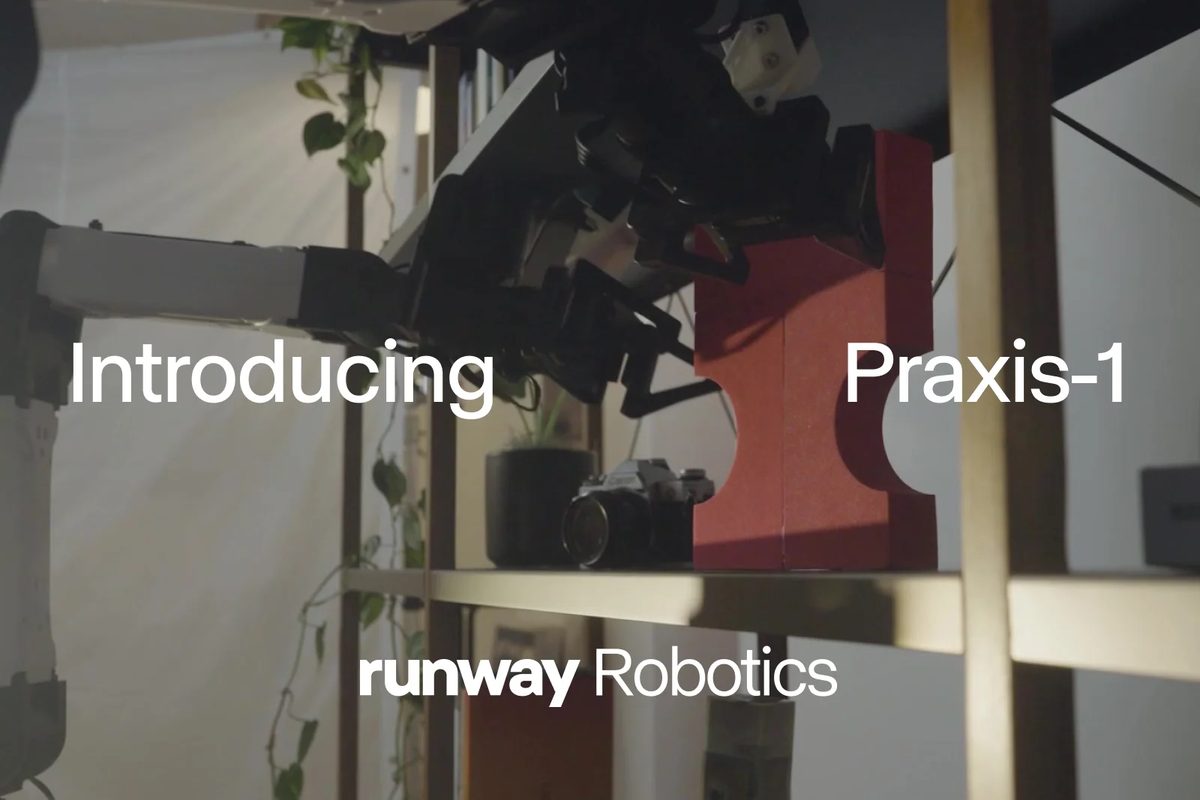
Runway announced Praxis-1 in September 2026 as an early-access model for a handful of robotics partners. On November 11, it put the full weights online under the Apache 2.0 license, meaning anyone can download, run, and sell products built on it without paying Runway.

The model is a 27-billion-parameter system that predicts video frames and robot actions at the same time. Runway says it tops NVIDIA's RoboLab-120 benchmark at 46.2% success across 1,200 episodes, ahead of FLUX 3 Action at 42.9% and π0.5 at 28.0%. Those figures are Runway's own, and the company has published the weights so others can check them.

Why it matters

Open weights let any robotics lab fine-tune a frontier-scale control model on its own hardware, cutting the cost of building a general-purpose robot policy.

Questions about this story

Free account needed to ask — your question is kept and asked for you right after sign-up. Answers are public.

No questions yet — be the first to ask.

Key Indicators

46.2%
RoboLab-120 success rate
Runway's self-reported success across 1,200 simulated episodes on NVIDIA's benchmark.
27B
Model parameters
Mixture-of-experts diffusion transformer that predicts video and actions jointly.
80.0%
SimplerEnv success after RT-1 fine-tune
Runway's reported result after adapting to Google's RT-1 robot, which was not in pretraining.
62 ms
Inference latency
Reported response time on Reactor's hosted inference, per the company's blog.

Voices

Curated perspectives — historical figures and your fellow readers.

Sign up to generate historical perspectives on this story.

Organizations Involved

Timeline

September 2026 November 2026

2 events Latest: Today
  1. Praxis-1 weights go public under Apache 2.0

    Today Release

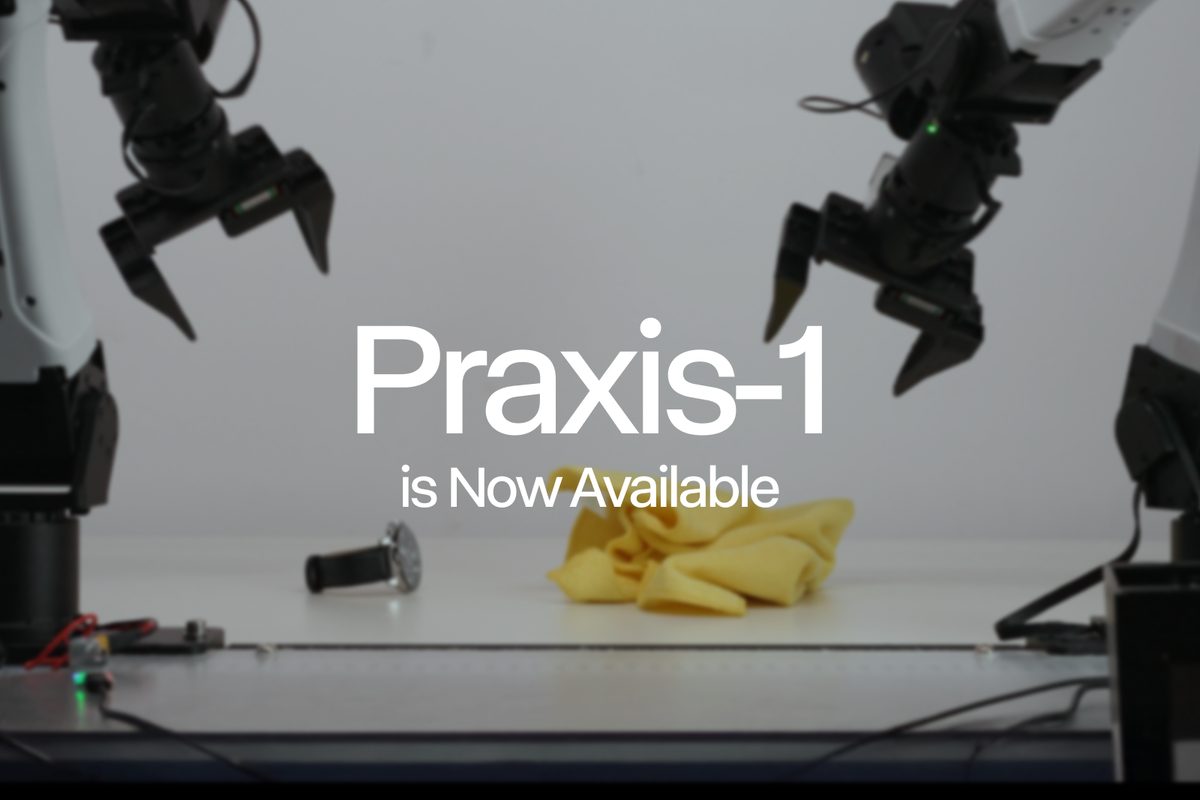
    Runway publishes weights and fine-tuning code on GitHub and Hugging Face, with hosted inference on Reactor.

  2. Runway announces Praxis-1

    Announcement

    Runway unveils its first open-weight world action model and begins testing with early partners.

Scenarios

1

Praxis-1 becomes a common fine-tuning base for robot startups

Possible Resolves by Q2 2027

Discussed by: Runway, which frames open weights as a way to let hardware developers adapt the model to their own embodiments

If small robotics teams can fine-tune Praxis-1 on a few hundred demonstrations and get working policies, the model becomes a default starting point the way open language models did. Runway's own Noble Machines result, 15 of 15 simulated trials after under 30 minutes of demonstrations, is the proof point it is pushing.

2

Runway's benchmark lead does not survive independent testing

Possible Resolves by Q1 2027

Discussed by: Neural Brew, which flags the results as self-reported and notes four higher entries on the leaderboard

Runway's 46.2% is its own number. Independent labs may find the model underperforms on real hardware, especially on the failure modes Runway itself lists: grabbing look-alike objects, vague instructions, and multi-step tasks given in one prompt. If replication falls short, the open release still stands but the headline claim weakens.

3

A commercial robot ships with Praxis-1 inside

Uncertain Resolves by End of 2027

Discussed by: Runway, which says partners are running it on humanoid, industrial, and dual-arm hardware

The Apache 2.0 license allows commercial use. If a partner moves from simulation to a shipping product running Praxis-1, the open release becomes a supply-chain fact rather than a research artifact. Runway has not announced a production deployment yet.

Historical Context

2 moments from history that rhyme with this story — and how they unfolded.

July 2023

Meta releases Llama 2 open weights (2023)

Meta published the weights for Llama 2, a large language model, with a license permitting commercial use. Competing labs had kept frontier models closed behind paid APIs.

Then

Startups and researchers began fine-tuning Llama 2 for niche tasks, and derivative models spread quickly.

Now

Open-weight language models became a durable alternative to closed APIs, and Meta's move pushed other labs to release weights too.

Why this matters now

Praxis-1 is the same bet applied to robot control: release the weights, let others adapt them, and make the model a standard.

October 2008

Google open-sources Android (2008)

Google released Android's source code under a permissive license, letting any handset maker build a phone on it without paying Google for the operating system.

Then

Phone makers adopted Android quickly, and a wave of low-cost smartphones followed.

Now

Android became the most widely used mobile operating system, and Google's control shifted from the code to the services layered on top.

Why this matters now

Runway is giving away the model to gain adoption, hoping the value moves to hosted inference and tooling rather than the weights themselves.

Sources

(5)