

Pull to refresh
Logo
Study links inherited CDK12 mutations to early, metastatic prostate cancer

Study links inherited CDK12 mutations to early, metastatic prostate cancer

New Capabilities

Five of 4,535 men with aggressive disease carried the inherited variant, and all five were diagnosed after the cancer had already spread

Overview

Updated 12 minutes ago

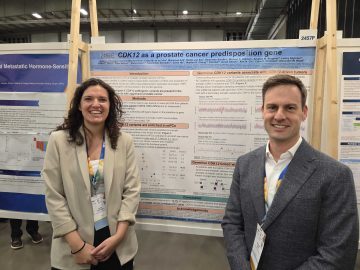
Five men with aggressive prostate cancer carried the same rare inherited mutation, and all five had cancer that had already spread beyond the prostate when it was found. They were 44 to 62 years old. The gene is CDK12.

Until this study, harmful CDK12 changes were thought to arise only inside tumors, not in the DNA a person is born with. Researchers found them in about one in 1,000 men with aggressive disease, and each man's tumor carried a second, acquired CDK12 fault plus a distinctive pattern of duplicated DNA that pointed back to the inherited copy.

Why it matters

One extra gene on a test clinics already run could flag families whose prostate cancer has spread by their early 60s.

Questions about this story

Free account needed to ask — your question is kept and asked for you right after sign-up. Answers are public.

No questions yet — be the first to ask.

Key Indicators

5
Men with an inherited CDK12 variant
All five were diagnosed with metastatic prostate cancer between ages 44 and 62.
0.1%
Share of aggressive prostate cancer patients carrying the variant
Roughly one in 1,000 of the 4,535 people whose inherited DNA was sequenced.
4,535
Patients in the study
Combined discovery and validation cohorts of people with aggressive prostate cancer.
11.4x
Odds ratio versus population controls
Compared with the gnomAD v4.1.0 reference set; confidence interval 3.6 to 27.8.
2-7%
Share of metastatic prostate cancers with CDK12 mutations
Most of these changes are acquired inside the tumor, not inherited.

Voices

Curated perspectives — historical figures and your fellow readers.

Sign up to generate historical perspectives on this story.

People Involved

Organizations Involved

Timeline

2025 November 2026

3 events Latest: 4 days ago
  1. Findings reach a general science audience

    Latest Research

    Coverage details the five carriers, the ages at diagnosis, and the recommendation to add CDK12 to hereditary testing panels.

  2. Study and university announcement make the finding public

    Research

    UBC and BC Cancer report five inherited CDK12 carriers among 4,535 patients with aggressive prostate cancer.

  3. Conference abstract reports the first four carriers

    Research

    An Annals of Oncology abstract describes two germline CDK12 carriers in each of two cohorts, all with CDK12-driven tumors.

Scenarios

1

CDK12 added to standard hereditary prostate cancer testing

Possible Resolves by End of 2027

Discussed by: Study authors, including Alexander Wyatt, who say existing panels can absorb the gene

Multi-gene hereditary cancer panels already sequence dozens of genes at once, so adding CDK12 is a software and guideline decision rather than a new device. Wyatt's team recommends it. The gatekeeper is the guideline body that tells clinicians which genes to test, and it usually wants penetrance estimates before adding a rare variant.

2

Follow-up study confirms an inherited CDK12 link to ovarian cancer

Possible Resolves by End of 2028

Discussed by: The study authors, who call the ovarian signal a clue that needs more work

Several of the five carriers had relatives with ovarian cancer, and the team found one additional ovarian cancer patient with an inherited CDK12 variant whose tumor carried the same duplication signature. A larger case-control study would be needed to show the association is real and to size the risk.

3

Prospective screening study opens for CDK12 carriers

Unlikely Resolves by Q2 2028

Discussed by: The Pathologist, which reports that larger prospective studies are needed to set screening strategy

Knowing a man carries CDK12 does not yet settle what screening he should get, or how often. Answering that requires enrolling carriers before symptoms appear and following their PSA and imaging over years. Studies of very rare genotypes struggle to recruit enough families.

Historical Context

3 moments from history that rhyme with this story — and how they unfolded.

1994-1995

BRCA1 and BRCA2 identified (1994-1995)

Two genes behind inherited breast and ovarian cancer were cloned within a year of each other, turning a family pattern into a testable mutation. Commercial testing arrived quickly, initially through one company's patents.

Then

Carriers could learn their risk and choose earlier screening or preventive surgery.

Now

BRCA testing became routine, and drugs that exploit the same broken DNA-repair pathway, including PARP inhibitors, were approved for carriers.

Why this matters now

CDK12 also codes for a DNA-repair protein. This is the template the new finding is trying to follow: inherited variant, then panel, then possibly a drug that targets the defect.

1990s

Lynch syndrome and mismatch repair genes (1990s)

Families with unusually high rates of colon and endometrial cancer were traced to inherited defects in DNA mismatch repair genes, which were identified in the early 1990s.

Then

Carriers were offered earlier and more frequent colonoscopy.

Now

Tumors with the same defect later became candidates for checkpoint immunotherapy, so an inherited risk became a way to choose treatment.

Why this matters now

Shows how a rare germline variant can end up guiding both screening and drug selection, which is the bet behind testing families for CDK12.

June 2013

Association for Molecular Pathology v. Myriad Genetics (2013)

The US Supreme Court ruled unanimously that isolated human gene sequences could not be patented, ending the exclusive hold one company had over BRCA testing.

Then

Other labs began offering BRCA tests and prices fell.

Now

Single-gene tests gave way to multi-gene panels, the format into which a newly implicated gene can be slotted.

Why this matters now

Explains why adding CDK12 is cheap: the panels exist, and no one owns the gene.

Sources

(8)