
Pull to refresh
Logo
ANC loses its outright majorities in South Africa's metros

ANC loses its outright majorities in South Africa's metros

Rule Changes

With 99% of municipal votes counted, the ANC sits near 31% nationally, its weakest local result since 1994, and coalition talks begin in most councils

Overview

Updated 1 hour ago

South Africa's governing African National Congress won about 31% of the vote in this week's municipal elections, with 99% of ballots counted. That is the party's weakest local government result since 1994, down from 45.6% in 2021 and 64.9% in 2006.

No party won an outright majority in any of the country's eight metropolitan areas. That leaves 135 of 213 councils hung, against 66 after the last municipal vote, and hands the choice of mayors to negotiations that must finish within 14 days.

Why it matters

Every hung metro now depends on a deal: which parties pair up decides who runs Johannesburg's water, power and roads.

Questions about this story

Free account needed to ask — your question is kept and asked for you right after sign-up. Answers are public.

No questions yet — be the first to ask.

Key Indicators

31%
ANC national vote share
With 99% of votes counted, per Reuters.
24.6%
Democratic Alliance national share
Main opposition party, second nationally.
9.72%
MK Party national share
Jacob Zuma's party, third nationally and strongest in KwaZulu-Natal.
45.6%
ANC share in 2021 municipal vote
The party's previous local election result.
135
Hung councils
Councils with no majority party, up from 66 in 2021 and 27 in 2016.
53
Councils the ANC controls outright
Out of 213 councils nationwide.

Voices

Curated perspectives — historical figures and your fellow readers.

Sign up to generate historical perspectives on this story.

People Involved

Organizations Involved

Timeline

6 events Latest: Today
Tap a bar to jump to that date
  1. With 99% counted, ANC falls to about 31%

    Today Election result

    The ANC's worst municipal showing since 1994; final results were due at 6 p.m.

  2. No outright majority in any of the eight metros

    Today Election result

    Johannesburg, Tshwane and eThekwini are among the councils now dependent on coalitions.

  3. DA leads Johannesburg count at about 35%

    Today Election result

    The ANC sits near 20% in the city, opening a mayoral path for DA veteran Helen Zille.

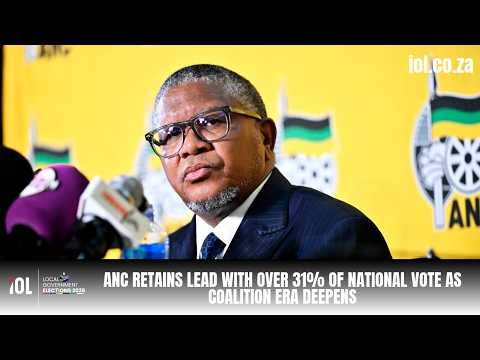
  4. Mbalula concedes service failures cost votes

    Statement

    The ANC's secretary-general said water, electricity and fuel-price complaints made door-to-door campaigning hard.

  5. ANC says councils will be settled in talks

    Statement

    The party acknowledged no outright majorities and said coalition shape would follow the count.

  6. ANC slides toward 32% as count passes 60%

    Election count

    Partial results put the ANC near 32% and the DA near 25%, pointing to a historic loss.

Scenarios

1

DA-led coalition elects Helen Zille mayor of Johannesburg

Possible Resolves by Nov 22, 2026

Discussed by: Reuters, citing the Johannesburg count and the DA's coalition statement

The DA leads Johannesburg with about 35% against 20% for the ANC. If it reaches terms with smaller parties inside the 14-day window, the new council can elect Zille, whose campaign focused on potholes and leaking pipes. The deal would put the country's commercial hub under a coalition that excludes the ANC.

2

ANC holds a metro through a deal with MK or smaller parties

Uncertain Resolves by Nov 22, 2026

Discussed by: IOL and Reuters reporting on hung councils and ANC coalition options

The ANC says it will consider coalitions, confidence-and-supply arrangements or opposition depending on the municipality. In eThekwini its share fell to 16.46% and in Gauteng province to 21.57%, so any ANC-led council would need partners. MK controls three KwaZulu-Natal municipalities outright and is short in 15 others, making it a decisive partner there.

3

Talks deadlock and councils run without majority agreements

Possible Resolves by Nov 30, 2026

Discussed by: Political analysts Dale McKinley and Ntsikelelo Breakfast, commenting on the fragmented map

135 councils have no majority party, up from 66 in 2021. If negotiations fail, councils can still convene and elect mayors through shifting votes, producing minority administrations that struggle to pass budgets. That outcome would extend the pattern of unstable local government seen since the 2016 vote, when 27 councils were hung.

Historical Context

3 moments from history that rhyme with this story — and how they unfolded.

August 2016

Municipal elections (2016)

The ANC lost control of Johannesburg, Tshwane and Nelson Mandela Bay to opposition coalitions, the first time it had lost major cities since 1994. Nationally, 27 councils ended up with no majority party.

Then

Opposition coalitions took power in several metros, some of which collapsed within two years.

Now

Coalition politics became a routine feature of South African local government rather than an exception.

Why this matters now

The 2026 map has five times as many hung councils as 2016, so the bargaining that started then is now the normal way cities are governed.

November 2021

Municipal elections (2021)

The ANC fell to 45.6% of the national vote and lost its outright majorities in most metros, leaving 66 councils hung. The DA and smaller parties became necessary partners in city governments.

Then

Coalition talks dragged on in several cities; some councils cycled through mayors.

Now

The 2021 result confirmed a 15-year decline in ANC support, driven largely by complaints about water and electricity service.

Why this matters now

The 2026 result extends that decline: the ANC lost nearly 15 percentage points in five years and now controls 53 of 213 councils outright.

2006-2011

ANC's municipal peak (2006-2011)

The ANC won 64.9% of the municipal vote in 2006. In 2011 it still won outright majorities in seven of the eight metros, including 58.56% in Johannesburg and 61.07% in eThekwini.

Then

The party governed almost every major city without partners.

Now

Those margins eroded at every subsequent local election, with urban support falling fastest.

Why this matters now

The comparison shows how far the ANC's urban base has fallen: Johannesburg is now at 20.27% and eThekwini at 16.46%.

Sources

(8)