


Pull to refresh
Logo
Labor Department restores contractor-friendly test for worker classification

Labor Department restores contractor-friendly test for worker classification

Rule Changes

The final rule replaces a 2024 standard under which any single factor could tip a worker toward employee status

Overview

Updated 1 hour ago

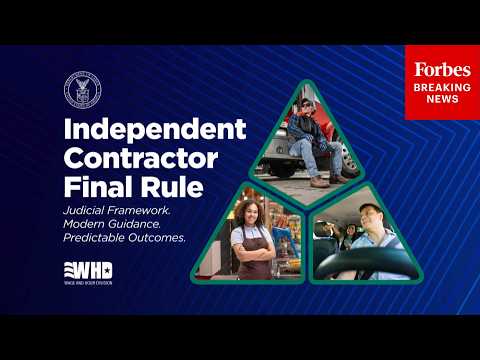
The Labor Department finalized a rule on Thursday that makes it easier for companies to treat workers as independent contractors instead of employees. The new test turns mainly on two questions: how much control the company exercises over the worker, and whether the worker can make or lose money through their own effort or investment.

Employees cost up to 30% more than contractors, according to surveys, because employers owe them minimum wage, overtime, unemployment insurance and expense reimbursements. Trucking firms, delivery apps and home-health agencies have argued the 2024 standard was unworkable. State laws, including California's ABC test, can still require employee status no matter what the federal rule says.

Why it matters

The federal default for millions of drivers, delivery workers and home-health aides now leans toward contractor status, with state law the remaining backstop.

Questions about this story

Free account needed to ask — your question is kept and asked for you right after sign-up. Answers are public.

No questions yet — be the first to ask.

Key Indicators

30%
Added cost of an employee
Surveys cited in reporting on the rule put the premium for employee status at up to this much.
60 days
Publication to effect
The rule takes effect 60 days after it is formally published in the Federal Register.
3
Federal statutes covered
The rule governs classification under the Fair Labor Standards Act, the Family and Medical Leave Act and the Migrant and Seasonal Agricultural Worker Protection Act.

Voices

Curated perspectives — historical figures and your fellow readers.

Sign up to generate historical perspectives on this story.

People Involved

Organizations Involved

Timeline

2024 November 2026

3 events Latest: Today
  1. Final rule restores the control test

    Today Final rule

    The department publishes the replacement rule, which takes effect 60 days after formal publication, expected in January 2027.

  2. Labor Department moves to rescind the 2024 analysis

    Proposed rule

    A notice proposes replacing the 2024 standard with the control-and-entrepreneurial-opportunity test used in Trump's first term.

  3. Biden administration sets a broader employee test

    Rulemaking

    The Labor Department finalizes a rule listing several classification factors, any one of which could tip a worker toward employee status.

Scenarios

1

Rule takes effect in January with no court order blocking it

Likely Resolves by Feb 28, 2027

Discussed by: The Labor Department, which set a 60-day clock after publication, and business groups that sought the change

The rule is published in the Federal Register and becomes operative in January 2027. Companies that rely on contractors adjust their agreements and actual practices to match the control and profit-or-loss factors. Worker advocacy groups may sue, but no injunction arrives before the effective date.

2

A federal court blocks the rule before it takes effect

Possible Resolves by Q1 2027

Discussed by: Bloomberg Law, which reported the rule will likely draw legal challenges

Worker advocacy groups or states sue in a sympathetic district and ask for a preliminary injunction, arguing the department skipped required analysis or misread the statute. A judge grants a stay, leaving the 2024 rule's status, or no rule at all, in place while the case proceeds.

3

Rule takes effect, then a court sets it aside on the merits

Uncertain Resolves by End of 2027

Discussed by: Employment lawyers, including Littler, who note courts no longer owe deference to agency interpretations after Loper Bright

The rule goes into force, but litigation reaches a merits ruling within the year. Because courts are not required to defer to the department's reading of the statute, a judge can reject the test outright, leaving classification to case-by-case analysis under the statute itself.

Historical Context

3 moments from history that rhyme with this story — and how they unfolded.

2017-2021

Trump's first-term contractor rule (2017-2021)

The first Trump Labor Department adopted a test saying workers who run their own businesses or serve competing companies, such as a driver working for both Uber and Lyft, could be treated as contractors.

Then

Business groups treated the standard as a settled safe harbor for gig and trucking models.

Now

The Biden administration replaced it in 2024, and the current rule restores its core logic, showing how completely the test now tracks the party in the White House.

Why this matters now

The new rule is described as similar to that first-term standard, making this the second time the same test has been adopted and repealed.

2024

The 2024 independent contractor rule

The Biden Labor Department finalized a standard with multiple classification factors, where any single one could tip a worker toward employee status. Republicans in Congress tried to block it and failed; trade groups kept lobbying for repeal.

Then

Employers faced a broader set of ways to be found misclassifying workers.

Now

The rule lasted under two years before the department proposed rescinding it in February 2026.

Why this matters now

This is the rule the November 19 action replaces, and its factor-by-factor approach is what the new two-part test discards.

2024

Loper Bright Enterprises v. Raimondo (2024)

The Supreme Court ended the practice of courts deferring to federal agencies' interpretations of ambiguous statutes. Agency rules now stand or fall on the courts' own reading of the law.

Then

Agencies lost a routine advantage in litigation over their regulations.

Now

Every interpretive rule, including this one, is more exposed to a judge who reads the statute differently.

Why this matters now

Employment lawyers note the decision means the department's test is a position a court may adopt or reject, not a binding gloss on the Fair Labor Standards Act.

Sources

(10)