


Pull to refresh
Logo
UserTesting brings customer research into AI workflows with MCP servers

UserTesting brings customer research into AI workflows with MCP servers

New Capabilities

Product teams can recruit participants and launch tests from inside ChatGPT, Claude, and Figma Make

Yesterday: UserTesting launches MCP servers in early access

Overview

Updated 50 minutes ago

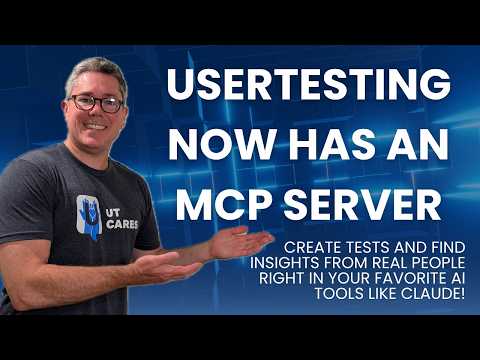
UserTesting's research platform can now be driven from inside ChatGPT, Claude, or Figma Make. On September 24, the company launched Model Context Protocol (MCP) servers that let product teams recruit participants, create studies, and launch tests without leaving their AI tools.

The move responds to a product development cycle that keeps shrinking, where customer research is becoming a continuous input rather than a discrete phase. UserTesting's combined network spans seven million participants across 34 countries, and the servers tap both the UserTesting and User Interviews platforms.

Why it matters

Product teams can validate AI-generated ideas with real customers without leaving their AI tools, shortening the distance from idea to feedback.

Questions about this story

Free account needed to ask — your question is kept and asked for you right after sign-up. Answers are public.

No questions yet — be the first to ask.

Key Indicators

7M+
Participant network size
Combined UserTesting and User Interviews network spanning 34 countries.
2
MCP servers launched
One connector for UserTesting, one for User Interviews.
4
Named supported AI clients
ChatGPT, Claude, Figma Make, and Gemini, plus other MCP-compatible apps.

Voices

Curated perspectives — historical figures and your fellow readers.

Ever wondered what historical figures would say about today's headlines?

Sign up to generate historical perspectives on this story.

Organizations Involved

Timeline

July 2026 September 2026

2 events Latest: Yesterday
  1. UserTesting launches MCP servers in early access

    Latest Product Launch

    Both UserTesting and User Interviews get MCP servers, letting teams recruit participants, create studies, and launch tests from ChatGPT, Claude, Figma Make, and Gemini.

  2. July release pushes test results into AI clients

    Product Release

    UserTesting's July 2026 release begins sending study results directly into Claude, ChatGPT, and Figma Make, an early step toward AI-embedded research.

Scenarios

1

UserTesting MCP expands to full research querying

Likely Resolves by Q2 2027

Discussed by: UserTesting product roadmap and early-access feedback

The early MCP version returns only test-level AI summaries, not session transcripts, and can't search across past research or run Live Conversation tests. If UserTesting lifts those limits, the MCP becomes the standard way teams pull customer insight into AI decision-making rather than a draft-and-launch shortcut.

2

Rival research platforms ship MCP connectors

Possible Resolves by Q3 2027

Discussed by: MCP ecosystem observers and product analytics analysts

MCP is an open standard, so any platform can build a connector. A rival like Qualtrics or Maze shipping a fuller-featured connector could erode UserTesting's head start, letting teams choose which research platform plugs into their AI tools based on recruiting depth and data access.

3

Early access stalls, MCP stays niche

Unlikely Resolves by Q1 2027

Discussed by: Workflow-tool adoption skeptics

The MCP can't yet build audiences or screeners, can't run Live Conversation tests, and returns only test-level summaries. Teams may decide the draft-and-launch loop doesn't change how they work, and the 7-million-participant network only matters if teams actually launch studies this way.

Historical Context

3 moments from history that rhyme with this story — and how they unfolded.

2015-2018

Slack's app-integration era (2015-2018)

Slack popularized the idea that daily work tools could live inside a single chat interface through app integrations. Teams stopped switching between windows and instead pulled data and actions into the conversation where decisions happened.

Then

Software vendors rushed to build Slack integrations to stay relevant in team workflows.

Now

Chat-based interfaces became central to how many teams coordinate, and integration depth became a competitive feature.

Why this matters now

MCP does for AI workflows what Slack integrations did for chat: it pulls tools into the interface where work happens, and vendors that integrate early gain distribution.

November 2024

Anthropic introduces MCP standard (November 2024)

Anthropic released the Model Context Protocol, an open standard letting AI assistants connect to external data sources and tools. The protocol spread quickly across the AI industry as a common way to plug services into chatbots.

Then

AI tools gained the ability to read files, query databases, and trigger actions in other software through a shared interface.

Now

MCP became a de facto connector layer for AI applications, with clients like ChatGPT, Claude, and Figma Make adopting it.

Why this matters now

UserTesting is building on that open standard rather than a proprietary integration, so its server works across every MCP-compatible AI client.

2000s

The programmable web and REST APIs (2000s)

The spread of REST APIs let developers embed third-party services like Stripe payments, Twilio messaging, and Google Maps directly into their own products, turning services into building blocks.

Then

Companies with strong APIs became essential infrastructure because their services were embedded everywhere.

Now

Platform distribution shifted from top-level apps to the APIs woven into other products.

Why this matters now

MCP is a new interface layer for AI, and research platforms that plug in early could become the default source of customer insight in AI-native workflows.

Sources

(9)