


Pull to refresh
Logo
Researcher discloses Windows CLFS zero-day that grants SYSTEM privileges

Researcher discloses Windows CLFS zero-day that grants SYSTEM privileges

New Capabilities

SignDrop turns a 2025 logging-security feature into a privilege-escalation path, with no patch or CVE assigned

Overview

Updated Yesterday

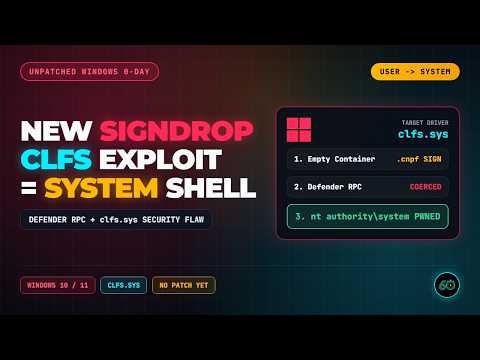
On November 10, a researcher publishing as Nightmare Eclipse released SignDrop, a working exploit that lets an ordinary Windows user gain full System rights. The flaw lives in the Common Log File System (CLFS), a logging service built into Windows. It abuses a security check Microsoft added to that driver in October 2025.

The exploit needs a specific setup: a Windows 11 26H2 or Server 2025 build whose CLFS authentication setting is in learning or enforcement mode. No patch, CVE identifier, or advisory appeared in Microsoft's November updates, which shipped the same day.

Why it matters

A standard user account can become SYSTEM on affected machines, and the same chain is claimed to disable antivirus self-protection.

Questions about this story

Free account needed to ask — your question is kept and asked for you right after sign-up. Answers are public.

No questions yet — be the first to ask.

Key Indicators

10
CLFS flaws in CISA's exploited-vulnerabilities catalog
The logging driver has been a frequent target for privilege escalation.
80%
Windows installations estimated vulnerable
An estimate from the researcher, reported by BleepingComputer, covering affected builds.
3
Windows builds where the exploit was tested
Windows 11 26H2, a 26H2 experimental build, and Windows Server 2025 experimental.
90
Days before learning mode moves to enforcement
Established installs automatically shift into the mode the exploit targets.

Voices

Curated perspectives — historical figures and your fellow readers.

Sign up to generate historical perspectives on this story.

People Involved

Organizations Involved

Timeline

October 2025 November 2026

6 events Latest: Yesterday
Tap a bar to jump to that date
  1. Microsoft says it is investigating

    Latest Statement

    The company reports no evidence of exploitation and says Defender blocks attempted exploitation.

  2. Independent test confirms it works

    Assessment

    78researchlab reports the exploit functions but is too unreliable for operational use.

  3. SignDrop exploit published

    Disclosure

    The researcher releases a CLFS privilege-escalation chain using Windows Defender to create a file as SYSTEM.

  4. ShieldBreak bypass released

    Disclosure

    A Defender bypass that evaded the RoguePlanet patch, later tracked as CVE-2026-69414.

  5. Researcher discloses GreenPlasma

    Disclosure

    A local privilege-escalation flaw, later tracked as CVE-2026-45586.

  6. Microsoft adds CLFS log-file authentication

    Security update

    Updates to Windows 11 25H2, 26H1, and Server 2025 add a hash-based check so the driver parses only logs it wrote.

Scenarios

1

Microsoft patches SignDrop and assigns a CVE

Likely Resolves by End of 2026

Discussed by: The Hacker News and Ars Technica both note the absence of a fix as the key open question

The most common path for a confirmed Windows privilege-escalation flaw is a fix in a monthly update with a CVE identifier. Because the exploit requires an established 26H2 build, Microsoft could scope a patch to affected builds. The next monthly update window is the earliest realistic timing.

2

Microsoft disputes exploitability and declines to patch

Possible Resolves by Jan 31, 2027

Discussed by: Independent testers who found the requirements narrow and reliability poor

Microsoft could argue the exploit depends on a specific build and configuration and does not warrant a patch. Dormann found only one of his many machines qualified, and 78researchlab judged it unreliable for real attacks. That reading would push the issue toward documentation rather than a fix.

3

Attackers exploit SignDrop in the wild and CISA adds it to KEV

Unlikely Resolves by Feb 28, 2027

Discussed by: Security press tracking the driver's history of active exploitation

CLFS flaws have drawn ransomware use before, and ten sit in CISA's known-exploited catalog. If a working, reliable variant appears, the agency could add SignDrop to that list, which compels US federal agencies to patch. The exploit's current unreliability makes this less likely near-term.

Historical Context

2 moments from history that rhyme with this story — and how they unfolded.

April 2025

CLFS flaws used in ransomware (2025)

A CLFS vulnerability was exploited in ransomware campaigns. Ten CLFS flaws now appear in CISA's catalog of vulnerabilities known to have been exploited in attacks.

Then

Attackers used the driver to escalate privileges on compromised machines.

Now

The pattern pushed Microsoft to add authentication to CLFS log files in October 2025.

Why this matters now

SignDrop targets the very authentication feature built to stop this class of attack, turning the defense into the entry point.

May-June 2026

GreenPlasma disclosure and fix (2026)

Nightmare Eclipse disclosed a local privilege-escalation flaw in May and limited proof-of-concept code. Microsoft fixed it in June as CVE-2026-45586.

Then

The patch closed one hole in a widening series of disclosures.

Now

The researcher continued releasing exploits, and the public dispute with Microsoft hardened.

Why this matters now

It shows the disclosure-then-patch cycle that SignDrop may follow, and the adversarial relationship behind the releases.

Sources

(5)