


Pull to refresh
Logo
Workday launches autopilot AI agents for hiring, payroll, and accounting

Workday launches autopilot AI agents for hiring, payroll, and accounting

New Capabilities

Talent Acquisition Agent enters early adopter access; payroll, accounting, and deployment agents follow in early 2027

Yesterday: Workday unveils autopilot agents at Rising 2026

Overview

Updated Yesterday

Workday's new AI agents don't wait for someone to log in. The Talent Acquisition Agent scans open job requisitions around the clock, flags roles at risk of missing fill dates, and drafts candidate outreach before a recruiter even opens the system - what Workday calls a shift from copilot to autopilot.

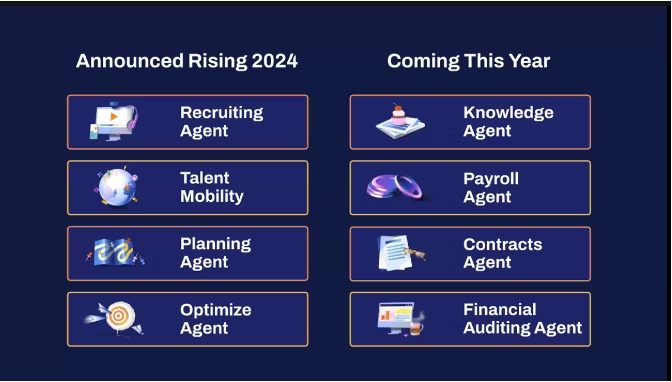
At its Workday Rising conference in Las Vegas, the company announced four autopilot agents spanning hiring, payroll, accounting, and deployment. Customers choose which tasks run automatically and which need human approval, with every agent action logged. The payroll, accounting, and deployment agents enter early adopter access in early 2027.

Why it matters

Enterprise software is shifting from answering questions to completing work - the human role moves from data entry to approving agent actions.

Questions about this story

Free account needed to ask — your question is kept and asked for you right after sign-up. Answers are public.

No questions yet — be the first to ask.

Key Indicators

4
Autopilot agent types announced
Talent acquisition, payroll, accounting, and deployment agents were unveiled at Workday Rising 2026.
5,000
Customers with Deployment Agent activated
Nearly 5,000 customers activated the Deployment Agent since Workday introduced it in September 2025.
1
Agent in early adopter access at launch
Talent Acquisition Agent entered early adopter access on October 13, 2026, with general availability planned for early 2027.

Voices

Curated perspectives — historical figures and your fellow readers.

Ever wondered what historical figures would say about today's headlines?

Sign up to generate historical perspectives on this story.

People Involved

Organizations Involved

Timeline

September 2025 2027

4 events Latest: Yesterday
Tap a bar to jump to that date
  1. Payroll, accounting, deployment agents enter early adopter access

    Upcoming Planned

    Workday plans to bring autopilot capabilities to the Payroll, Accounting, and Deployment Agents for early adopter customers in early calendar year 2027.

  2. Workday unveils autopilot agents at Rising 2026

    Latest Product launch

    Workday announces four autopilot agents spanning hiring, payroll, accounting, and deployment. Talent Acquisition Agent enters early adopter access immediately.

  3. Sana becomes the new Workday Home

    Product launch

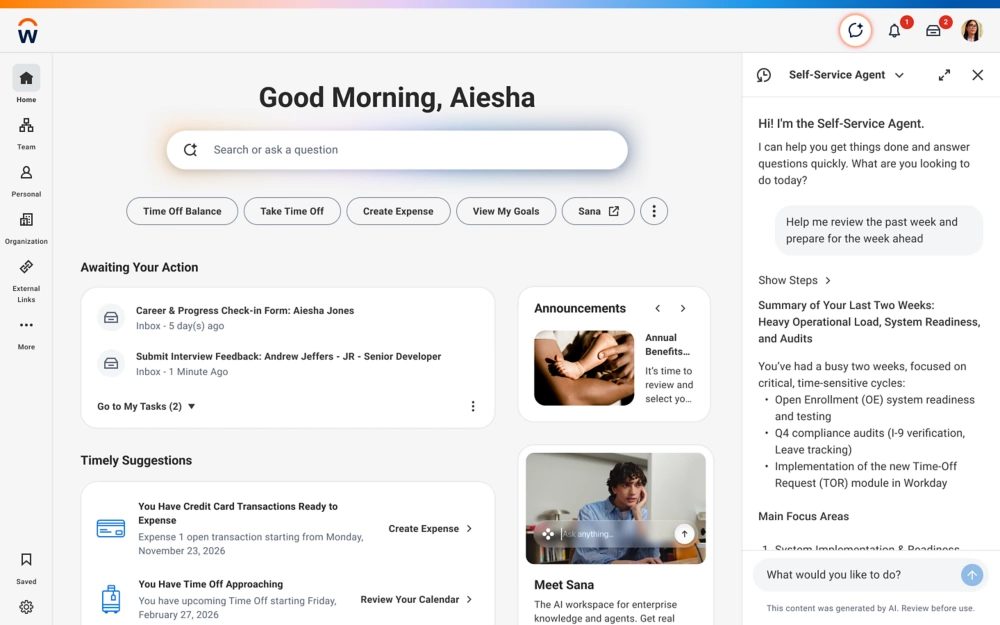
    Workday makes Sana its primary interface, an agentic experience that brings tasks, decisions, meetings, and knowledge into one place.

  4. Workday announces Deployment Agent

    Product launch

    Workday releases its first agentic tool to simplify how customers set up, update, and manage the platform. Nearly 5,000 customers eventually activate it.

Scenarios

1

Talent Acquisition Agent hits general availability in early 2027

Likely Resolves by Q2 2027

Discussed by: Workday's launch materials and analysts tracking the agentic AI market

Workday says general availability for the Talent Acquisition Agent is planned for early 2027, with payroll, accounting, and deployment agents entering early adopter access on the same timeline. If the rollout holds, customers beyond a handful of early adopters can run hiring workflows with continuous agent assistance.

2

Autopilot rollout slips into late 2027 amid compliance scrutiny

Possible Resolves by End of 2027

Discussed by: Enterprises demanding stricter guardrails; analysts who watched prior automation hype cycles

Workday says its agents are lawful by design and customers control how far agents go. But enterprises may demand more human-in-the-loop controls, or compliance reviews in unionized or heavily regulated industries could push timelines back. Payroll errors carry legal weight, so finance teams may move slower than hiring teams.

3

Sana becomes Workday's primary interface, accelerating agent adoption

Uncertain Resolves by End of 2027

Discussed by: Workday's announcement that Sana is the new Workday Home

Sana is now the entry point for Workday users, an agentic experience where employees start and finish work across HR, finance, and IT. If agents live in the interface employees see daily, adoption may compound quickly as users delegate routine tasks to agents and shift toward supervisory roles.

Historical Context

3 moments from history that rhyme with this story — and how they unfolded.

September 2024

Salesforce launches Agentforce (2024)

At Dreamforce in September 2024, Salesforce introduced Agentforce, a platform for building AI agents that take actions across customer data rather than just answering questions. Early deployments covered sales and service workflows, handling tasks like case resolution and lead qualification.

Then

Agentforce became Salesforce's flagship AI product and a template for enterprise agentic AI.

Now

It pushed competitors like Microsoft and ServiceNow to accelerate their own autonomous agent roadmaps.

Why this matters now

Workday's autopilot agents extend the same shift from copilot to agentic action into HR and finance - the back office where Salesforce's customer-facing agents don't reach.

2016-2021

Robotic process automation boom (2016-2021)

Companies like UiPath and Blue Prism raised billions promising software robots that would automate back-office tasks such as invoice processing and data entry. UiPath went public in April 2021 at a valuation near $30 billion.

Then

Enterprises deployed RPA bots but found they broke when underlying systems changed, requiring constant maintenance.

Now

RPA became a component of broader automation stacks - not the standalone revolution its backers promised.

Why this matters now

Workday's autopilot agents promise similar back-office automation and face the same question: can intelligent agents reliably operate on complex, changing enterprise systems.

2005-2012

Workday's founding and cloud ERP disruption (2005)

Dave Duffield and Aneel Bhusri founded Workday in 2005 to deliver HR and finance software as cloud subscriptions, challenging incumbents SAP and Oracle. The company went public in 2012 after seven years of building.

Then

Workday grew through the late 2000s as enterprises embraced cloud software.

Now

It became a standard for large-enterprise HR and finance systems, proving cloud could replace on-premise ERP.

Why this matters now

The autopilot launch is Workday's attempt to do for AI what it did for cloud: make agentic autonomy the new standard for how enterprise software operates.

Sources

(9)