


Pull to refresh
Logo
AbbVie Phase 2 results clear zumilokibart for Phase 3 eczema trials

AbbVie Phase 2 results clear zumilokibart for Phase 3 eczema trials

New Capabilities

All three dose regimens beat placebo at 16 weeks; mid-dose picked for Phase 3 trials

Today: AbbVie presents APEX Part B as EADV late-breaker

Overview

Updated 1 hour ago

Patients with moderate to severe atopic dermatitis on the mid-dose of zumilokibart hit 65.9% skin clearance at 16 weeks, versus 23.4% on placebo. AbbVie presented the Phase 2 results as a late-breaker at the European Academy of Dermatology and Venereology congress in Vienna on Sept. 30.

Zumilokibart is an anti-IL-13 antibody with a half-life of about 77 days, far longer than existing options. AbbVie picked the mid-dose for Phase 3 and says the goal is rapid skin and itch improvement with fewer injections. The company acquired the drug's developer, Apogee Therapeutics, for about $10.9 billion earlier this year.

Why it matters

If Phase 3 confirms these results, eczema patients could manage severe disease with a few injections a year instead of every other week.

Questions about this story

Free account needed to ask — your question is kept and asked for you right after sign-up. Answers are public.

No questions yet — be the first to ask.

Key Indicators

65.9%
Mid-dose EASI-75 response at week 16
Versus 23.4% on placebo in Phase 2 APEX Part B.
$10.9B
AbbVie's acquisition price for Apogee
Cash deal at $135.11 per share, expected to close in the third quarter of 2026.
77 days
Zumilokibart's half-life
Engineered for extended half-life, enabling longer dosing intervals.
346
Patients in APEX Part B
Randomized 1:1:1:1 to low, mid, high dose, or placebo.

Voices

Curated perspectives — historical figures and your fellow readers.

Ever wondered what historical figures would say about today's headlines?

Sign up to generate historical perspectives on this story.

People Involved

Organizations Involved

Timeline

May 2026 September 2026

2 events Latest: Today
  1. AbbVie presents APEX Part B as EADV late-breaker

    Today Conference Presentation

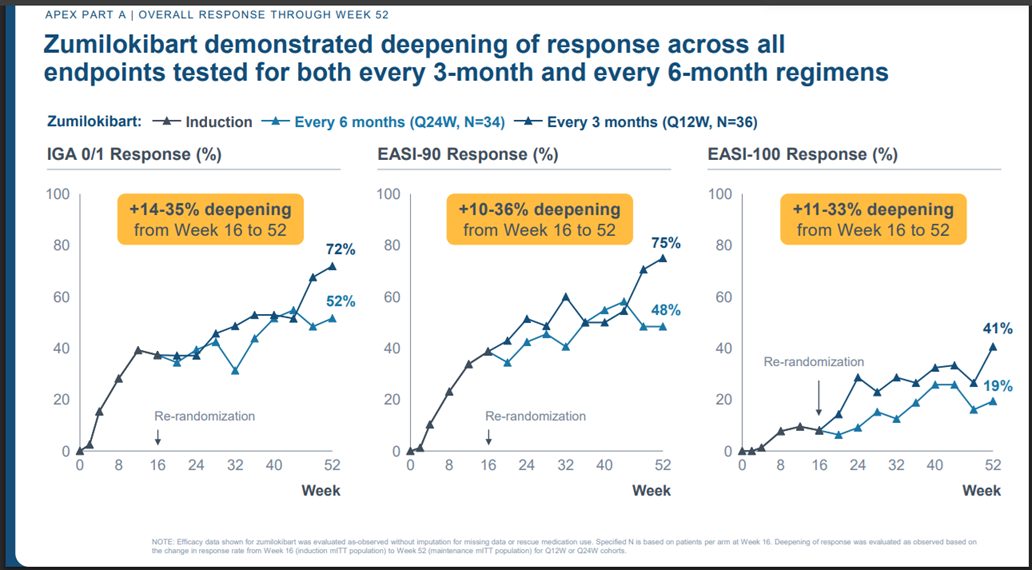
    AbbVie confirms all dose regimens beat placebo, selects mid-dose for Phase 3, and presents 52-week APEX Part A maintenance data.

  2. Apogee reports Phase 2 APEX Part B success

    Clinical Trial

    Mid-dose zumilokibart achieved 65.9% EASI-75 at week 16 versus 23.4% placebo; all doses met the primary endpoint.

Scenarios

1

ADventure Phase 3 trials confirm zumilokibart's efficacy

Likely Resolves by Q2 2028

Discussed by: AbbVie statements; dermatologytimes.com analysis

Phase 3 ADventure 1 and 2 trials enroll about 400 patients each, testing the mid-dose against placebo with EASI-75 and IGA 0/1 as co-primary endpoints at week 16. If topline matches Phase 2, AbbVie files for approval and targets a 2029 launch.

2

Durability or safety concerns slow the program

Possible Resolves by Q2 2028

Discussed by: dermatologytimes.com; clinical observers

Maintenance dosing every three to six months has not been tested long-term, and noninfective conjunctivitis appeared in 10.6% of mid-dose patients in Phase 2. If 52-week data show waning response or new safety signals, Phase 3 timelines or the regulatory submission slip.

3

Regulatory review pushes launch past 2029

Possible Resolves by End of 2029

Discussed by: Market analysts

Even with clean Phase 3 data, FDA review, manufacturing scale-up, and label negotiations could push commercial launch beyond 2029. The extended-interval dosing schedule may draw additional safety questions before approval.

Historical Context

2 moments from history that rhyme with this story — and how they unfolded.

March 2017

Dupilumab becomes the AD standard of care (2017)

The FDA approved dupilumab, the first biologic for moderate-to-severe atopic dermatitis, after trials showed a substantial share of patients on biweekly dosing reaching clear or almost-clear skin. It quickly became the top-selling AD biologic.

Then

Dupilumab became the default biologic for severe eczema within months of approval.

Now

It proved the IL-4/IL-13 pathway is the main driver of type-2 inflammation in AD, reshaping the treatment market.

Why this matters now

Zumilokibart targets the same pathway with a half-life permitting far fewer injections, the main differentiation for a late entrant.

2021-2024

IL-13 rivals enter the atopic dermatitis market (2021-2024)

LEO Pharma's tralokinumab won FDA approval in late 2021, and Eli Lilly's lebrikizumab followed in 2024. Both are anti-IL-13 antibodies competing with dupilumab, though neither displaced it as the top seller.

Then

The anti-IL-13 class grew but required dosing every two to four weeks.

Now

New anti-IL-13 entrants can win approval but must compete on more than efficacy alone.

Why this matters now

Zumilokibart enters a validated class; its extended half-life is the main point of difference.

Sources

(5)