


Pull to refresh
Logo
McNeel ships open-source RhinoAI, letting outside AI agents drive Rhino

McNeel ships open-source RhinoAI, letting outside AI agents drive Rhino

New Capabilities

Rhino 9 arrives with Grasshopper 2 and an optional plug-in that hands modelling to Claude, Codex, Gemini or a local model — with the user paying for the tokens

Overview

Updated 42 minutes ago

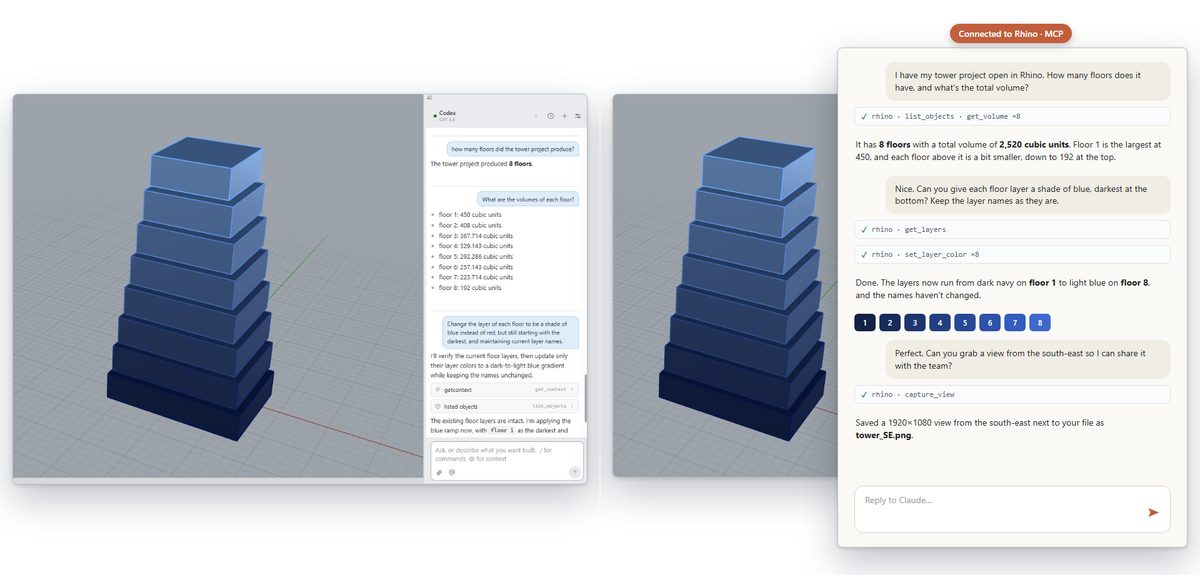
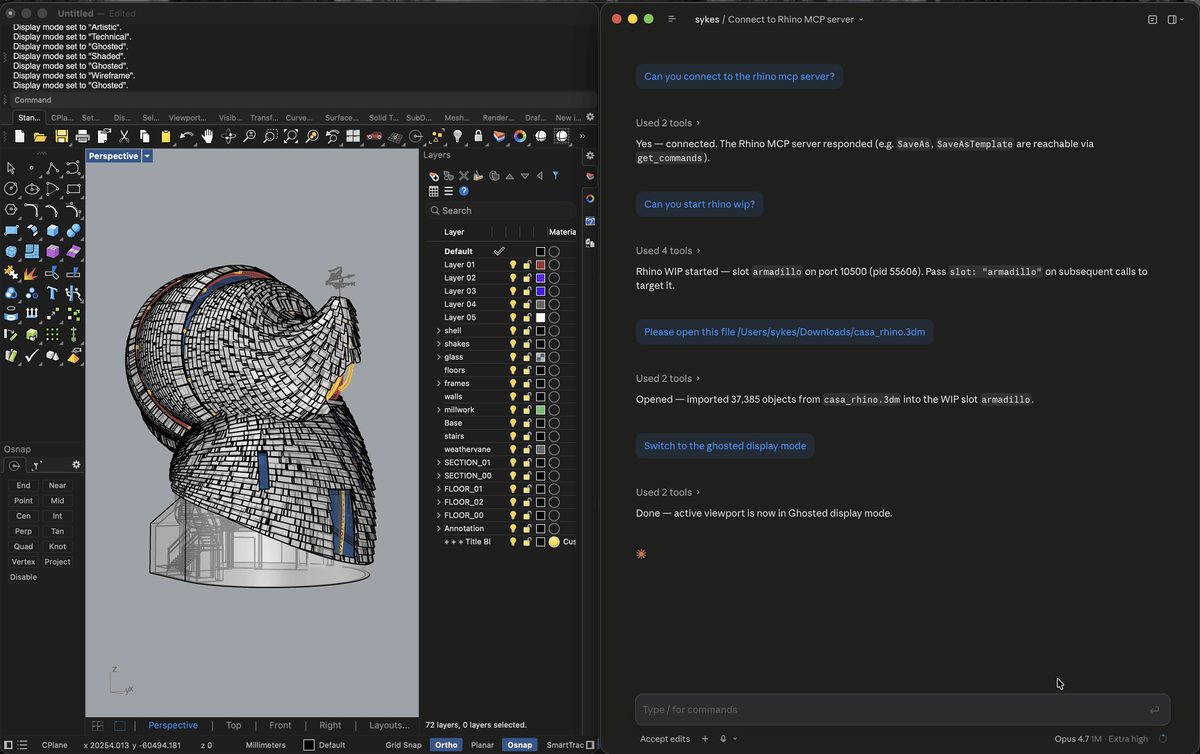
Rhino has always been operated by hand. On 28 October 2026, McNeel shipped Rhino 9 with an optional plug-in called RhinoAI that lets an AI agent — Claude, Codex, Gemini, GitHub Copilot or a local model — open Rhino, run commands and build geometry. The plug-in is open source under an MIT licence and connects through a Model Context Protocol server, an open standard for wiring AI models to outside tools.

McNeel did not put AI in the core of Rhino. RhinoAI is a separate install, and it runs on whatever model the user already pays for. That choice keeps McNeel's low-cost, no-subscription business model intact while moving the cost of the intelligence to the customer. It also means the plug-in can only do what Rhino's software development kit exposes.

Why it matters

RhinoAI tests whether an AI agent, not a person, operates design software — and the user, not McNeel, pays for the model.

Questions about this story

Free account needed to ask — your question is kept and asked for you right after sign-up. Answers are public.

No questions yet — be the first to ask.

Key Indicators

9.5
Merged pull requests per developer per working day
Steve Baer and Andy Le Bihan averaged 3.3 between October 2022 and June 2026, then 9.5 from August to mid-October 2026.
330
Attendees at Rhino World 2026
About 50 more than the 2023 edition, with a waiting list after McNeel opened the event to users as well as resellers.
$0
Licence cost of the RhinoAI plug-in
Published on GitHub under an MIT licence; the AI model and its usage costs are the user's own.
2
Grasshopper versions RhinoAI connects to
Grasshopper 1 and the new Grasshopper 2 both work with the plug-in.

Voices

Curated perspectives — historical figures and your fellow readers.

Sign up to generate historical perspectives on this story.

People Involved

Organizations Involved

Timeline

March 2026 November 2026

5 events Latest: Yesterday
Tap a bar to jump to that date
  1. AEC Magazine publishes a detailed account of RhinoAI

    Latest Publication

    The trade magazine reports how the plug-in was built, what it demonstrated, and where it failed.

  2. Rhino 9 ships for Windows and Mac

    Release

    The release lands five days after Bob McNeel set the date in conversation with the audience, and includes Grasshopper 2.

  3. Developers report a threefold jump in output

    Presentation

    Steve Baer and Andy Le Bihan say merged pull requests per working day rose from 3.3 to 9.5.

  4. Rhino World 2026 opens near Barcelona

    Conference

    About 330 people attend the partner and user gathering in Castelldefels, roughly 50 more than in 2023.

  5. McNeel makes AI a daily development focus

    Strategy

    The company drops its habit of waiting for new technology to settle, and starts using AI internally for development and testing.

Scenarios

1

Third-party Grasshopper plug-ins complete the move to version 2

Uncertain Resolves by Q2 2027

Discussed by: McNeel staff at Rhino World, who noted that not every third-party plug-in has made the move

Grasshopper 2 ships with Rhino 9, but AEC teams depend on plug-ins that still only run in version 1. If enough plug-in developers port their tools, Grasshopper 1 becomes a legacy environment. If they don't, version 1 stays the working version for years, and the new metadata and multi-threading features stay out of production work.

2

McNeel ships SDK access to the RhinoAI panel

Likely Resolves by Q2 2027

Discussed by: Callum Sykes, who listed SDK access to the panel as next on the roadmap

Right now developers can build against Rhino's software development kit, but they cannot add their own skills to the in-Rhino AI panel. SDK access would let plug-in makers ship AI-driven commands inside their own tools. The trigger is a release note on the public repository describing that access.

3

McNeel bundles a paid AI subscription into Rhino

Unlikely Resolves by End of 2027

Discussed by: No one at McNeel has proposed this; the plug-in's design deliberately avoids it

RhinoAI runs on the user's own agent, so the model and its cost are the user's choice. A first-party AI subscription would reverse that and change McNeel's pricing model. The trigger would be an AI line item appearing on McNeel's buy page alongside Rhino licences.

Historical Context

2 moments from history that rhyme with this story — and how they unfolded.

1963

Sketchpad (1963)

Ivan Sutherland's doctoral thesis at MIT produced Sketchpad, the first program that let a person draw and manipulate geometry directly on a screen with a light pen. It established the pattern every CAD tool has followed since: the human decides, the software executes.

Then

Sketchpad was a research project and ran on one machine, but it defined interactive computing for graphics.

Now

Direct manipulation became the assumed interface for design software, and the person at the input device stayed in charge of the geometry.

Why this matters now

RhinoAI is the first widely distributed test of whether that 60-year assumption holds — whether the agent, not the hand, decides what gets built.

November 2024

Anthropic publishes the Model Context Protocol (November 2024)

Anthropic released an open specification for connecting AI models to outside tools and data sources, and published reference servers alongside it. The protocol gave developers a standard way to expose functions to an agent instead of writing bespoke integrations for each model.

Then

Early adopters were mostly developer tools and coding assistants.

Now

The protocol spread to other software categories, and vendors began shipping MCP servers as a way to let customers' AI agents operate their products.

Why this matters now

RhinoAI is an MCP server. That is why it can work with Claude, Codex, Gemini, Copilot or a local model without McNeel writing a separate integration for each.

Sources

(7)