


Pull to refresh
Logo
Roblox opens Open Cloud to AI agents in Studio

Roblox opens Open Cloud to AI agents in Studio

New Capabilities

Studio MCP clients can now manage games and import 3D assets under per-game permissions.

Overview

Updated 57 minutes ago

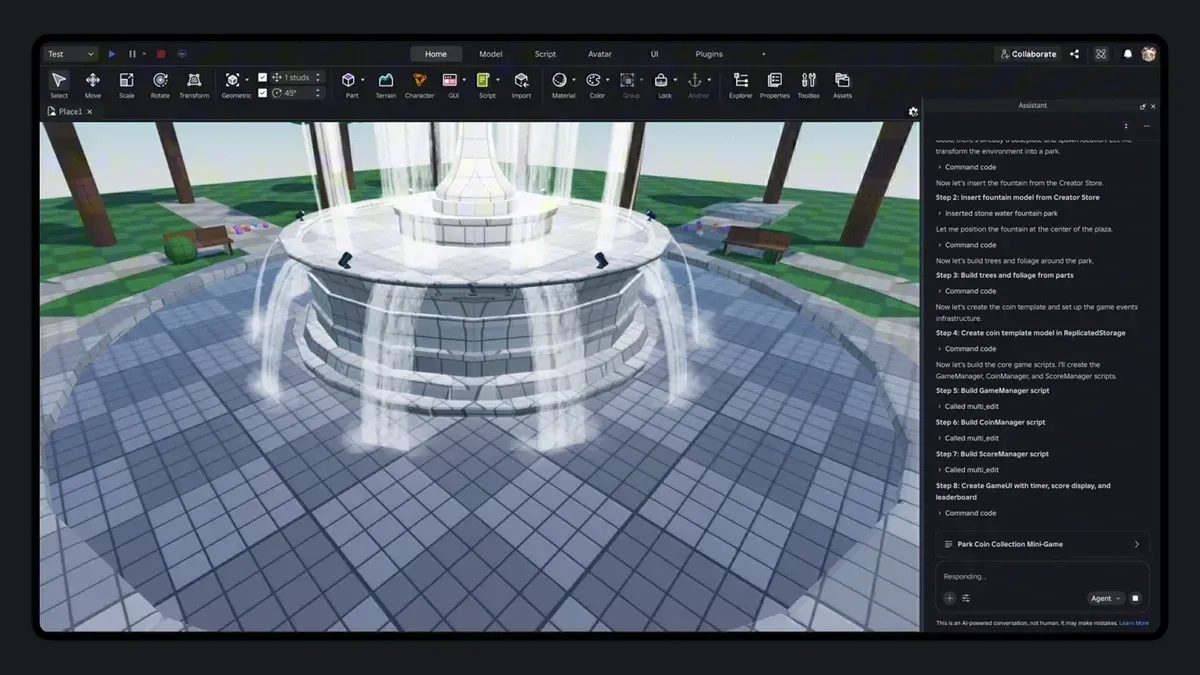
A Roblox developer can now open an AI chat inside Studio and tell it to create a game pass, change a place setting, publish an update, or import a Blender model. The agent can do it without a separate API key.

Roblox expanded its Studio Model Context Protocol (MCP) server, an open standard that lets AI tools talk to the game engine. The update adds an open_cloud_invoke tool for Roblox's Open Cloud APIs, a per-game permission screen, and three Skills that teach agents how to use the new powers. Uploads are permanent, and HTTP requests fail in unsaved places until the place is published.

Why it matters

If you build on Roblox, an AI assistant can now run live game tasks and upload permanent assets under permissions you set.

Questions about this story

Free account needed to ask — your question is kept and asked for you right after sign-up. Answers are public.

No questions yet — be the first to ask.

Key Indicators

3
New Skills for MCP agents
They cover Open Cloud calls, permission checks, and asset import.
6
Permission sections in Studio
Creators can limit assets, game settings, data stores, HTTP, and monetization.
0
API keys pasted by developers
Studio manages Open Cloud credentials and enforces scopes per game.

Voices

Curated perspectives — historical figures and your fellow readers.

Sign up to generate historical perspectives on this story.

Organizations Involved

Timeline

2 events Latest: Yesterday
  1. Expanded Studio MCP tooling is available to creators

    Latest Rollout

    The Open Cloud and asset-import features are live in Studio MCP clients, with a known HTTP caveat for unsaved places.

  2. Roblox announces Open Cloud access for Studio MCP

    Product update

    Roblox says MCP clients can call Open Cloud APIs and import 3D models under per-game permissions.

Scenarios

1

Roblox keeps MCP permissions per game

Likely Resolves by May 1, 2027

Discussed by: Roblox's MCP documentation and developer forum announcement

Roblox says permissions are saved to a creator's account for each game, and collaborators set their own. If that stays, no one can grant a team-wide scope by accident. The setup could change if creators complain about repeating the same permission work on every game.

2

A costly agent action forces a mandatory confirmation step

Possible Resolves by May 1, 2027

Discussed by: Roblox's Skills guidance and developer forum risk notes

Roblox's Skills tell agents to ask before spending money, touching players, using secrets, or publishing. A publicized mistake could push Roblox to make those confirmations a Studio requirement, not just an instruction inside the agent.

3

Asset import becomes the main MCP use case

Possible Resolves by Feb 1, 2027

Discussed by: Top of Games and Juicebox coverage

The import workflow exports GLB or FBX files, uploads them, then fixes scale, rotation, textures, and anchoring. If creators adopt it widely, Roblox could publish import volume or a case study. If not, Open Cloud management stays the headline feature.

Historical Context

2 moments from history that rhyme with this story — and how they unfolded.

March 2023

ChatGPT plugins (2023)

OpenAI let ChatGPT call third-party services through plugins, so a chat could search the web, book travel, or query a database. The plugins ran through external APIs, much like Roblox's open_cloud_invoke calls Open Cloud.

Then

Plugins showed demand for model-initiated actions but had uneven reliability and a limited rollout.

Now

OpenAI later folded external actions into GPTs and actions, and confirmation and scoping became standard design concerns.

Why this matters now

Roblox is making the same move inside a game engine, with per-game scopes and agent instructions to ask before risky actions.

June 2021

GitHub Copilot (2021)

GitHub previewed Copilot, an AI pair programmer that suggested code inside the editor. It did not run production changes on its own.

Then

Developers debated licensing and correctness, but the tool spread quickly.

Now

AI coding assistants became normal, with human review as the control point.

Why this matters now

Roblox moves the assistant from suggesting code to executing platform operations, so permissions replace review as the main guardrail.

Sources

(5)