


Pull to refresh
Logo
Milyli adds AI-powered redaction to Blackout document review platform

Milyli adds AI-powered redaction to Blackout document review platform

New Capabilities

Azure-powered system identifies PII and privileged content across native file formats

Today: Milyli launches AI-powered redaction for Blackout

Overview

Updated 46 minutes ago

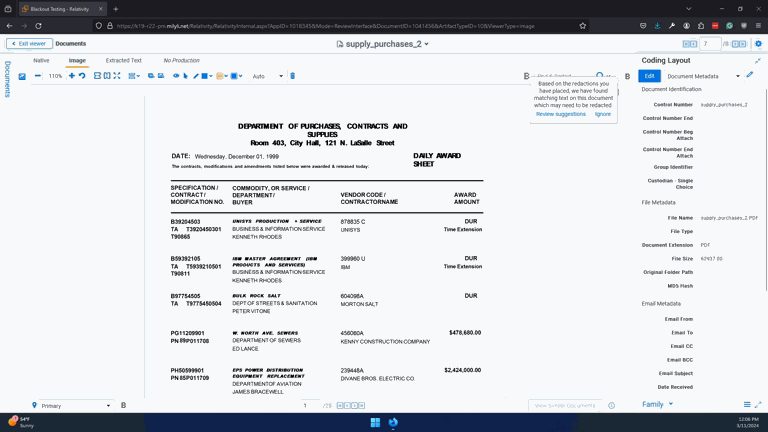
Milyli's Blackout redaction platform now uses AI to find and remove sensitive data automatically. The system, powered by Azure Language through Foundry Tools, identifies names, addresses, phone numbers, social security numbers, and privileged content. It works across native Excel, PDF, and dozens of other file formats.

The release targets legal teams that manually review thousands of documents before sharing them in litigation, investigations, and regulatory compliance. Blackout has placed more than 7 billion redactions for law firms, service providers, and government agencies.

Why it matters

Legal teams can now redact sensitive data in native spreadsheets without converting files or manual searches, cutting review time on large productions.

Questions about this story

Free account needed to ask — your question is kept and asked for you right after sign-up. Answers are public.

No questions yet — be the first to ask.

Key Indicators

7B+
Redactions placed by Blackout
Total redactions placed across law firms, service providers, and government agencies.
$50
Entry-level monthly price
Basic tier covers 25 documents per month with unlimited users and workspaces.
25
Documents per month at basic tier
Entry-level plan includes 25 documents monthly; Growth tier covers up to 200.

Voices

Curated perspectives — historical figures and your fellow readers.

Ever wondered what historical figures would say about today's headlines?

Sign up to generate historical perspectives on this story.

People Involved

Organizations Involved

Timeline

2025 October 2026

5 events Latest: Today
Tap a bar to jump to that date
  1. Milyli launches AI-powered redaction for Blackout

    Today Product

    Milyli announced Automated AI Redaction for Blackout, using Azure Language through Foundry Tools to detect and redact PII and privileged content automatically.

  2. TransPerfect integrates Blackout with Reef Discovery

    Today Integration

    TransPerfect Legal announced Blackout's redaction and markup capabilities are now available inside its Reef Discovery review platform.

  3. Cloud-based Blackout available for licensing

    Product

    The new cloud-based Blackout became available to current customers under existing agreements, adding secure production and sharing functionality.

  4. Blackout redaction goes live on Reveal Enterprise

    Integration

    Reveal announced Blackout was fully integrated into its Enterprise platform after acquiring the source code late the previous year.

  5. Milyli previews cloud-based Blackout at Relativity Fest

    Product

    Milyli showed a new cloud-based version of Blackout at Relativity Fest 2025, built on technology that has placed over 7 billion redactions.

Scenarios

1

AI redaction becomes standard in eDiscovery

Likely Resolves by Q2 2027

Discussed by: Milyli, TransPerfect, Reveal

The AI redaction feature spreads through Reveal Enterprise and TransPerfect's Reef Discovery integrations. Legal teams adopt automated redaction for routine productions, making it the default workflow for PII removal in large document sets. Milyli reports adoption figures showing a majority of Blackout customers using the AI features.

2

Rivals launch competing AI redaction

Possible Resolves by Q2 2027

Discussed by: Legal technology analysts

Relativity, Everlaw, or another eDiscovery platform announces similar AI-powered native redaction for Excel and PDF files. The feature becomes a commodity rather than a differentiator for Blackout, and pricing pressure follows.

3

Accuracy concerns slow adoption

Unlikely Resolves by End of 2027

Discussed by: Legal technology commentators

A high-profile redaction failure or audit finding raises questions about AI redaction accuracy. Legal teams in high-stakes litigation stick with manual review for privileged content, limiting AI redaction to lower-risk document sets.

Historical Context

2 moments from history that rhyme with this story — and how they unfolded.

2011-2015

Predictive coding in eDiscovery (2011)

In Da Silva Moore v. Publicis Groupe, a federal judge approved the use of predictive coding, an algorithm-assisted review method, for document production. The ruling was the first court acceptance of computer-assisted review in eDiscovery.

Then

Legal teams began using predictive coding for large-scale document review, cutting costs and review time.

Now

Algorithm-assisted review became standard practice in eDiscovery, setting a precedent for AI tools in legal workflows.

Why this matters now

AI redaction faces the same adoption question: will courts and legal teams trust algorithms with high-stakes decisions about sensitive data?

December 2006

Electronic discovery rules (2006)

The Federal Rules of Civil Procedure were amended to address electronically stored information, making email, spreadsheets, and other digital files subject to discovery in federal litigation.

Then

Legal teams had to manage growing volumes of digital evidence, creating demand for automated review tools.

Now

The amendments drove the growth of the eDiscovery industry and the tools that now handle billions of documents.

Why this matters now

The 2006 rules created the document volume problem that AI redaction now addresses.

Sources

(8)