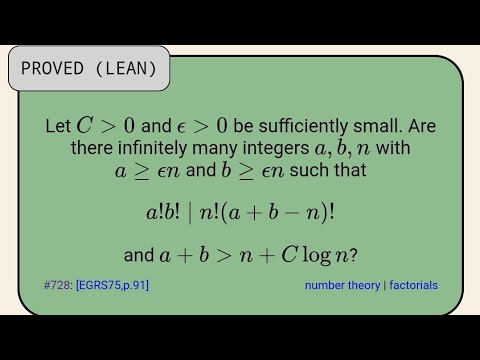
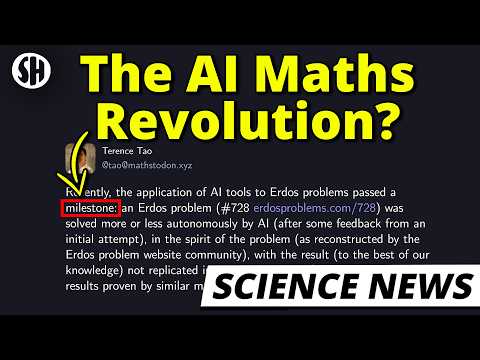
For the first time, AI systems are independently solving mathematical problems that stumped human researchers for decades. Since Christmas 2025, 15 legendary Erdős problems have moved from 'open' to 'solved'—11 by AI, including the first on January 6, 2026, from OpenAI's GPT-5.2 Pro and Harmonic's Aristotle theorem prover.
The achievement marks a shift in what automated systems can contribute: unlike competition problems with known solutions, these are genuine open questions that working mathematicians had failed to solve. Fields Medalist Terence Tao, who personally verified several AI-generated proofs, says these represent the 'lowest hanging fruit' from Erdős's collection—solvable with known techniques that simply hadn't received enough attention. The harder problems, requiring genuinely novel insights, remain out of reach.
Questions about this story
Free account needed to ask — your question is kept and asked for you right after sign-up. Answers are public.
No questions yet — be the first to ask.
Key Indicators
15
Erdős Problems Solved Since Christmas
Problems moved from 'open' to 'solved' on the official Erdős Problems website between December 25, 2025 and January 11, 2026
11
Solutions Crediting AI
Of the 15 recently solved problems, 11 specifically credited AI models as involved in the solution process
3
Full AI Solutions, Jan 6-10
Erdős #728, #729 and #205 fully solved by GPT-5.2 with Aristotle, Lean-verified; a similar 2014 result by Pomerance was found for #728
5/6
IMO 2025 Problems Solved
Harmonic's Aristotle achieved gold-medal performance at the 2025 International Mathematical Olympiad with formally verified proofs
14 events
Latest: January 11th, 2026 · 9 months ago
Showing 8 of 14
JK to step
Tap a bar to jump to that date
Jump to
January 2026
AI Solutions Documented Across Multiple Problem Categories
LatestDocumentation
Terence Tao updates the erdosproblems.com wiki with comprehensive tracking of AI contributions across 10 categories, including solutions, partial results, literature reviews, and formalizations.
GPT-5.2 and Aristotle Solve Problems #729 and #205
Solution
GPT-5.2 Pro (for #729) and GPT-5.2 Thinking (for #205), each combined with Aristotle, produce full Lean-verified solutions to Erdős Problems #729 and #205, extending the autonomous solution approach.
AlphaProof Proves Variant of Problem #477
Solution
DeepMind's AlphaProof produces a Lean-verified proof of a variant of Erdős Problem #477.
First Fully Autonomous AI Solution to Open Erdős Problem
Breakthrough
Kevin Barreto and Liam Price use GPT-5.2 Pro and Harmonic's Aristotle to solve Erdős Problem #728 autonomously. Terence Tao reviewed the result; a similar 2014 result by Carl Pomerance was identified in the literature.
Claude Opus 4.5 Upgrades Partial Result to Full Solution
Solution
Anthropic's Claude Opus 4.5 and Gemini 3 Pro upgrade an existing partial result on Erdős Problem #871 to a full solution with Lean verification.
December 2025
Pace of AI-Assisted Solutions Accelerates
Milestone
Beginning Christmas Day, AI-assisted solutions to Erdős problems accelerate dramatically, with 15 problems moving to solved status over the following three weeks.
OpenAI Releases GPT-5.2
Technical
OpenAI releases GPT-5.2 family including Pro variant with enhanced mathematical reasoning, which will prove central to subsequent Erdős breakthroughs.
Aristotle Autonomously Solves Problem #1026
Solution
Boris Alexeev uses Aristotle to autonomously solve Erdős Problem #1026 in Lean. The next day, a prior human solution from 2016 is discovered in the literature.
November 2025
Aristotle Achieves First Erdős Partial Result
Breakthrough
Harmonic's Aristotle produces a partial solution to Erdős Problem #124, inspiring amateur mathematicians to systematically apply AI to the problem collection.
First Human-AI Collaborative Erdős Solution
Breakthrough
Boris Alexeev, Wouter van Doorn, and Terence Tao collaborate with Gemini DeepThink and Aristotle to achieve partial solution to Erdős Problem #367.
AlphaEvolve Applied to Erdős Problems
Research
DeepMind's AlphaEvolve system is tested on multiple Erdős problems, achieving slight improvements on some constructions but not matching past results on others.
AI startup Harmonic releases paper on Aristotle, a theorem prover achieving gold-medal equivalent performance on 2025 IMO problems with Lean-verified proofs.
July 2024
DeepMind's AlphaProof Achieves IMO Silver Medal Standard
Milestone
Google DeepMind announces that AlphaProof and AlphaGeometry solved 4 of 6 International Mathematical Olympiad problems, the first AI system to reach silver-medal level with formally verified proofs.
September 1996
Paul Erdős Dies, Leaving Hundreds of Open Problems
Background
Hungarian mathematician Paul Erdős dies at 83, leaving a legacy of over 1,500 papers and hundreds of unsolved problems with cash bounties attached.
Scenarios
1
AI Solves Major Open Problem, Transforms Mathematical Research
Possible
Discussed by: MIT Technology Review, Nature commentary; optimistic AI researchers
Within 12-24 months, AI systems solve one of the higher-bounty Erdős problems or another famous conjecture, demonstrating ability to generate genuinely novel mathematical insights. This would trigger massive investment in AI-for-math tools and fundamentally change how research mathematics is conducted, with AI becoming standard collaborator on major papers.
AI systems continue solving problems from the accessible tail of Erdős's collection—those solvable with existing techniques that simply hadn't received attention—but make no progress on the core difficult problems requiring novel mathematical insights. The gap between solving competition problems and research problems proves larger than anticipated. AI becomes useful for routine tasks but doesn't transform discovery.
3
Verification Crisis Undermines Trust
Possible
Discussed by: Mathematics community forums, Lean proof assistant developers
A high-profile AI solution is later discovered to contain subtle errors that formal verification missed due to misformalization of the problem statement, or reliance on unstated axioms. The incident causes mathematicians to question all AI-generated results and require exhaustive human review, significantly slowing the pace of AI-assisted mathematics.
4
Human-AI Collaboration Becomes Standard Practice
Likely
Discussed by: Erdős problems community, AI for Math Initiative partners
Rather than autonomous solving, the dominant mode becomes tight human-AI collaboration: AI handles literature review, numerical exploration, and proof formalization while humans provide problem selection, creative insights, and strategic direction. This hybrid approach produces more results than either alone, and becomes the norm for mathematical research within five years.
Historical Context
3 moments from history that rhyme with this story — and how they unfolded.
1 of 3
June 1976
Four Color Theorem Computer Proof (1976)
Kenneth Appel and Wolfgang Haken at the University of Illinois announced they had proved the four color theorem—that any map can be colored with just four colors so no adjacent regions share a color. Their proof required over 1,000 hours of computer time to verify 1,936 special cases. It was the first major mathematical theorem proved with substantial computer assistance.
Then
The mathematical community reacted with 'equal parts celebration and dismay.' Many mathematicians refused to accept a proof humans couldn't verify by hand. Colleague William Tutte celebrated that they 'smote the kraken' while others despaired at computers 'encroaching on human ingenuity.'
Now
The proof gained grudging acceptance and established computer-assisted proof as legitimate, if controversial. It foreshadowed today's debates about AI-generated proofs and what constitutes mathematical understanding versus mere verification.
Why this matters now
The 1976 controversy over computer proofs mirrors today's debates about AI theorem provers. The key difference: modern formal verification in Lean provides stronger guarantees than 1976's case-checking, but questions about mathematical insight versus brute-force verification persist.
2 of 3
March 2016
AlphaGo Defeats Lee Sedol (2016)
DeepMind's AlphaGo defeated world Go champion Lee Sedol 4-1 in a match watched by 200 million people. Game 2's 'Move 37'—a play that seemed wrong to expert commentators but proved decisive—demonstrated AI could find strategies humans had never considered in a game with more possible positions than atoms in the universe.
Then
Lee Sedol described feeling 'speechless' and the match triggered intense global interest in AI capabilities. Top Go players began studying AI moves to improve their own play.
Now
AlphaGo's success demonstrated reinforcement learning could master complex domains, directly inspiring the AlphaProof architecture now being used for theorem proving. The paradigm of AI finding solutions humans couldn't see is now being tested in mathematics.
Why this matters now
Just as AlphaGo found moves that looked wrong but proved correct, AI theorem provers are now finding proof paths mathematicians hadn't explored. The question is whether mathematical insight can emerge from pattern-matching at scale, as game-playing strategy did.
3 of 3
August 2014
Kepler Conjecture Formal Verification (2014)
Thomas Hales announced completion of the Flyspeck project, a 12-year effort to formally verify his 1998 computer-assisted proof of the Kepler conjecture (about optimal sphere packing). The original proof had been accepted only with 99% confidence because referees couldn't verify all computational components; Flyspeck provided complete formal verification in Isabelle and HOL Light proof assistants.
Then
The verification resolved lingering doubts about the proof's correctness and demonstrated that major mathematical results could be machine-verified end-to-end.
Now
Flyspeck pioneered the formal verification methodology now used by Aristotle and AlphaProof. It established that Lean-style proof assistants could provide ironclad guarantees for complex mathematical arguments.
Why this matters now
The Kepler verification took 12 years of human effort. Today's AI systems can formalize proofs in hours or days. This acceleration is what makes the current moment transformative—not just that AI can find proofs, but that it can verify them at scale.