



Pull to refresh
Logo
AiPrise launches token sharing for verified customer records

AiPrise launches token sharing for verified customer records

New Capabilities

Compliance platform lets payment partners reuse KYC and KYB evidence with consent

Overview

Updated 1 hour ago

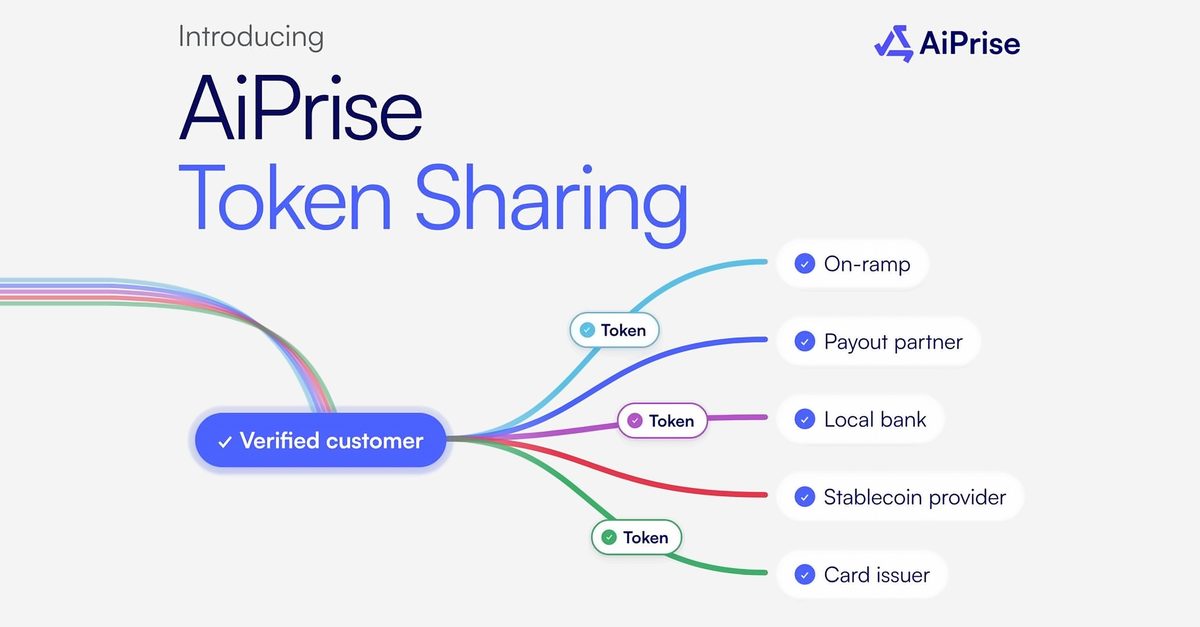
A single cross-border payment can pass through an on-ramp, a payout partner and a local bank. Each often collects the same business documents and runs its own Know Your Customer and Know Your Business checks. AiPrise says some businesses on its platform have been verified by as many as 13 different companies.

On Nov. 12, AiPrise launched Token Sharing. A company that has already verified a customer can send the underlying record to a partner as a token, a secure digital record of the verification, with the customer's consent. The receiving company can reuse checks that fit its policy, run extra checks, and request missing documents through the same token. Each company still makes its own compliance decision.

Why it matters

If reusable KYC records spread, onboarding a business across payment partners could shrink from days of repeat document requests to one verified file.

Questions about this story

Free account needed to ask — your question is kept and asked for you right after sign-up. Answers are public.

No questions yet — be the first to ask.

Key Indicators

13
Most verifications for one business on AiPrise
AiPrise says one business was verified by 13 different companies over the platform's history.
6x
Increase in repeat business verifications
Repeat verifications rose sixfold over the past year, according to AiPrise.
27
Times AiPrise was KYB'd in six months
CEO Chaitanya Sarda said the company was verified 27 times in its first six months.
11
Launch partners in the Token Sharing network
Includes MoneyGram, dLocal, BlindPay and Tazapay.
3-5 days
Typical delay to resolve follow-up requests
AiPrise says cross-platform document requests traditionally take this long.

Voices

Curated perspectives — historical figures and your fellow readers.

Sign up to generate historical perspectives on this story.

People Involved

Organizations Involved

Timeline

October 2026 November 2026

3 events Latest: Yesterday
  1. AiPrise launches Token Sharing

    Latest Product Launch

    The feature lets a company that has verified a customer share the KYC or KYB record, evidence and audit trail with a partner, with consent.

  2. AiPrise names 11 launch partners

    Network

    MoneyGram, dLocal, BlindPay, Tazapay and seven others are listed as participating companies.

  3. MoneyGram selects AiPrise for verification

    Partnership

    MoneyGram says it will use AiPrise to support compliance and fraud prevention across its global network.

Scenarios

1

Payment partners go live with shared KYC tokens

Possible Resolves by May 12, 2027

Discussed by: AiPrise launch materials

AiPrise says Token Sharing is available to customers from Nov. 12. The test is whether named partners such as MoneyGram, dLocal or Tazapay disclose live imports, not just participation.

2

Regulators set rules for reusing third-party KYC evidence

Uncertain Resolves by Nov 12, 2027

Discussed by: Compliance teams and regulators; no official guidance yet

Shared KYC evidence crosses privacy and anti-money-laundering rules. A regulator could issue guidance on consent, audit logs and whether a recipient can rely on a donor's checks.

3

Token Sharing remains a pilot as partners keep separate checks

Possible Resolves by May 12, 2027

Discussed by: No named forecaster; the scenario hinges on integration friction

Partners may sign up but keep manual reviews because their policies, data-residency rules or risk models differ. Without public live-use disclosures, the network stays a pilot.

Historical Context

2 moments from history that rhyme with this story — and how they unfolded.

2014

SWIFT KYC Registry (2014)

SWIFT launched a central registry where banks could upload standard KYC documents for correspondent banking relationships. The goal was to reduce repeated document requests across institutions.

Then

Banks adopted it as a document repository, but many still ran their own due diligence.

Now

The registry showed that shared KYC data can be standardized, but it did not transfer compliance decisions.

Why this matters now

AiPrise is trying a similar idea with evidence and an active token rather than a central document pool.

2018

UK Open Banking (2018)

UK regulators required major banks to let customers share account data with authorized third parties through secure APIs. Consent sat with the customer.

Then

Adoption grew slowly at first, then expanded into payments and lending apps.

Now

It established consent-based data portability as a regulated model in financial services.

Why this matters now

Token Sharing applies the same consent principle to KYC and KYB records, where privacy stakes are higher.

Sources

(6)