


Pull to refresh
Logo
arXiv caps each author at two submissions per month

arXiv caps each author at two submissions per month

Rule Changes

Preprint server acts as AI tools drive record paper volume

3 days ago: arXiv caps submissions at two per month

Overview

Updated 1 hour ago

Researchers who post work to arXiv now face a hard cap: two submissions per calendar month, with no more than three papers active at once. The preprint server, where physicists and computer scientists share research before peer review, announced the limit on October 1.

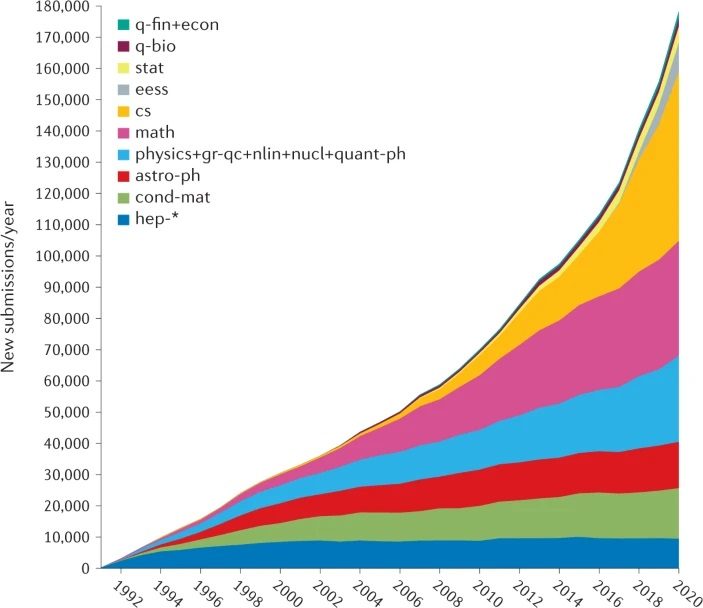
Monthly submissions nearly doubled in two years, reaching a record 40,363 in September. That surge generated about 9,000 support tickets for arXiv's small staff and its 170 volunteer moderators. ArXiv points to AI tools that make it easy to produce thin papers, salami-sliced work, and dense AI-written text that fails its standards.

Why it matters

Physicists and computer scientists who post more than two papers a month now hit a hard ceiling at the field's dominant preprint server.

Questions about this story

Free account needed to ask — your question is kept and asked for you right after sign-up. Answers are public.

No questions yet — be the first to ask.

Key Indicators

2 per month
Monthly submission cap per author
Maximum papers a single submitter can post per calendar month.
3 at once
Active submission limit
Maximum number of pending or active papers per submitter at any time.
40,363
Submissions in September 2026
Record monthly total, nearly double the 20,569 posted in September 2024.
~9,000
Support tickets in September 2026
Tickets generated for arXiv staff and volunteer moderators that month.
6x
Growth in cs.AI submissions
Computer science and AI submissions are up more than sixfold, per arXiv's announcement.

Voices

Curated perspectives — historical figures and your fellow readers.

Ever wondered what historical figures would say about today's headlines?

Sign up to generate historical perspectives on this story.

People Involved

Organizations Involved

Timeline

January 2024 October 2026

3 events Latest: 3 days ago
  1. arXiv caps submissions at two per month

    Latest Policy

    The preprint server announces that each submitter is limited to two papers per calendar month and three active submissions, citing AI-driven volume and moderator strain.

  2. September sets a record with 40,363 submissions

    Data

    Monthly submissions nearly double September 2024's total, generating about 9,000 support tickets for staff and moderators.

  3. arXiv adds a 3-active-submission limit

    Policy

    During 2024, arXiv begins limiting each submitter to three active submissions at any time, a precursor to the monthly cap.

Scenarios

1

ArXiv's two-per-month cap becomes permanent policy

Likely Resolves by Oct 1, 2027

Discussed by: arXiv moderators and the service's official announcement, which frames the cap as protecting volunteer time

If submission volume keeps doubling, the monthly cap stays in place and arXiv may adjust the numbers rather than lift them. The service says it will continue to monitor effects and modify the policy as needed, which keeps a permanent cap on the table.

2

ArXiv builds AI moderation tools and raises the cap

Possible Resolves by Oct 1, 2027

Discussed by: ArXiv's announcement, which calls the policy a stopgap while it improves moderation tools and procedures

ArXiv says it needs time to improve its moderation tooling. If automated vetting can reliably screen low-quality or AI-generated papers, the service could raise or remove the monthly cap. The outcome depends on whether such tools can match the judgment of human volunteer moderators.

3

ArXiv raises the cap after researcher backlash

Unlikely Resolves by Apr 1, 2027

Discussed by: Times Higher Education, which reports that opinion among scholars is divided, and researchers with large backlogs or conference deadlines

Some academics warn the cap forces them to choose which papers to submit and penalizes those with backlogs or fixed conference deadlines. If complaints grow loud enough, arXiv could grant exemptions or raise the limit before its broader policy review. This scenario treats the cap as politically fragile rather than technically necessary.

Historical Context

3 moments from history that rhyme with this story — and how they unfolded.

September 1993

Eternal September (1993)

America Online opened Usenet access to its subscribers, flooding the text-based discussion network with hundreds of thousands of newcomers in a single month. Volunteer moderators and established users were overwhelmed by spam and low-quality posts.

Then

Usenet's signal-to-noise ratio collapsed and many newsgroups became unusable.

Now

The episode became shorthand for how open systems degrade when cheap access scales faster than moderation can keep up.

Why this matters now

Both cases involve a free, largely volunteer-run communication channel hit by a sudden flood of low-value content, forcing structural limits.

March-June 2020

COVID preprint surge (2020)

BioRxiv and medRxiv, health-focused preprint servers, saw submission volumes spike during the pandemic as researchers rushed to share findings. Moderators faced enormous queues and had to prioritize speed over thorough review.

Then

The servers added screening steps and slowed announcement times to manage the influx.

Now

Preprints became more central to science, but the demonstration that volatile submission surges strain volunteer moderation became a recurring problem.

Why this matters now

Shows the same pattern arXiv faces now: a free preprint server reacting to a submission surge by tightening its vetting process.

2010-2018

The replication crisis in psychology (2010s)

Psychology faced a reckoning as replication attempts failed at high rates, exposing how publication pressure encouraged thin, underpowered, or salami-sliced studies. Journals and funders responded by demanding more rigorous standards.

Then

Fields adopted pre-registration and stronger statistical standards.

Now

The crisis showed that volume-driven quality erosion in scholarship requires structural, not just individual, fixes.

Why this matters now

ArXiv's announcement names salami papers as a symptom of AI-driven volume, echoing the quality concerns that drove the replication crisis reforms.

Sources

(7)