


Pull to refresh
Logo
AI harness finds cross-field solutions to open scientific problems

AI harness finds cross-field solutions to open scientific problems

New Capabilities

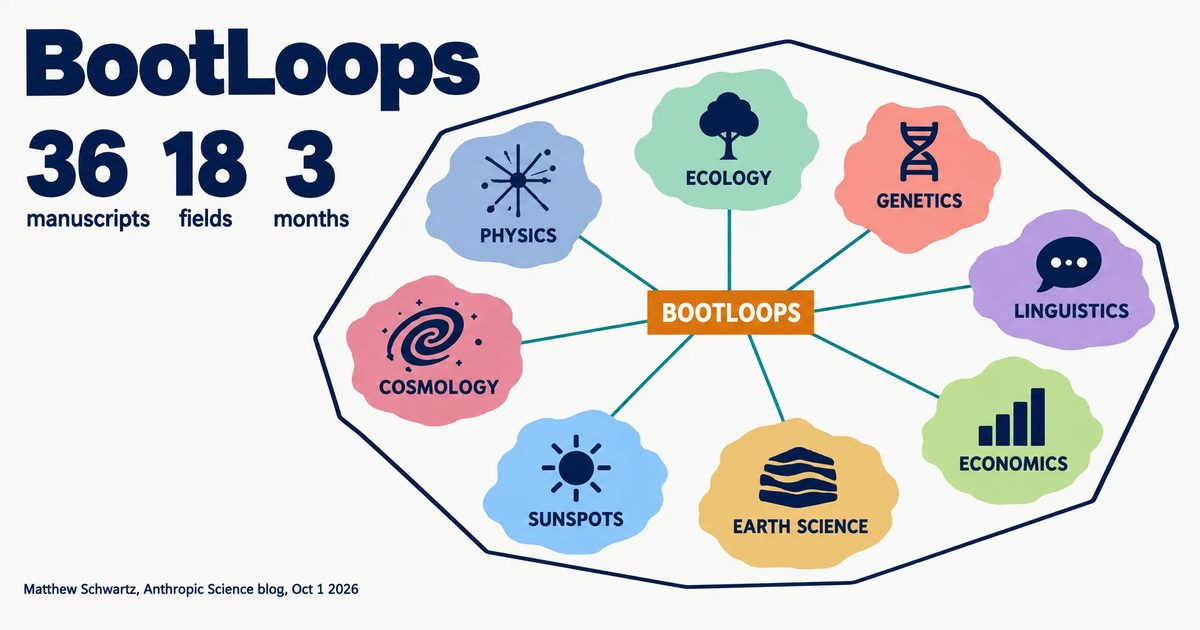
Harvard physicist's BootLoops tool generated 36 preprints across 22 disciplines in three months by reusing mathematical techniques between fields.

Yesterday: Science Magazine reports the BootLoops results

Overview

Updated 1 hour ago

A Harvard physicist's AI harness solved open problems in 22 scientific fields by borrowing mathematical tools from one discipline and applying them to another. The system, called BootLoops, produced 36 research manuscripts in about three months.

All 36 are preprints, not peer-reviewed papers. Whether the results survive scrutiny will decide if this becomes a standard research method or a cautionary example of AI-generated results outpacing human verification.

Why it matters

Cross-field discovery usually depends on rare individual insight. BootLoops automates the transfer — and the new bottleneck is verifying results, not finding them.

Questions about this story

Free account needed to ask — your question is kept and asked for you right after sign-up. Answers are public.

No questions yet — be the first to ask.

Key Indicators

36
Research manuscripts produced in three months
Produced with BootLoops across about 18 to 22 fields with 19 coauthors.
22
Scientific fields represented
From high-energy physics and ecology to linguistics and health policy.
15
Previously uncalculated Feynman integrals solved
30 frontier integrals evaluated end-to-end; 15 had never been solved.
6,072
Languages in the AccStack linguistics database
Word stress and tone rules standardized, with a bibliography of 160,000 works.
~$1B
Estimated taxpayer savings from Medicare rating changes
Optimized plan-evaluation thresholds calculated with interval arithmetic.
4,452
Economics replication packages audited
Discrepancies found in 3,460 articles; 30,000 legacy scripts ported to open source.

Voices

Curated perspectives — historical figures and your fellow readers.

Ever wondered what historical figures would say about today's headlines?

Sign up to generate historical perspectives on this story.

People Involved

Organizations Involved

Timeline

1939 October 2026

4 events Latest: Yesterday
Tap a bar to jump to that date
  1. Science Magazine reports the BootLoops results

    Latest Report

    Science Magazine publishes an account of the 36 preprints, covering the cross-field solutions and noting verification questions remain open for several manuscripts.

  2. BootLoops 1.0 released with 36 preprints

    Release

    Matthew Schwartz releases BootLoops 1.0 on GitHub under an MIT license. The system solved 15 previously uncalculated Feynman integrals, Etienne's ecology equation, and Watson's 1939 problem.

  3. Etienne formulates the neutral biodiversity equation

    Historical

    Ecologist Rampal Etienne publishes an equation testing Hubbell's neutral theory of biodiversity. It goes unsolved at scale for two decades.

  4. Watson poses the random-walk 'final problem'

    Historical

    George Watson poses the problem of the return probability of a three-dimensional lattice random walk. It resists exact solution for nearly a century.

Scenarios

1

BootLoops results clear peer review, validating cross-field AI discovery

Likely Resolves by Q2 2027

Discussed by: The project team and Anthropic's October 1 research post

The 36 preprints move through peer review in their respective fields. If the key results — the Feynman integrals, the ecology equation resolution, and Watson's random-walk solution — hold up, the approach gains credibility as a standard research tool and other groups begin building similar harnesses.

2

Independent replication fails for some BootLoops results

Possible Resolves by Q2 2027

Discussed by: The project's own caveats; AI-agent experiments on health studies

The project notes some manuscripts have not yet been fully verified by humans. A separate batch of AI-agent experiments on 40 health studies found the analysis behind the main result did not match the paper's description in 36 cases. If similar problems surface in BootLoops papers, the approach attracts a reputation for unreliability and review standards tighten.

3

BootLoops-style tooling is adopted across research groups

Possible Resolves by End of 2027

Discussed by: The open-source MIT License release; model-agnostic design

Because BootLoops is open source and works with Claude, ChatGPT, or Gemini, independent research groups adopt the harness for their own cross-disciplinary work. The repository gains traction and the protocols become a template. This turns BootLoops from one lab's tool into shared research infrastructure.

Historical Context

2 moments from history that rhyme with this story — and how they unfolded.

2018–2020

AlphaFold protein prediction (2018–2020)

DeepMind's AlphaFold system predicted protein structures from amino acid sequences. In the 2020 CASP14 competition, it achieved accuracy comparable to experimental methods — a goal scientists had chased for five decades.

Then

Results published in Nature in 2021; the AlphaFold database opened to public access with hundreds of millions of predicted structures.

Now

Became a standard tool in structural biology, changing how drug discovery begins and earning the approach a Breakthrough Prize.

Why this matters now

Like BootLoops, AlphaFold was an AI system solving a problem humans had failed at for decades. Its path from initial skepticism to accepted tool shows how BootLoops' preprints might be received.

Late 1980s–1990s

Rise of computer algebra systems (1980s–1990s)

Systems such as Mathematica (released 1988) and Maple let ordinary scientists perform symbolic computation — factoring, integrating, solving equations — that previously required specialist skills or exhausting manual work.

Then

Rapid adoption across physics, engineering and mathematics; heavy computation became a normal research step.

Now

Mathematical computation was democratized; these tools are now standard in education and research worldwide.

Why this matters now

BootLoops extends this trajectory. Computer algebra automated the calculation; BootLoops automates the choice of which calculation to run and which field's tools to borrow.

Sources

(6)