
Pull to refresh
Logo
BASF opens $1 billion MDI plant in Louisiana

BASF opens $1 billion MDI plant in Louisiana

Money Moves

The Geismar expansion nearly doubles BASF's North American MDI capacity as China's Wanhua controls about a third of the global market.

Overview

Updated 1 hour ago

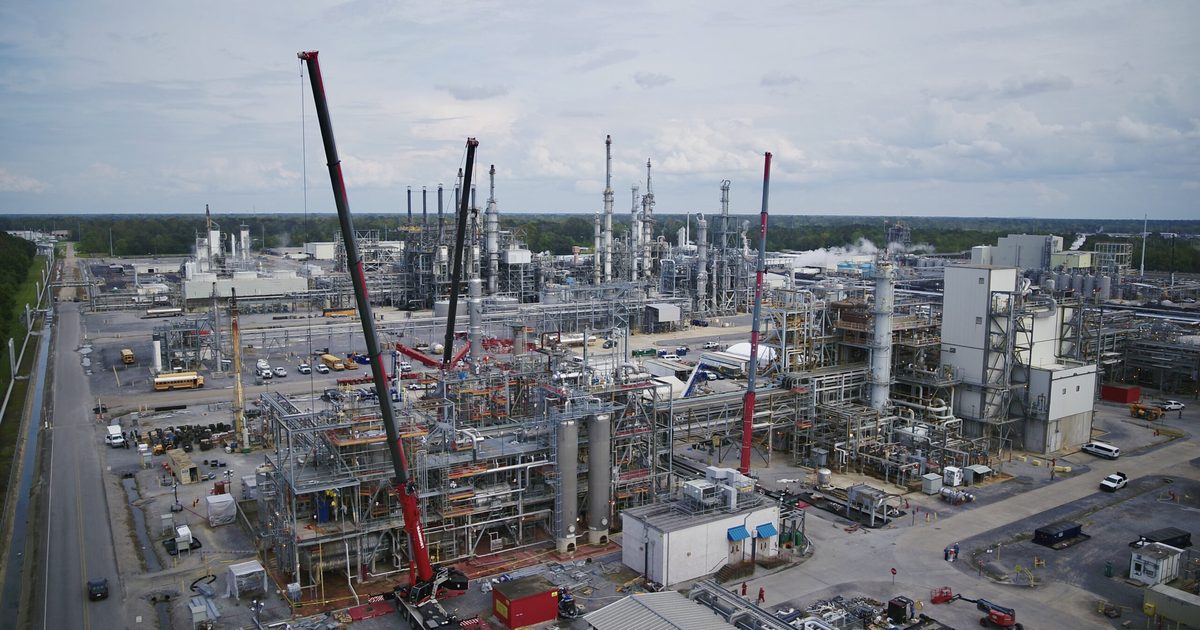
BASF's Geismar, Louisiana, plant can now make about 600,000 metric tons of MDI a year, nearly double its previous capacity. MDI is the chemical that becomes the rigid foam in building insulation, refrigerators and car parts. The $1 billion facility, inaugurated in November 2026, makes BASF the largest MDI producer in North America.

The bet is that North American customers will buy locally made supply instead of imports. It lands in a market where China's Wanhua makes roughly a third of the world's MDI and keeps adding more. BASF's answer is to build near its customers and link each plant so one unit's byproducts feed another.

Why it matters

A local MDI supply could make insulation and appliance foam more reliable for North American builders and manufacturers.

Questions about this story

Free account needed to ask — your question is kept and asked for you right after sign-up. Answers are public.

No questions yet — be the first to ask.

Key Indicators

600,000
Geismar MDI capacity
Annual capacity after the expansion, up from 380,000 tonnes.
$1B
Investment
BASF's largest wholly owned investment in North America.
2.2M
BASF global MDI capacity
Total annual MDI capacity after Geismar.
3.8M
Wanhua MDI capacity
Annual capacity at the end of 2025, about a third of the world total.
35%
Wanhua's projected global share
Estimated share if its Fujian expansion is completed.
380,000
Previous Geismar capacity
Annual MDI capacity before the expansion.

Voices

Curated perspectives — historical figures and your fellow readers.

Sign up to generate historical perspectives on this story.

People Involved

Organizations Involved

Timeline

November 2016 November 2026

8 events Latest: Today
Tap a bar to jump to that date
  1. BASF opens $1 billion MDI plant at Geismar

    Today Opening

    The new unit nearly doubles site capacity to about 600,000 tonnes a year.

  2. BASF studies India MDI complex

    Expansion

    BASF secures land in Dahej, Gujarat, for a feasibility study.

  3. Geismar wins emissions-rule exemption

    Regulation

    The site gets a two-year exemption from two EPA emissions standards.

  4. Wanhua capacity reaches 3.8 million tonnes

    Capacity

    Wanhua ends 2025 with about a third of global MDI capacity.

  5. Upstream units expand

    Construction

    BASF expands several existing upstream units that feed the MDI plant.

  6. New MDI synthesis unit starts

    Construction

    The first phase adds a synthesis unit and decommissions an older one.

  7. Construction begins in three phases

    Construction

    BASF starts building the expansion, splitting the work into three phases.

  8. BASF announces Geismar MDI expansion

    Announcement

    BASF says it will expand MDI production at its Geismar, Louisiana, site.

Scenarios

1

BASF's Geismar bet pays off with high utilization

Possible Resolves by End of 2027

Discussed by: BASF executives and polyurethane market analysts

BASF said the expansion responds to long-term growth in construction, appliances and transportation. If North American demand holds, the plant runs near capacity and BASF considers another regional expansion. The trigger is BASF's own capacity and investment announcements.

2

Wanhua confirms 4.5 million tonnes, widening its lead

Likely Resolves by Q2 2027

Discussed by: Wanhua's 2025 annual report and chemical-industry trade press

Wanhua said it would add 700,000 tonnes at Fujian by the second quarter of 2026, which would lift its total to 4.5 million tonnes and its global share above 35%. No official confirmation of completion has appeared. If it lands, price pressure on BASF and Covestro grows.

3

Covestro breaks ground on Shanghai MDI plant

Possible Resolves by End of 2027

Discussed by: Covestro management and Asian chemical trade press

Covestro is preparing a 660,000-tonne MDI plant in Shanghai for the end of the decade and studying a similar plant in the UAE. A final investment decision or groundbreaking would mark the next capacity wave moving to Asia.

Historical Context

2 moments from history that rhyme with this story — and how they unfolded.

1999–2025

Wanhua scales from 20,000 to 3.8 million tonnes (1999–2025)

China's Wanhua Chemical started making MDI at low quality in the 1980s. By 1999 its annual capacity was 20,000 tonnes, less than 1% of the world total. It expanded aggressively and bought Hungary's BorsodChem in 2011. By the end of 2025 it could make 3.8 million tonnes a year, about a third of global capacity.

Then

Wanhua became the world's largest MDI producer, overtaking BASF and Covestro.

Now

Its scale gave it cost advantages and pricing influence, forcing Western producers to rethink where and how they build.

Why this matters now

BASF's Geismar plant is a response to that scale: build local supply in a market where a state-backed rival keeps adding capacity.

2018–2020s

Covestro's Baytown MDI plant stalls (2018–2020s)

In 2018 Covestro's supervisory board approved about €1.5 billion for a 500,000-tonne MDI plant at Baytown, Texas, its largest single investment at the time. It was meant to start in 2024. The pandemic, rising interest rates, a weak Chinese property market and soft demand derailed the plan.

Then

Covestro shelved the US project and later pivoted to Asia.

Now

The reversal showed how demand timing can sink a chemical megaproject, even for a major producer.

Why this matters now

BASF's Geismar bet carries the same risk: a large, slow project arriving into an uncertain demand cycle.

Sources

(7)