

Pull to refresh
Logo
Pacific Power moves Oregon transmission line east after public pushback

Pacific Power moves Oregon transmission line east after public pushback

Built World

Utility shifts 180-mile line into a rural corridor; some residents remain split

Today: Route M named preferred corridor

Overview

Updated 2 hours ago

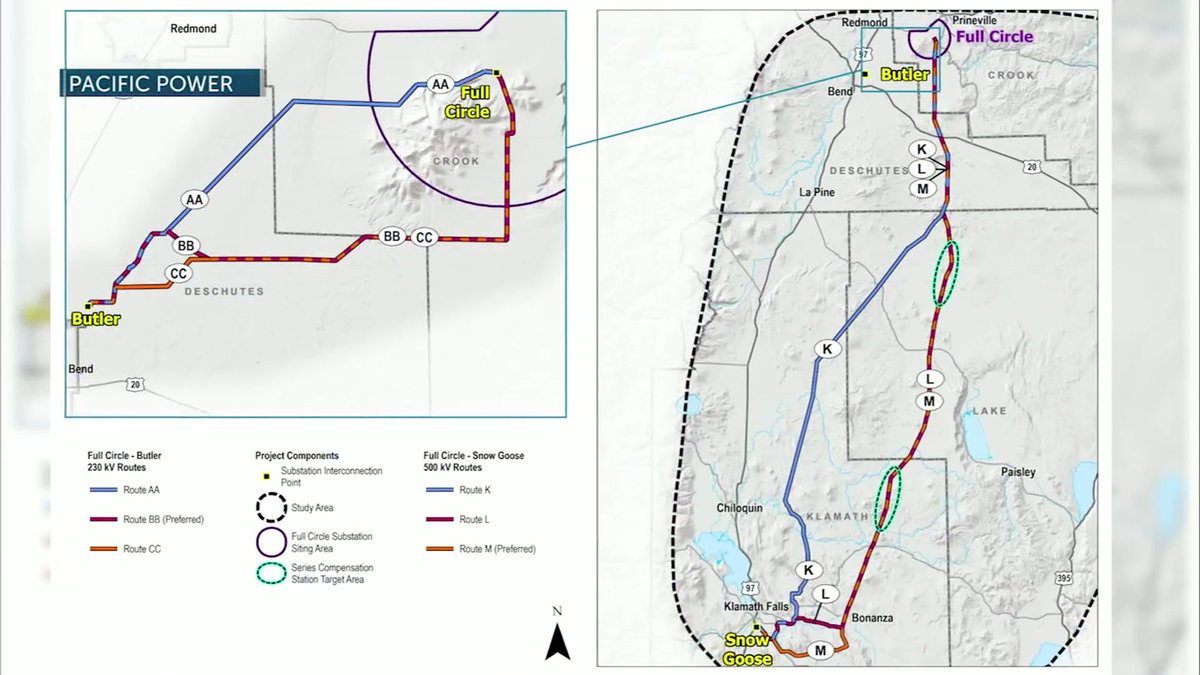
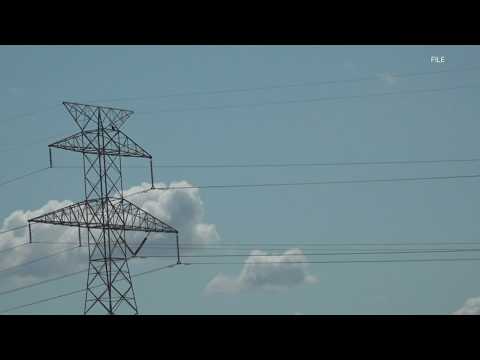
Pacific Power has moved its preferred route for a 180-mile transmission line east, away from subdivisions near Bend, after a year of community opposition. The new Route M runs through a more rural corridor across Crook, Deschutes, Lake, and Klamath counties, from a proposed substation near Prineville to an existing connection near Klamath Falls.

The 500-kilovolt line is designed to ease grid congestion and move renewable energy across south-central Oregon. Route M is preliminary, and PacifiCorp says it could change before the routing study concludes this year. Some Powell Butte residents welcome the shift; others were told the line could come within half a mile of their homes.

Why it matters

This line determines how Oregon's renewable energy reaches the grid for decades, and whether rural residents near Bend live next to 180-foot towers.

Questions about this story

Free account needed to ask — your question is kept and asked for you right after sign-up. Answers are public.

No questions yet — be the first to ask.

Key Indicators

180 mi (290 km)
Transmission line length
Runs from a proposed substation near Prineville to Snow Goose near Klamath Falls.
500 kV
Line voltage
High-voltage line designed to move renewable energy across the regional grid.
800+
Public comments
Written comments PacifiCorp received during its first outreach round.
160-180 ft
Steel tower height
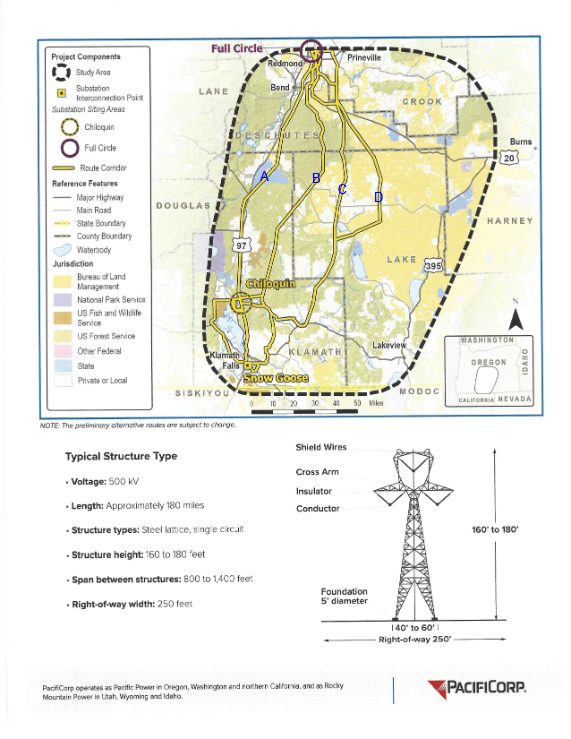
Single-circuit steel lattice towers spaced 800-1,400 feet apart in a 250-foot right-of-way.

Voices

Curated perspectives — historical figures and your fellow readers.

Ever wondered what historical figures would say about today's headlines?

Sign up to generate historical perspectives on this story.

Play

Exploring all sides of a story is often best achieved with Play.

Most of these play right now — no account needed. Sign up to save scores, keep a streak, and unlock Debate and Predict. Log in Sign Up
Predict 3 ways this could play out. Back the one you believe — contrarian picks score more when a scenario has a resolution date. Log in to play

People Involved

Organizations Involved

Timeline

November 2023 September 2026

6 events Latest: Today
Tap a bar to jump to that date
  1. Virtual open house scheduled

    Upcoming Public Meeting

    Residents can review and comment on the refined routes online.

  2. Route M named preferred corridor

    Today Announcement

    PacifiCorp identifies Route M for the 500-kV line and Route BB for a 230-kV connector east of Bend.

  3. Public hearing held on project

    Public Hearing

    Oregon holds a public hearing on the Blueprint South transmission line project.

  4. Powell Butte residents pack community meeting

    Public Meeting

    Opponents of Routes A and B voice concerns about homes, farms, and scenic land near the proposed corridor.

  5. Deschutes commissioners urge eastern Route D

    Statement

    Chang and DeBone press PacifiCorp to favor an eastern corridor affecting fewer homes and farms.

  6. Routing study begins for Blueprint South line

    Planning

    PacifiCorp launches a study to find a route for a 500-kV line across four Oregon counties.

Historical Context

3 moments from history that rhyme with this story — and how they unfolded.

2008-present

Gateway West transmission line (2008-present)

A roughly 1,000-mile, 500-kV transmission line proposed across Idaho and Wyoming by Rocky Mountain Power, a PacifiCorp brand. Routing was revised multiple times in response to concerns about scenic views, sage grouse habitat, and local opposition.

Then

Some segments completed; others delayed for over a decade by environmental review and routing disputes.

Now

Became a model for phased transmission development with ongoing public engagement.

Why this matters now

The closest precedent to Blueprint South: a 500-kV line from the same utility parent navigating rural routing conflicts.

2014-2020

Atlantic Coast Pipeline (2014-2020)

Duke Energy and Dominion Energy planned a 600-mile natural gas pipeline through West Virginia, Virginia, and North Carolina. Legal challenges over the Appalachian Trail crossing and environmental permits drove mounting delays and cost overruns.

Then

The companies cancelled the project in July 2020 after years of litigation.

Now

Showed that cumulative legal opposition can kill an infrastructure project entirely.

Why this matters now

A reminder that routing opposition, if it persists through litigation, can end a project.

2014-2024

Mountain Valley Pipeline (2014-2024)

A 303-mile natural gas pipeline from West Virginia to Virginia. Legal challenges over water crossings and federal permits halted construction repeatedly. The 2023 Fiscal Responsibility Act directed agencies to approve remaining permits, and the pipeline was completed in June 2024.

Then

Construction finished after years of delays and cost increases.

Now

Set a precedent for Congress overriding environmental review to speed energy infrastructure.

Why this matters now

Shows how permitting and legal challenges can stretch a major energy project into a decade-long fight.

Sources

(6)