


Pull to refresh
Logo
Indiana wins $175M federal grant to unclog regional grid choke point

Indiana wins $175M federal grant to unclog regional grid choke point

Built World

DOE funding targets the PJM-MISO seam, unlocking 2,000-4,000 megawatts of transfer capacity and saving ratepayers up to $150 million a year

Today: Story compiled; project enters planning phase

Overview

Updated 1 hour ago

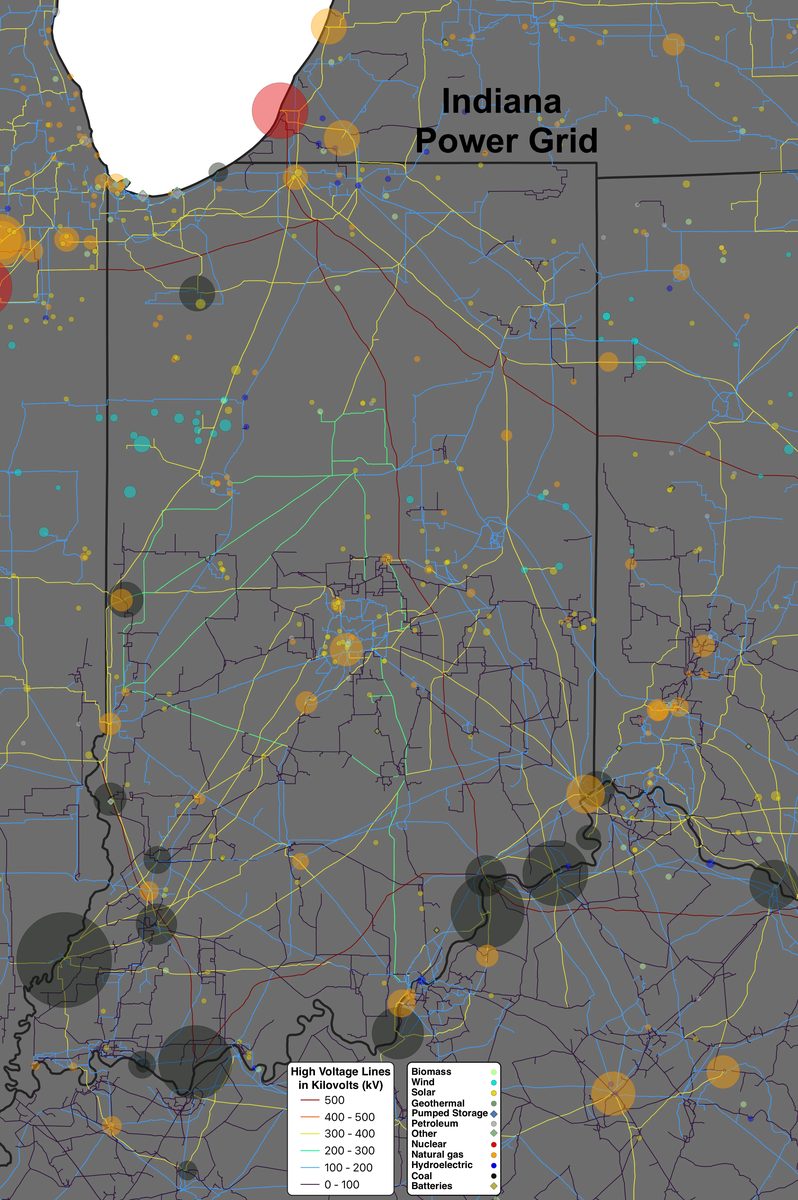
Indiana sits on a seam between two of America's largest electricity grids, the Midcontinent Independent System Operator and PJM Interconnection. Power flows across that border are bottlenecked, forcing operators to burn expensive backup generation and driving up costs for ratepayers across the region. On September 25, the U.S. Department of Energy awarded Indiana $175 million to fix it.

The project will replace aging power lines with high-capacity conductors, add real-time monitoring so lines can carry more power in favorable weather, and install software that routes electricity along cheaper paths. Officials expect it to unlock 2,000 to 4,000 megawatts of transfer capacity and save ratepayers between $50 million and $150 million annually. Sponsors add another $150 million, bringing the total to $325 million.

Why it matters

Every household and business in the PJM-MISO region pays higher power bills because of this bottleneck — this project could shave up to $150 million off those costs each year.

Questions about this story

Free account needed to ask — your question is kept and asked for you right after sign-up. Answers are public.

No questions yet — be the first to ask.

Key Indicators

$175M
Federal SPARK grant to Indiana
Department of Energy funding from the $1.9 billion SPARK program, matched by $150 million in sponsor investment.
2,000-4,000 MW
New transfer capacity at PJM-MISO seam
Megawatts of additional power flow unlocked at Indiana's interconnection once upgrades are complete.
$50-150M
Projected annual ratepayer savings
Estimated cost savings from relieving congestion at the interconnection point, per DOE General Counsel Jonathan Brightbill.
$325M
Total project cost
Combined federal grant ($175M) plus sponsor matching ($150M).
4 years
Expected buildout duration
Construction expected to begin within 18 months and complete in roughly four years.

Voices

Curated perspectives — historical figures and your fellow readers.

Ever wondered what historical figures would say about today's headlines?

Sign up to generate historical perspectives on this story.

People Involved

Organizations Involved

Timeline

November 2021 October 2026

3 events Latest: Today
  1. Story compiled; project enters planning phase

    Today Planning

    Indiana Office of Energy Development begins preparing project deployment. Construction expected to start within 18 months.

  2. DOE awards $175M SPARK grant to Indiana

    Funding

    Department of Energy announces the grant at Indiana's State Capitol to upgrade transmission at the PJM-MISO seam. Project unlocks 2,000-4,000 MW and saves $50-150M annually.

  3. Bipartisan Infrastructure Law signed

    Legislation

    President Biden signs the $1.2 trillion infrastructure law, creating the $10.5 billion GRIP program for grid resilience and innovation.

Scenarios

1

Grid upgrades complete on schedule, congestion savings materialize

Likely Resolves by Jan 1, 2031

Discussed by: DOE officials, Governor Braun's office

Construction begins within 18 months and completes in four years as projected. Reconductoring and grid-enhancing technologies unlock the full 2,000-4,000 megawatts of transfer capacity. PJM and MISO report reduced congestion costs, and ratepayers see the $50-150 million in annual savings reflected in wholesale electricity prices.

2

Project delayed by permitting, supply chain, or cost overruns

Possible Resolves by Jan 1, 2028

Discussed by: Industry analysts monitoring transmission buildout timelines

Transmission projects routinely face permitting delays, utility equipment shortages, and construction cost inflation. A delay of 12-24 months would push completion past the four-year target, delaying congestion relief and ratepayer savings. Indiana's fragmented utility landscape — with multiple investor-owned utilities across the state — could complicate right-of-way coordination.

3

Reconductoring underdelivers: actual capacity gain falls short of projections

Unlikely Resolves by Jan 1, 2031

Discussed by: Grid engineering commentators

Advanced conductors sometimes underperform in real-world conditions compared with engineering estimates. If the actual unlocked transfer capacity lands well below the 2,000 megawatt low end, the congestion relief and savings would shrink correspondingly. Grid operators would adapt but the promised ratepayer benefit would be partially unrealized.

Historical Context

2 moments from history that rhyme with this story — and how they unfolded.

August 2003

Northeast Blackout (2003)

A software bug at FirstEnergy's control room in Ohio caused a cascade of transmission line failures that blacked out 50 million people across the northeastern U.S. and Ontario. The blackout caused an estimated $6 billion in economic losses and lasted up to four days in some areas.

Then

Congress passed the Energy Policy Act of 2005, making grid reliability standards mandatory and enforceable for the first time.

Now

The blackout exposed how fragile coordination is between separate grid operators, a structural problem that persists in the limited transfer capacity at seams like PJM-MISO.

Why this matters now

The PJM-MISO seam congestion Indiana's grant targets is the same class of inter-operator coordination problem that contributed to the 2003 cascade. Weak seams between independently operated grids remain the grid's most vulnerable points.

2009-2014

ARRA Smart Grid Investment Grants (2009)

The American Recovery and Reinvestment Act directed $4.5 billion to smart grid deployment, funding 99 projects that installed 15 million smart meters and thousands of automated substation systems across the country.

Then

Utilities modernized distribution systems and gained real-time visibility into grid conditions, but transmission-level capacity gains remained modest.

Now

The program established the template for federal cost-share grid investment, which the Bipartisan Infrastructure Law's GRIP program — the parent of SPARK — now follows at a larger scale.

Why this matters now

The 2009 grants proved the federal cost-share model for grid modernization works at scale. SPARK extends that approach to transmission — the harder problem the earlier program barely touched.

Sources

(7)